by Ellen Seidler | Ad Sponsored Piracy, Copyright, Law, Piracy
[vc_row][vc_column][vc_column_text]
London Police turn tables on web pirates
In a nice twist of karma, the London Police have stepped up their battle against online piracy sites, fighting fire with fire, by placing banner ads on pirate sites warning users to stay away. Since advertising revenue drives the engine of online piracy this latest initiative by the City of London Police Intellectual Property Crime Unit (PIPCU) as part of their “Operation Creative” anti-piracy campaign is more than a little ironic.
…police banners are now replacing a wide range of legitimate brand adverts on infringing websites. The pop-up will inform the user that the website is under investigation by the City of London Police unit for copyright infringement and will advise the user to exit the website.
Launched this past March, the goal of Operation Creative is to “disrupt and prevent websites from providing unauthorised access to copyrighted content, in partnership with the creative and advertising industries.”

London police are placing banner ads like this on known pirate websites to warn visitors that the site is not legit and is offering up illegal files
This latest anti-piracy gambit comes on the heals of PIPCU’s shutdown of a number of infringing websites. The PIPCU’s Andy Fyfe explained this latest initiative to insert police warnings into banner ads on pirate sites:
This new initiative is another step forward for the unit in tackling IP crime and disrupting criminal profits. Copyright infringing websites are making huge sums of money though advert placement, therefore disrupting advertising on these sites is crucial and this is why it is an integral part of Operation Creative.
This work also helps us to protect consumers. When adverts from well known brands appear on illegal websites, they lend them a look of legitimacy and inadvertently fool consumers into thinking the site is authentic.
Operation Creative specifically targets the scourge that is ad sponsored piracy:
The Police Intellectual Property Crime Unit (PIPCU) based in the City of London Police has today called upon advertisers and brand holders to continue to support its work to tackle Intellectual Property crime following the launch of its Infringing Website List (IWL). The IWL, the first of its kind to be developed, sets out to disrupt the advertising revenues on illegal websites globally.
This unique initiative forms part of the unit’s ground-breaking Operation Creative, designed to disrupt and prevent websites from providing unauthorised access to copyrighted content, in partnership with the creative and advertising industries. The IWL is an online portal providing the digital advertising sector with an up-to-date list of copyright infringing sites, identified by the creative industries and evidenced and verified by the City of London Police unit, so that advertisers, agencies and other intermediaries can cease advert placement on these illegal websites.
Disrupting advertising is a vital part of Operation Creative, as advertising is a key generator of criminal profits for websites providing access to infringing content. A recent report by the Digital Citizens Alliance estimated that in 2013 piracy websites generated $227million from advertising.
Kudos to the London Police for their ongoing efforts to fight online piracy. Hopefully it’s an effort that will serve as a model for other law enforcement agencies to do the same.[/vc_column_text][/vc_column][/vc_row]

by Ellen Seidler | Film, Piracy, TV
 LGBT pirate blogs that claim to love the films and shows that reflect their lives, yet undermine creators ability to make more
It’s bad enough seeing indie LGBT films pirated via torrent sites like Pirate Bay and cyberlockers like Mega, but it’s particularly galling to see supposed fans of LGBT films operating websites that think nothing of undermining filmmakers from their own community. Time after time fans of LGBT films ask why more films reflecting their lives aren’t made, yet many of those same fans think nothing of pirating the LGBT films that are made effectively cannibalizing their own filmmakers.
LGBT films are usually made outside the Hollywood system and depend entirely on grassroots funding efforts to cover production costs. When these films are pirated, recouping expenses is made more difficult and threatens the filmmaker’s ability to create more films.
Much is made about the democratization of filmmaking through increasingly affordable technology. Yet no matter whether a film is shot on 35 mm or digital, it still costs money to create. Money–to pay for cast and crew, equipment and permits, insurance and meals–does not fall from the heavens. There’s also the cost of pre-production: planning, script development and completion, casting, location scouting, scheduling, hiring a crew, etc. After the film is shot, taking weeks or months, there are post-production costs to consider. These include editing, sound-mixing, music, special FX, color-correction and mastering. This entire process takes time and money. People who create indie films aren’t in it to get rich. They are driven by a passion to create and give voice to untold stories but it doesn’t come free. There are debts to be paid.
Unfortunately, this disconnect between those who create and those who consume threatens to gradually the diversity of voices (and choices) available. Fans may not miss what’s not made until it’s too late…As they say, actions speak louder than words. You can’t claim to support LGBT indie film yet download or stream illegal copies of those same films. However, as I surf the web and explore the many blogs dedicated to LGBT film, too often I find this hypocrisy in full bloom
The blog “Popcorn ‘N Tits” is part of the PNT Tv Network, “a femqueer entertainment website where you can find webseries, movies, music and literary articles that reflect our lives.” It’s beyond ironic, and rather sad that operators choose to exploit the very content they claim to love. Ironically one of their partner blogs features this plea,
This blog is dedicated to support the art of filmmaking. You love watching our movies, shorts, and web-series but filmmakers need money to make that happen. You can do this by donating to these projects, no matter how small the sum.
So true, yet this same blog network apparently doesn’t see the disconnect when it includes a site that apparently pirates movies and tv shows at will (see graphics below). Note this is only one example of many I’ve found during my web wanderings.


by Ellen Seidler | Copyright, Film, Law, Piracy, Tech
 Finally, after weeks–actually months–of repeatedly reporting (and waiting) the pirate movie website videolez.blogspot.com, a site featuring more than 100 pirated movies streamed via Google Drive-hosted embeds of stolen movies), finally bit the dust.
 Why after all this time and repeated violations did Google finally remove this site?
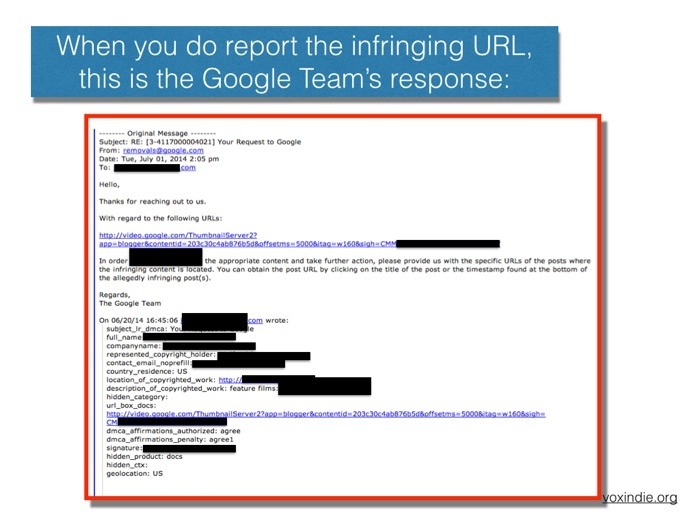
I think what finally turned a lightbulb on in the Google Team’s HQ was my response to a lame email they sent me as follow up to DMCA notices I’d issued (on behalf of myself and film distributors/producers I do anti-piracy work for). This is the email the Google Team sent to me in response to one (of many) DMCA notices sent via their online form:
Hello,
Thanks for reaching out to us.
You can obtain the post URL by clicking on the title of the post or the timestamp found at the bottom of the allegedly infringing post(s).
Regards,
The Google Team
The reason the Google Team’s email was ridiculous was because it was WRONG. It’s painfully clear that those employed by Google to respond to DMCA notices don’t truly understand their own products and just how pirates use them. This was my response:
Hello,
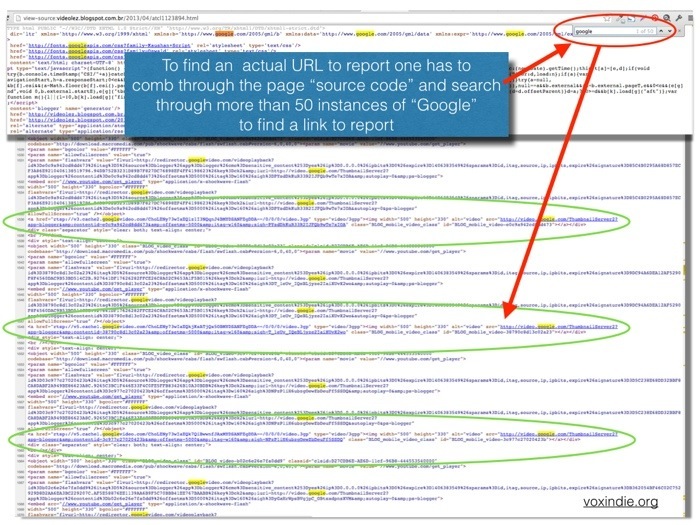
Actually we cannot determine the URL by clicking as you suggest….this requires going into the actual source code for an embedded stream.
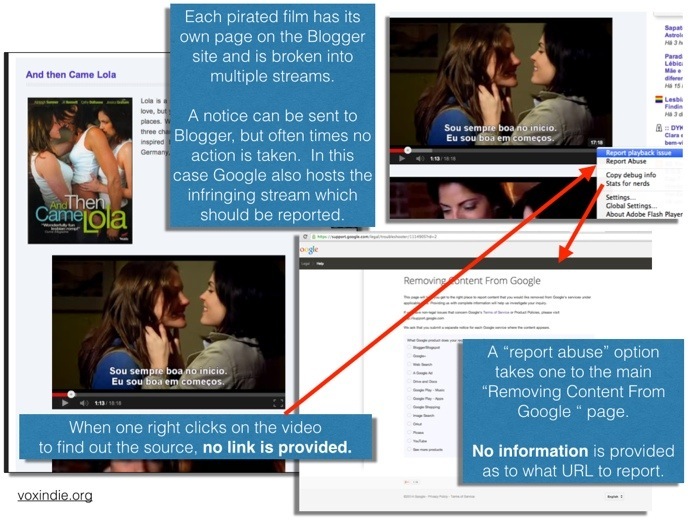
I’ve attached a PDF highlighting the issue with one of the films we reported. The URLS are not easily available. Right click on the video embed and get “report abuse” and you are taken to Google web takedown form with NO information about the offending URL.
PS-There are many more pages…in fact this entire blog is dedicated to pirating indie films and Google does zilch!
Here’s the
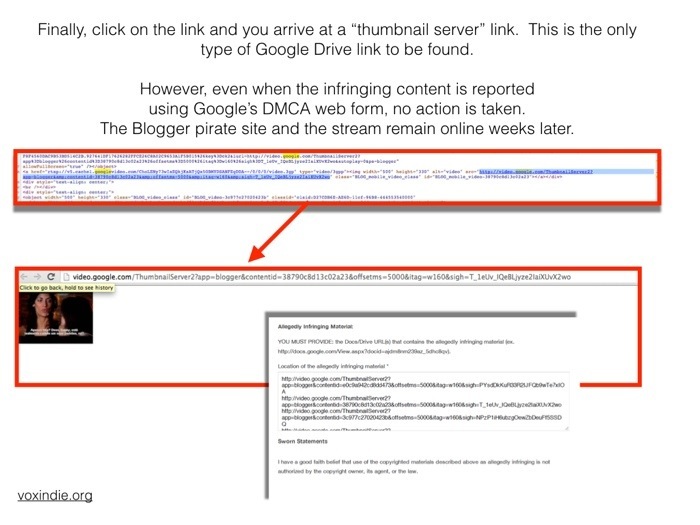
PDF I attached with my email sent to the Team in an effort to explain just what was going on with this particular Blospot.com pirate. Below are the graphics included in the PDF. They demonstrates, step-by-step, how Google could (and should) better understand its own products and respond appropriately upon receipt of DMCA notices rather than send out erroneous emails asking for more information; information that’s actually neither available nor relevant.


Unfortunately, this small victory is but a blip in the sea of Google-sponsored pirate sites. Moments after I discovered the VideoLez site had been removed, I checked another, similar pirate site that I’ve also reported multiple times. It remains alive and well. The countdown clock can be seen here.

I’ve asked it before, but I’ll ask it again. Why can’t Google clean up its act? Does it really deserve protection from liability under the DMCA “safe harbor” provision if it routinely fails to remove content and sites, despite repeated (and clear) requests? Title 17 › Chapter 5 › § 512 states outlines one aspect of Safe Harbor as follows:
(c) Information Residing on Systems or Networks At Direction of Users.—
(1) In general.— A service provider shall not be liable for monetary relief, or, except as provided in subsection (j), for injunctive or other equitable relief, for infringement of copyright by reason of the storage at the direction of a user of material that resides on a system or network controlled or operated by or for the service provider, if the service provider—
(A)
(i) does not have actual knowledge that the material or an activity using the material on the system or network is infringing;
(ii) in the absence of such actual knowledge, is not aware of facts or circumstances from which infringing activity is apparent; or
(iii) upon obtaining such knowledge or awareness, acts expeditiously to remove, or disable access to, the material;
(B) does not receive a financial benefit directly attributable to the infringing activity, in a case in which the service provider has the right and ability to control such activity; and
(C) upon notification of claimed infringement as described in paragraph (3), responds expeditiously to remove, or disable access to, the material that is claimed to be infringing or to be the subject of infringing activity. [underline added]
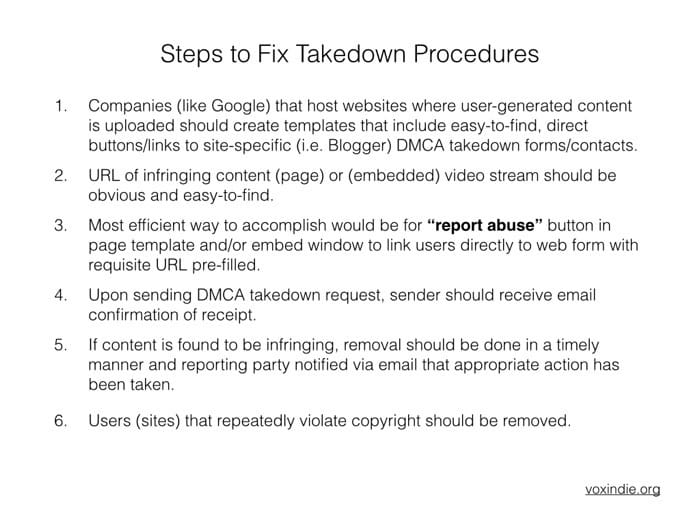
6 Easy Steps the Google Team could take to fix their DMCA takedown process
To allow Google’s web crawlers to find read my list of suggestions 😉 here it is again in text form:
-
Companies (like Google) that host websites where user-generated content is uploaded should create templates that include easy-to-find, direct buttons/links to site-specific (i.e. Blogger) DMCA takedown forms/contacts.
-
URL of infringing content (page) or (embedded) video stream should be obvious and easy-to-find.
-
Most efficient way to accomplish would be for “report abuse” button in page template and/or embed window to link users directly to web form with requisite URL pre-filled.
-
If content is found to be infringing, removal should be done in a timely manner and reporting party notified via email that appropriate action has been taken.
-
If content is found to be infringing, removal should be done in a timely manner and reporting party notified via email that appropriate action has been taken.
-
Users (sites) that repeatedly violate copyright should be removed.
Next “expeditious” move is Google’s…I’ll be waiting.

by Ellen Seidler | Ad Sponsored Piracy, Copyright, Film, Piracy, Tech
 Google comes in a close second to word-of-mouth in path to piracy poll
A while back one of the world’s most popular pirate websites, LetMeWatchThis went through tumultuous times as its domain name was hijacked and cloned by other not-so-nice pirates. According to torrentfreak.com the hijacking, and general confusion led to the domain switching to an entirely new domain, primewire.ag:
One of the largest unauthorized streaming movie websites on the Internet is at the center of what is probably the most confusing mess ever to hit the sector. Various hackings, hijackings, domain changes and nefarious happenings have turned 1Channel, LetMeWatchThis, PrimeWire.ag and Vodly.to into a maze of smoke and mirrors through which no regular user has a hope of navigating.
While it’s not clear if the dust as settled, what is clear is that someone operating the domain name primewire.ag is running a website full of illegal links to thousands of stolen movies. The pirate site, as mentioned in my earlier post today, makes money via advertising (mostly major American brands) but as I was researching the site for my post, I noticed another feature worth highlighting. In its sidebar, the website has posted a poll asking this question: How did you find us through our new name?
According to the results users turned, in large numbers, to that tried and true source for pirated content worldwide, Google search. Nearly 200,000 (29.88 %) users chose Google as their path to the site, second only to word of mouth which took top honors at 43%. While the poll is not scientific, it does provide more anecdotal evidence to what most believe to be true, Google is a major sign post on the path to online piracy. Even when pirate sites run into trouble with other pirates hacking and stealing their domains (ironic isn’t it), leave it to Google to come to the rescue.


by Ellen Seidler | Ad Sponsored Piracy, Copyright, Film
 Excuse me if I don’t get too excited over Creative Future’s recent letter to ad industry representatives praising their for its efforts against online piracy.
We are writing to thank you for the progress you have made in addressing the exploitative practices used by some in the online advertising marketplace, including the diversion of advertising to websites
engaged in piracy.
Your pledge to act to reduce digital piracy is commendable. In your June 19 letter to the Co-Chairs of the International Creativity and Theft-Prevention Caucus, you highlighted the “Core Criteria for Effective
Digital Advertising Assurance” that you are developing, as well as the Interactive Advertising Bureau’s recently announced “Trustworthy Digital Supply Chain Initiative.” We believe these are the kinds of industry-led voluntary actions that can most effectively take the profit out of piracy.
Of course some action against ad-sponsored piracy is better than none, but news flash, ad-sponsored piracy is not news. Every few months it seems some new initiative is announced yet, in reality, in the land of the online pirates and their quest for profits, nothing much has changed. A year ago the White House released a statement on best practices to “Combat Online Piracy and Counterfeiting” which included this statement:
The Administration strongly supports voluntary efforts by the private sector to reduce infringement and we welcome the initiative brought forward by the companies to establish industry-wide standards to combat online piracy and counterfeiting by reducing financial incentives associated with infringement. We believe that this is a positive step and that such efforts can have a significant impact on reducing online piracy and counterfeiting.Y
Is there an echo in here? Why all this coddling of piracy’s enablers? Enough with the self-congratulatory preening. DO SOMETHING! Four years ago I wrote this on my blog about ad-sponsored piracy, popuppirates.com, when I launched the site in June of 2010:
In the process of scouring the web for the thousands of illegal download links and online streams of our film (more than 55,000 documented to date) I quickly discovered that various, theoretically legit companies, seemed to be (indirectly) generating income through the placement advertising on websites featuring streams and download links to pirated films. In addition, and most troubling, is that fact these ads generate income for operators of these pirate websites and add to generous profit totals for ad providers…
…The nature of the advertising varies, but I was dismayed to discover that the ads were not limited to cheesy online gaming sites, etc. Rather, they include a number of legit companies like Sony, Radio Shack, Pixar, Porsche, ATT, Chase, Network Solutions, Auto-Zone and even Netflix (particularly ironic since they carry our film). The list of advertisers goes on and on. It’s the same situation, if not worse for other films. Ads are ubiquitous on pirated content throughout the web
Now, exactly four years later what has changed? Not much…
Just this morning I checked out primewire.ag, a notorious pirate site and within moments was confronted by major brands advertising promoting their products while simultaneously filling the coffers of the pirate profiteers. As I reloaded the pages and clicked through listing of download links to movies like “The Transformers-Age of Extinction” and “Rio 2” I was greeted with ads from Lexus, Verizon, ATT, Domino’s Pizza, State Farm Insurance, Mucinex, Dick’s Sporting Goods and BP popping up directly beneath a ” Support the Site” plea. This is just one pirate site and it took me less than 10 seconds to find multiple major brands advertising there.
Time for talk is over. I’ll “thank” advertisers for their (overdue) response when–and if– I click on these pirate sites and don’t see this anymore: