Is this really what lawmakers had in mind when they wrote the DMCA?
Seriously, it’s not that I just love spending my time bashing Google, but the fact is that this company deserves to be taken to task (every second of every day) for the lousy job it does dealing with the rampant piracy on its Blogger platform. The slide show below is simply more documentation as to just how absurd, convoluted and outright busted the DMCA takedown process is with the barnacle that is Blogger (Blogspot.com). While mothership Google pretends not to notice, web pirates grow and thrive in the waters of its safe harbor.
Not only does Blogger provide a sanctuary for movie pirates around the globe, but Google’s cloud-based storage Google Drive, often a host for the Blogger pirated movies streams, looks a lot more like Megaupload than a legit business. Figures, for a company trying to bust indie-musicians and rip-off professional photographers, developing slick and slimy ways to avoid the law seems about par for the crooked course.
Google makes billions leveraging content created by others. The least they could do is respect our right to remove it, but that would mean less content for them to leverage, and thus less money for them. For Google, though it regards itself as the emperor of tech, ever evolving to offer society the next big thing; it’s really just like many other multinational behemoths seeking to protect and its increase profits. Who cares where those profits come from? Given greed’s at the company’s core, I once again welcome you to another example of Google’s takedown labyrinth.
[rev_slider Google_DMCA_circus]
When Congress crafted the Digital Millennium Copyright Act (DMCA) in 1998 they explicitly carved out “safe harbor” from liability for copyright infringement so long as the service provider, “upon obtaining such knowledge or awareness, acts expeditiously to remove, or disable access to, the material.”
Section 512(c) limits the liability of service providers for infringing material on websites (or other information repositories) hosted on their systems. It applies to storage at the direction of a user. In order to be eligible for the limitation, the following conditions must be met:
The provider must not have the requisite level of knowledge of the infringing activity, as described below.
If the provider has the right and ability to control the infringing activity, it must not receive a financial benefit directly attributable to the infringing activity.
Upon receiving proper notification of claimed infringement, the provider must expeditiously take down or block access to the material.
The legislation also contains this language with regard to a service provider being eligible for limitations on liability, “: (1) it must adopt and reasonably implement a policy of terminating in appropriate circumstances the accounts of subscribers who are repeat infringers…
After you step through these slides and read my previous posts examining Google’s dysfunctional takedown procedures, can you really believe Google is “expeditiously” honoring the intent of the DMCA? If so, I’ve got a bridge to sell you…
How much more of Googlenocchio can filmmakers take?
Google publicly brags about its “commitment to make copyright work better online” but the in reality it’s just a big, fat LIE.
I must say it was pretty ironic when, in the midst of working on this post, Ironically, I received this email from an indie film director asking my advice about dealing with Google:
Ellen, I have a quick question. I am having problems submitting DMCA notices to Google on some of the links, where I have submitted them before and Google hasn’t taken them down. [emphasis added]
When I try and re-submit–this can be weeks months later–it won’t allow me to submit the form, saying, the link has been submitted before. Do you have this problem, not sure if I am doing something wrong, or is there nothing I can do !
Sound familiar? I’m sure it does to the many indie filmmakers who, like myself and my colleague above, are routinely at the mercy of Google’s not-so-transparent, lame DMCA takedown procedure when we find stolen copies of our work online.
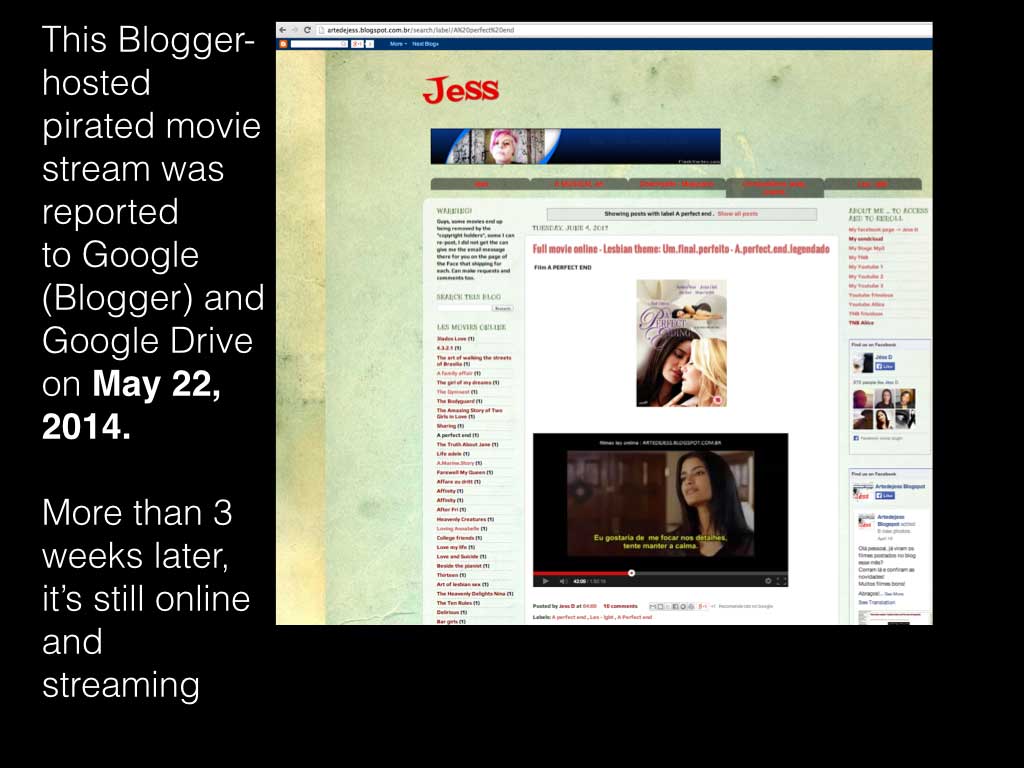
To dramatize just how flagrant Google’s DMCA foot dragging is I created a clock to track the company’s (lack of) action when it comes to efficient removal of pirated content from Blogger-hosted pirate sites. The clock below began started clicking on April 24th when 2 links were reported for copyright infringement. As of today, June 17th, nearly 2 months later, both pirated movies remain online as does the pirate Blogger-hosted website (see graphic below)
UPDATE: The site was removed July 10th, 2014, nearly 3 months after the first DMCA takedown notices was sent to Google.
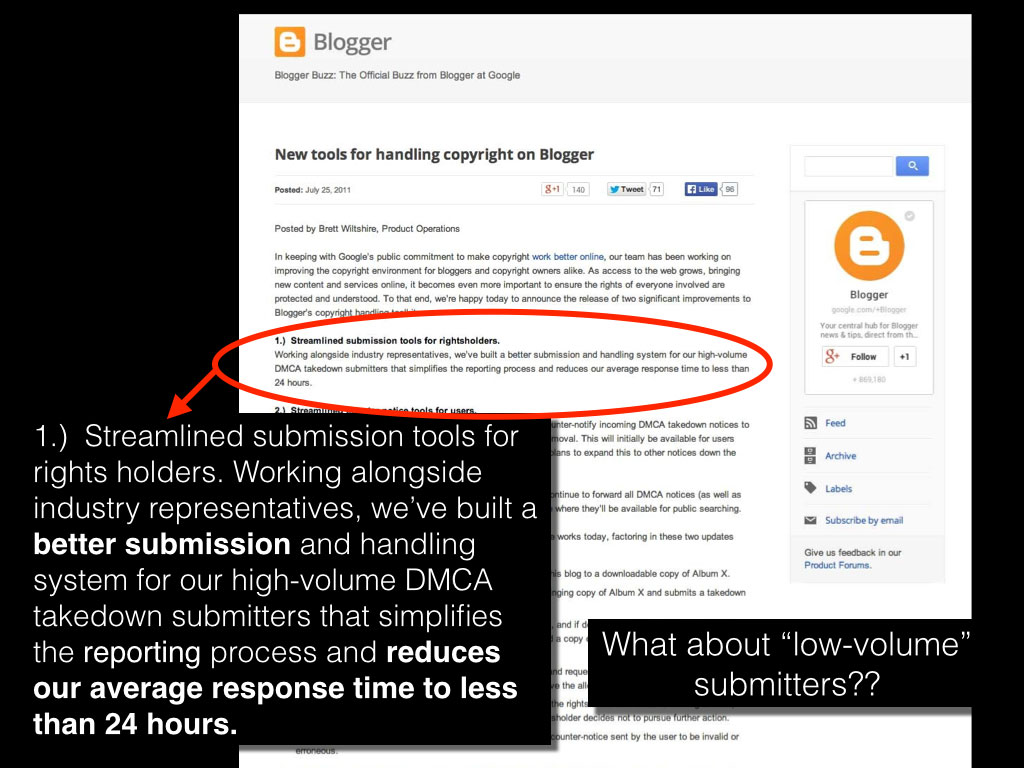
Remember, this is just ONE example of Google’s slow as molasses (or non-existent?) takedown work-flow. Remember this promise?
1.) Streamlined submission tools for rightsholders.
Working alongside industry representatives, we’ve built a better submission and handling system for our high-volume DMCA takedown submitters that simplifies the reporting process and reduces our average response time to less than 24 hours. [emphasis added]
When it comes to Google, broken promises are merely its modus operandi. When Google flacks claim the company cares about copyright infringement, it’s just a lie.
Google’s claim that it’s doing a great job streamlining its response to DMCA takedown notices on its Blogger-hosted websites doesn’t jibe with the truth. This year the U.S. Patent and Trade Office (USPTO) has been holding a series of hearings with the goal of “improving the operation of the DMCA notice and takedown policy.”
The first public meetingwas held this past March in Alexandria, Virginia and second took place May 8th in Berkeley, California. I was able to attend the Berkeley hearing in person and heard representatives from content creation industries and service providers give their perspectives on the current state of “notice and takedown” for infringing content and what could/should be done to “fix” it.
Each speaker presented a PowerPoint, links to which can be found here and a video archive here. As with the initial hearing in March, Google was represented by its Legal Director for Copyright, Fred von Lohmann who walked the audience through Google’s “DMCA notice and takedown tools” and highlighted what he called the company’s “trusted submitter program.” In his PowerPoint, Mr. von Lohmann referenced Google blog post from 2011 “New tools for handling copyright on Blogger” that supposedly highlighted the great progress that’s been made in streamlining the process.
Listening to Mr. von Lohmann it seemed clear that his words were designed for an audience made up of government officials and industry representatives and not indie artists. He (carefully) described a two-tiered system in which “trusted” submitters have access to a wealth of takedown mechanisms to remove infringing content from Google affiliates. However, aside from YouTube, access to these “trusted” programs seems limited to the big film and music entities.
Specifically, with regard to Blogger, the criteria as to how one becomes a part of this so-called “trusted submitter” program remains murky and ill-defined. Immediately following the event I searched Google to find out more (and how to apply) I only came across a link to Mr. von Lohmann’s USPTO PowerPoint. There was nothing on any Google site to answer the question as to how indie rights holders could utilize this so-called “tool.” Since there was no more information to be found, shortly after the event I took to Twitter to ask @flohmann directly for a clarification on his presentation. The response thus far, only crickets…
In addition to this lack of clarity as to who exactly can take advantage of certain tools, Mr. von Lohmann’s careful characterization of his company efficient takedown system did not match my user experience, particularly with regard to Blogger. Over these past few years I’ve documented time and time again the many ways Blogger--and therefore Google–fails to live up to its promises to remove infringing content from its platforms.
Yet, according to Google’s self-published, self-serving report, “How Google Fights Piracy,” (that I’ve criticized in a previous post) the company continues to insist that it’s proactive fighting piracy on its Blogger web-publishing platform:
We remain vigilant against the use of the Blogger platform by pirates looking to set up a free website…we will remove infringing blog posts when properly notified by a copyright owner, and will terminate the entire blog [emphasis added] where multiple complaints establish it as a repeat infringer.
Sorry, but the facts clearly don’t match up with this corporate hyperbolic PR spin. Truth be told, Blogger’s takedown system is, in reality, a hot mess. Add Google Drive to the mix and company claims of a “streamlined” takedown process seem even more absurd.
Blogger content that is reported as infringing takes weeks, not days to remove.
Blogger hosted blogs that are in the business of promoting pirated movies remain online despite multiple, repeated DMCA notices and despite clear evidence they exist to pirate films.
The Google DMCA takedown procedure is not easy to navigate. Once users find it, they must repeatedly choose options in order to (eventually) get to the correct takedown form, even someone well versed in the procedure. Why not offer direct links to the correct forms for each platform?
Blogger’s website templates offer no direct links to Google’s (streamlined) takedown form. Why can’t Blogger hosted sites automatically provide a button/link in their menu bar or footer, designed as part of any page template to enable easy and direct access to Google’s “streamlined” takedown form?
Google Drive takedown procedures are convoluted and unclear. No easy way to determine file’s URL to report and no direct link to report.
When a file is reported on Google drive it can take weeks, not days, to remove the infringing content.
Rather than fulfill its promise to expedite takedowns for copyright infringement, it seems that the “Google Team” does everything within its power to make the process convoluted, cumbersome and difficult–particularly for individual artists who don’t have the deep pockets to hire help and/or automate the takedown workflow. Please take some time to review the graphics that I’ve created that illustrate just how badly Google is doing when it comes to Blogger (and Google Drive) takedowns.
Given the complexity (and hilarity) of attempting to remove pirated stream of our film “And Then Came Lola” (seen in the example above) hosted on Google Drive I made the following video that will walk viewers through the process. Weirdly I was able to find the URL (that was not the case with some of the other examples I’ve provided) yet that didn’t help much since pirated copy is still, as of today, June 1st, available on line–more than two weeks after I sent a DMCA takedown notice to Google.As far as I’m concerned, when Google characterizes itself as doing a good job with this process I can only shake my head. No matter how many ways Google spins it, it’s not true.
While researching the issue of sexism in advertising for a piece I posted earlier today I came across this series of ads sponsored by the United Nations and produced by Memac Ogilvy & Mather Dubai in which they employed a simple Google search and the subsequent “auto-complete” results to illustrate just how pervasive sexism remains in our world.
Click to enlarge
According to a post on the UN Women website, “the searches confirm the urgent need to continue making the case for women’s rights, empowerment and equality, a cause the organization is pursuing around the world.” The site provides more background on the ad series:
…uses genuine Google searches to reveal the widespread prevalence of sexism and discrimination against women. Based on searches dated 9 March, 2013 the ads expose negative sentiments ranging from stereotyping as well as outright denial of women’s rights.
“When we came across these searches, we were shocked by how negative they were and decided we had to do something with them,” says Christopher Hunt, Art Director of the creative team. The idea developed places the text of the Google searches over the mouths of women portraits, as if to silence their voices.
“The ads are shocking because they show just how far we still have to go to achieve gender equality. They are a wake up call, and we hope that the message will travel far,” adds Kareem Shuhaibar, copy writer.
Memac Ogilvy & Mather Dubai created a video to highlight their findings, “The Autocomplete Truth.” It’s worth watching (below):
According to Google, its auto-complete search predictions are “a reflection of the search activity of users and the content of web pages.” Since the UN campaign was created in 2013 I thought I’d check Google for a local update of such “activity.” I can’t attest to what search results might appear in Dubai, but according to Google search results I got today (from a U.S. IP), the search term “women should” ismagically transformed into “women shouldn’t” thenauto-completed with the phrases “should not vote” and “should stay at home.”
When I searched using “women are” the auto-completes transformed it into the phrases “women aren’t funny, women are shallow, and women are like bacon.” The final phrase provided would could be considered a case of reverse sexism, “women are better than men.”
Frankly,I’d much prefer seeing an auto-complete that read “women are equal to men.” 🙂 Clearly Google’s algorithms and our society still need work.
Misogyny be found everywhere, even inadvertently on the pages of Salon
In the aftermath of the terrible Santa Barbara massacre, Salon.com Assistant News Editor Prachi Gupta posted a story today in which she examined the role misogyny plays in “nerd culture.” Gupta said she wrote the piece to explore issues raised by, “Arthur Chu, a self-identified nerd who has written a gripping call-to-action in the Daily Beast.” Her piece, like several that have appeared on Salon.com this week, adds to the overdue and significant conversations being played out across social media hashtags (#YesAllWomen) and via news outlets across the country. Gupta quotes Chu:
So, a question, to my fellow male nerds:
What the fuck is wrong with us?
How much longer are we going to be in denial that there’s a thing called “rape culture” and we ought to do something about it? No, not the straw man that all men are constantly plotting rape, but that we live in an entitlement culture where guys think they need to be having sex with girls in order to be happy and fulfilled. That in a culture that constantly celebrates the narrative of guys trying hard, overcoming challenges, concocting clever ruses and automatically getting a woman thrown at them as a prize as a result, there will always be some guy who crosses the line into committing a violent crime to get what he “deserves,” or get vengeance for being denied it.
I strongly urge everyone to read both Ms. Gupta’s and Mr. Chu’s worthwhile posts, but in doing so I’d also like to point out that perhaps Salon.com’s editorial staff should examine their own pages and consider how it, inadvertent though it may be, some of their own advertisements add fuel to the notion that women should be viewed as sex objects. Take a look at the story and note the photo/headline teases “From Around the Web” window that adorns lower right sidebar in the screen capture below: Now in the scheme of things, they’re relatively minor and juvenile examples–but nonetheless, the double entendre’s are clear. Websites subscribe to these feeds to attract traffic and clicks, i.e. income and they’re ubiquitous, and I’m sure many would argue harmless. Perhaps so, but maybe the fact we have grown so accustomed to images such as these, is worth examining while we’re on the subject of the general misogyny and sexual objectification of women. Layer by layer, bit by bit, these advertising images do add up to something greater and more troubling.
Ms. Gupta notes the, “pervasive sexism” that plagues our society. With that in mind, perhaps when Chu asks, “What the fuck is wrong with us?” Salon’s editors could begin to answer that question by revisiting the sexist spam that splashed on their own pages.
As an indie film and broadcast journalism veteran, I'll share my perspectives on issues of interest to the creative community and beyond--Ellen Seidler


 Is this really what lawmakers had in mind when they wrote the DMCA?