by Ellen Seidler | Copyright, Film, Piracy, Politics, Tech
 Google’s claim that it’s doing a great job streamlining its response to DMCA takedown notices on its Blogger-hosted websites doesn’t jibe with the truth. This year the U.S. Patent and Trade Office (USPTO) has been holding a series of hearings with the goal of “improving the operation of the DMCA notice and takedown policy.”
The first public meeting was held this past March in Alexandria, Virginia and second took place May 8th in Berkeley, California. I was able to attend the Berkeley hearing in person and heard representatives from content creation industries and service providers give their perspectives on the current state of “notice and takedown” for infringing content and what could/should be done to “fix” it.
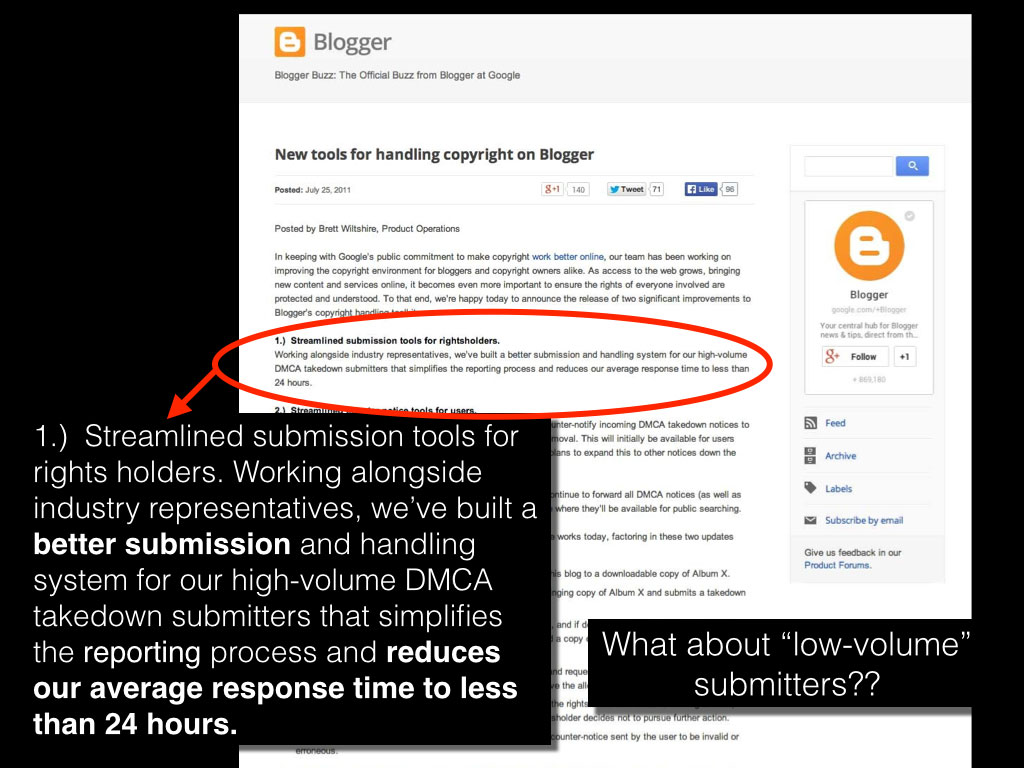
Each speaker presented a PowerPoint, links to which can be found here and a video archive here. As with the initial hearing in March, Google was represented by its Legal Director for Copyright, Fred von Lohmann who walked the audience through Google’s “DMCA notice and takedown tools” and highlighted what he called the company’s “trusted submitter program.” In his PowerPoint, Mr. von Lohmann referenced Google blog post from 2011 “New tools for handling copyright on Blogger” that supposedly highlighted the great progress that’s been made in streamlining the process.
Listening to Mr. von Lohmann it seemed clear that his words were designed for an audience made up of government officials and industry representatives and not indie artists. He (carefully) described a two-tiered system in which “trusted” submitters have access to a wealth of takedown mechanisms to remove infringing content from Google affiliates. However, aside from YouTube, access to these “trusted” programs seems limited to the big film and music entities.
Specifically, with regard to Blogger, the criteria as to how one becomes a part of this so-called “trusted submitter” program remains murky and ill-defined. Immediately following the event I searched Google to find out more (and how to apply) I only came across a link to Mr. von Lohmann’s USPTO PowerPoint. There was nothing on any Google site to answer the question as to how indie rights holders could utilize this so-called “tool.” Since there was no more information to be found, shortly after the event I took to Twitter to ask @flohmann directly for a clarification on his presentation. The response thus far, only crickets…

In addition to this lack of clarity as to who exactly can take advantage of certain tools, Mr. von Lohmann’s careful characterization of his company efficient takedown system did not match my user experience, particularly with regard to Blogger. Over these past few years I’ve documented time and time again the many ways Blogger--and therefore Google–fails to live up to its promises to remove infringing content from its platforms.
 Yet, according to Google’s self-published, self-serving report, “How Google Fights Piracy,” (that I’ve criticized in a previous post) the company continues to insist that it’s proactive fighting piracy on its Blogger web-publishing platform:
We remain vigilant against the use of the Blogger platform by pirates looking to set up a free website…we will remove infringing blog posts when properly notified by a copyright owner, and will terminate the entire blog [emphasis added] where multiple complaints establish it as a repeat infringer.
Sorry, but the facts clearly don’t match up with this corporate hyperbolic PR spin. Truth be told, Blogger’s takedown system is, in reality, a hot mess. Add Google Drive to the mix and company claims of a “streamlined” takedown process seem even more absurd.
- Blogger content that is reported as infringing takes weeks, not days to remove.
- Blogger hosted blogs that are in the business of promoting pirated movies remain online despite multiple, repeated DMCA notices and despite clear evidence they exist to pirate films.
- The Google DMCA takedown procedure is not easy to navigate. Once users find it, they must repeatedly choose options in order to (eventually) get to the correct takedown form, even someone well versed in the procedure. Why not offer direct links to the correct forms for each platform?
- Blogger’s website templates offer no direct links to Google’s (streamlined) takedown form. Why can’t Blogger hosted sites automatically provide a button/link in their menu bar or footer, designed as part of any page template to enable easy and direct access to Google’s “streamlined” takedown form?
- Google Drive takedown procedures are convoluted and unclear. No easy way to determine file’s URL to report and no direct link to report.
- When a file is reported on Google drive it can take weeks, not days, to remove the infringing content.
Rather than fulfill its promise to expedite takedowns for copyright infringement, it seems that the “Google Team” does everything within its power to make the process convoluted, cumbersome and difficult–particularly for individual artists who don’t have the deep pockets to hire help and/or automate the takedown workflow. Please take some time to review the graphics that I’ve created that illustrate just how badly Google is doing when it comes to Blogger (and Google Drive) takedowns.


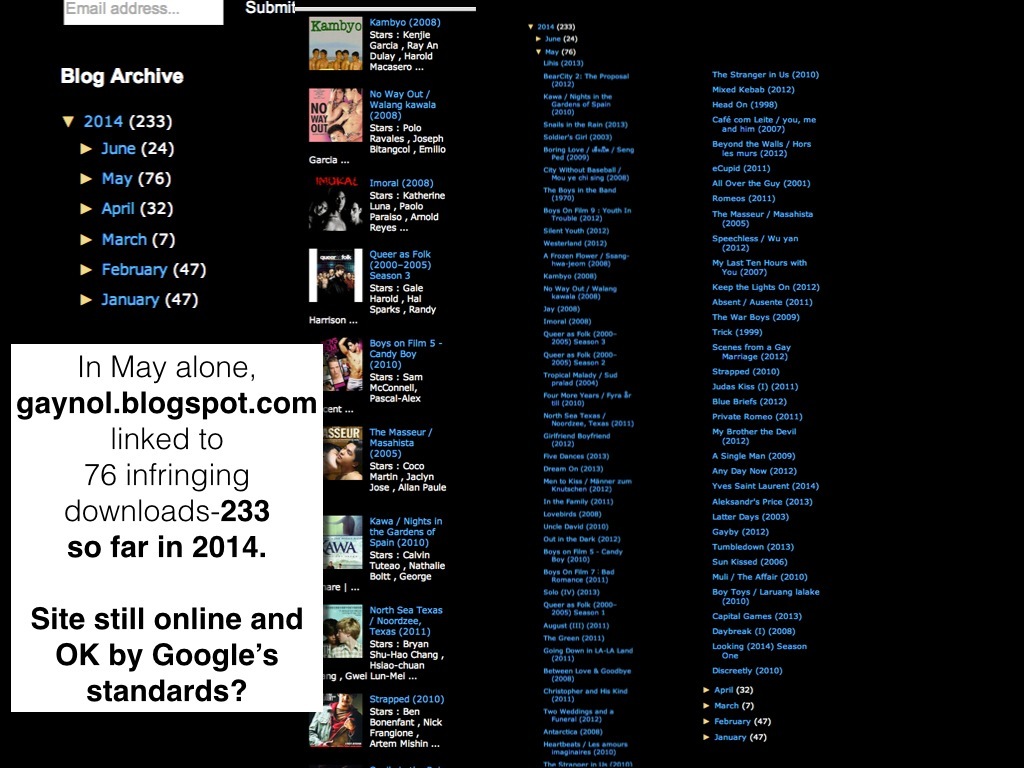


Given the complexity (and hilarity) of attempting to remove pirated stream of our film “And Then Came Lola” (seen in the example above) hosted on Google Drive I made the following video that will walk viewers through the process. Weirdly I was able to find the URL (that was not the case with some of the other examples I’ve provided) yet that didn’t help much since pirated copy is still, as of today, June 1st, available on line–more than two weeks after I sent a DMCA takedown notice to Google. As far as I’m concerned, when Google characterizes itself as doing a good job with this process I can only shake my head. No matter how many ways Google spins it, it’s not true.
https://vimeo.com/97077933
Coming soon, Part Two: How Google Could Fix its Broken DMCA Takedown System

by Ellen Seidler | Copyright, Film, Piracy, Politics
 The goals of protecting free speech and stopping online piracy are not mutually exclusive
The concept of protecting “free speech” is fundamental to sustaining healthy political discourse in any society. Yet in debates over copyright and content theft, those who oppose bringing any sort of regulation to the internet twist the concept of protecting “free speech” into a disingenuous cudgel to obfuscate the issue and generate opposition to anti-piracy efforts.
With this in mind, perhaps it’s worth looking at a recent example which demonstrates that the issue of squelching “free speech” is not inextricably linked to other forms of online expression, ie. piracy.
Russian social media site (and Facebook wannabe) Vkontakte (vk.com) provides a good example. Pavel Durov, the site’s founder, was recently pushed aside in favor of ownership interests tied to Russian President Vladimir Putin. Per news reports yesterday, he’s apparently left the Russia saying “Unfortunately, the country is incompatible with Internet business at the moment.” A piece published in January on TheVerge.com explained the power play in a piece, “How Putin’s cronies seized control of Russia’s Facebook,”
Durov, 29, sold his remaining stake in VK this week, officially ending his tenure at the helm of Russia’s most popular social network and turning the page on more than two years of turmoil and political strife.
Durov’s departure effectively transfers majority control of VK to business magnate Alisher Usmanov — Russia’s richest man, with an estimated worth of $20.2 billion, and a close ally of President Vladimir Putin. Durov sold his 12 percent stake to Ivan Tavrin, chief executive of telecom provider MegaFon, which Usmanov controls. (The exact sum of the sale was not disclosed, though it is believed to be between $300 and $400 million.) That means that Usmanov and his Kremlin-friendly allies now control 52 percent of the company, raising concerns over the future of VK and the freedom of its users.
It’s a stratagem that appears tied to disputes over political expression and Vladimir Putin’s crackdown on dissent that has become increasingly aggressive of late.
Even though much of the Russian media is known to be under state control, the Internet has remained relatively free, with blogs and social media sites providing an important and creative platform for political discussion. But on March 4, the Kremlin once again took the media battle it has been waging against pro-Western protests online. Russia’s Internet monitoring agency Roskomnadzor blocked 13 profiles associated with the Ukrainian protest movement on the popular Russian Facebook equivalent VKontakte because they “contained calls to commit terrorist acts and take part in unsanctioned mass action.”
Vk.com has been in the Kremlin’s sites since 2011 when Durov refused the government’s request to close down pages that promoted demonstrations against its policies after the results of parliamentary elections were disputed. According to a report in RIA Novosti:
“We received a request from the FSB to stop the activity of Vkontakte groups calling for riots and a revolution,” Vladislav Tsyplukhin, spokesman for social network VKontakte, wrote on his corporate web page.
“We explained in response that we have been following those groups and cannot block them as a whole just because some individual users have called for violence,” Tsyplukhin wrote.
The accounts of specific users who have explicitly called for public disorder however are being blocked by the company, he said, adding that there had not been any excessive “pressure, threats or rudeness” from the Federal Security Service (FSB) in its requests.
While expressions of political dissent are being squelched, online piracy remains alive and well on the site vk.com. Earlier this month it was announced that Sony, Universal and Warner were filing suit in Russian courts, charging the site with violating copyright. Since 2011 the site has also been on the Office of the United States Trade Representative’s list of Notorious Markets that “identifies markets around the world that harm American businesses and undermine our workers, through the infringement of intellectual property rights (IPRs).”
vKontakte.com (also operating as vK.com): The Russian site vKontakte.com, in the List since 2011, is styled primarily as a social networking site, and it is extremely popular in Russia and surrounding countries. While as a general matter, social networking sites can serve many salutary purposes, this site’s business model appears to include enabling the unauthorized reproduction and distribution, including streaming, of music and other content through the site and associated software applications.
In searching the site this week I easily found multiple users who utilized the site as a file host for thousands of websites offering streams of pirated movies.


According to a Russian blogger atkatyatrubilova.wordpress.com, Vk.com has an advantage over Facebook in attracting users due the fact piracy remains a perk not found on Facebook.
Nevertheless, Vkontakte offers a special feature which attracts more new members daily and makes them spend a lot of time online. Members are able to view thousands of pirated copies of domestic and foreign movies dubbed into Russian. In addition, it’s possible to upload and download video and audio files via the VK Tracker application.
Those who value free speech should be alarmed that Vk.com has fallen under the grip of Putin and his allies. The battle against piracy remains a separate issue here, and elsewhere. It’s time to disengage the two concepts. Fighting for one does not preclude fighting against the other.

by Ellen Seidler | Ad Sponsored Piracy, Copyright, Law, Piracy, Politics

Kim Dotcom, megalomaniac mastermind of Megaupload
Kim Dotcom sued by Hollywood studios
The legal woes for Megaupload’s founder Kim Dotcom continue with today’s news that six movie studios including Fox, Disney, Paramount, Columbia, Universal and Warner have filed a lawsuit in federal court charging Dotcom and his site with “massive” copyright infringement. From the complaint filed in federal district court in Virginia:
1. Until January 2012, when defendants were indicted on federal charges, defendants operated the notorious website and service located at www.Megaupload.com (“Megaupload” or �”Megaupload website”) as a commercial online hub for publicly providing popular copyrighted content, including thousands of plaintiffs’ copyrighted works, over the Internet to millions of Megaupload users without authorization ox license. On a daily basis, defendants intentionally infringed plaintiffs’ copyrighted motion picture and television programs on a massive scale and for a substantial profit. Defendants carried out this intentional, large-scale theft of plaintiffs’ intellectual property primarily through the operation of the Megaupload website, as well as associated websites like the video streanning service located at www.Megavideo.com (“Megavideo”).
2. Defendants intentionally and actively encouraged theix users to upload to the Megaupload computer servers infringing copies of the most popular entertainment content, including plaintiffs’ copyrighted television shows and movies. For example, through Megaupload’s “Uploader Rewards” program, defendants openly paid Megaupload users money to upload popular unauthorized and unlicensed content, including plaintiffs’ copyrighted television shows and movies, onto Megaupload’s computer servers. Pursuant to the Uploader Rewards program, the more often an uploaded file was downloaded by other users, the more money the uploader made.
3. Once a Megaupload user uploaded a file, defendants provided that user with a “link” to the infringing content and encouraged the user to disseminate the “link” as broadly as possible on the Internet so that as many people as possible would find the link and use it to download the infringing content from Megaupload’s servers.
4. Defendants profited handsomely from this copyright infringement in at least two ways: by selling users “premium” subscriptions, which enabled rapid, unrestricted downloading; and by selling online advertising space to advertisers.
The complaint goes to describe the site’s business model–one built on piracy whereby the more content uploaded, the more traffic for the site, and the more ad and subscription revenue earned–more than 25 million according to the complaint. It also pokes holes in the claims of Dotcom, and his apologists, that the site was a legitimate enterprise that merely provided storage for its users:
Contrary to some of defendants’ public assertions, Megaupload was not designed to be a private data storage provider. Users without premium subscriptions were restricted not only in their downloading capabilities, but also in their ability to store files on the site. Any content they uploaded would be deleted if it was not also downloaded within a certain period of time —after 21 days in the case of unregistered, anonymous users and after 90 days in the case of registered users who were not premium subscribers. Only premium subscribers (estimated to be 1% of users) could use Megaupload for long-term file storage. Thus, by design, Megaupload functioned not as a private online storage locker, but rather as a hub for uploading and downloading infringing copies of popular movies and television shows, including plaintiffs’ copyrighted works.
With this latest legal salvo fired against Megaupload and its founder perhaps it’s worth taking a moment to examine why YouTube, another site dependent on user-generated content (UGC) managed to survive and thrive, despite early accusations (and a major lawsuit) that labeled it a piracy cornucopia. Why did Megaupload end up on the dust bin of history while YouTube has become a web video (and music) juggernaut?
The early growth and popularity of both sites was dependent on the public’s general disregard for copyright law. Sure, some of the traffic to YouTube was generated by cute cat videos gone viral, but much of the site’s popular content included clips and often entire copies of tv shows and movies–content uploaders certainly had no right to disseminate. Like Megaupload, YouTube hid behind the shield of “safe harbor” and monetized the content with advertising but unlike Megaupload, the site did not offer cash or other incentives to uploaders, not directly anyway.*
In 2007 Viacom filed suit against YouTube and like today’s filing against Megaupload, the charge was “massive” and “brazen” copyright infringement. After seven years of legal back and forth, the parties finally announced they had settled the case in March, one week before they were scheduled to again face off in court. The companies issued a joint statement which characterized the resolution this way: “The settlement reflects the growing collaborative dialogue between our two companies on important opportunities, and we look forward to working more closely together.”
 Ultimately what separates YouTube/Google’s success versus Megaupload’s demise lies with the fact that the head honchos at Google determined that respecting copyright ultimately provided a better business model than ignoring it. On the heels of Viacom’s infringement suit, YouTube introduced its Content ID (digital fingerprinting) system in 2008 which gave rights holders a (relatively) efficient way to deal the massive copyright abuses that plagued the site. Rather than send hundreds, if not thousands of DMCA takedowns, musicians and filmmakers could claim content they own and be proactive in blocking, removing, or monetizing it. The key was that Content ID allowed the creators to determine if and how their content could be viewed on YouTube, not the other way around.
Megaupload paid lip service to honoring DMCA takedown requests, but in actuality was playing a shell game, removing infringing links but not removing the actual files. If you read the 70 page federal indictment against notorious pirate cyberlocker website Megaupload, you will find this charge on page 10, section 22:
When a file is being uploaded to Megaupload.com, the Conspiracy’s automated system calculates a unique identifier for the file (called a “MD5 hash”) that is generated using a mathematical algorithm. If, after the MD5 hash calculation, the system determines that the uploading file already exists on a server controlled by the Mega Conspiracy, Megaupload.com does not reproduce a second copy of the file on that server. Instead, the system provides a newand unique URL link to the new user that is pointed to the original file already present on the server. If there is more than one URL link to a file, then any attempt by the copyright holder to terminate access to the file using the Abuse Tool or other DMCA takedown request will fail because the additional access links will continue to be available.
During my dealings with Megaupload I’d long suspected as much. Time after time, I’d remove links using Megaupload’s content management tool only to see a duplicate file reappear (with a new link) minutes later. Of course, unlike federal authorities, I did not have access to the actual content residing on Megaupload’s servers, so I couldn’t really prove it.
In the fall of 2011 while I was researching a pirate blog that offered illegal downloads to LGBT films, I saw that the film “Kyss Mig” was being pirated. Since it’s a film distributed by the same company (Wolfe Video) that distributes our film I notified them of the infringing link. A DMCA notice was sent and, as expected, the link was disabled. However, when I went back to the website the following day I noticed that the disabled link had been replaced by a new one. That led me to again notify Wolfe and the exercise in futility was repeated. A few days later I noticed that the link was alive yet again, but the blog owner had changed things up (to protect her download) and the link now took me to an intermediate site “undeadlink.com.”
Essentially the site offered a convenient way to regenerate links to supposedly “dead” files on Megaupload (and apparently Fileserve). If Megaupload had actually removed the infringing file when it was originally reported, this wouldn’t have been an option. However, because Megaupload apparently did exactly what is spelled out in the indictment, it was very possible (and efficient). When I discovered what was going on last fall, and that it verified my suspicions, I decided to record the process. This video documents what I found.
[fve]http://vimeo.com/35648310[/fve]
Dotcom likes to pontificate (to anyone who will listen) and claims he’s “…at the forefront of creating the cool stuff that will allow creative works to thrive in an Internet age. I have the solutions to your problems. I am not your enemy.” Were that really true, why didn’t Mr. Dotcom use technology to transform Megaupload.com into legitimate UGC site by implementing a Content ID system like Youtube’s? Oh right, he would have had to share the profits. Despite disingenuous rhetoric to the contrary, unlike YouTube, Megaupload actually employed technology to ensure that copyright infringement continued rather than prevent it.
It’s an ethos that has allowed online piracy for profit (under the guise of innovation) to propagate across the globe. Why invest in a product when it’s just as easy to steal (and monetize) it? Of course Dotcom and Michael Robertson (founder of MP3tunes who was found liable and hit with a 41 million dollar verdict last month in a copyright infringement suit) have both discovered there are consequences to such theft, but this should be the norm, not the exception. Dotcom’s unbridled hubris and greed got the better of him. One can only imagine what he could have achieved had he crossed over from the dark side and followed YouTube’s lead.
Moving forward, preventing such businesses from taking root in the first place should be one goal in Congressional efforts to update the Digital Millennium Copyright Act for the 21st century. For all its faults, YouTube’s Content ID system lights the way for a possible path forward in redefining “safe harbor.” If a website’s business model to is predicated on “sharing” creative work, providing content creators with technological tools to safeguard their work should be a requirement for meeting the “safe harbor” provisions of the law. Such a requirement would not “break” the internet. It actually would could go a long way in fixing what’s currently broken.
Meanwhile, while YouTube has thrived where Megaupload has failed, businesses like YouTube can and should better reward the creators on whose work they depend. As online distribution options grow and improve, hopefully many will say goodbye to the opaque revenue “sharing” model imposed by YouTube (and others) and take their content to sites/businesses where formulas for compensation are more transparent, and more generous to those who actually create the content.

A download link to a pirated copy of our film on Megaupload.com
BTW, is there a way indie artists could jump on board the lawsuit filed by the studios? Why not make it a class action affair? There are plenty of indie musicians, filmmakers and authors around the world whose works (and livelihoods) were ripped off by Kim Dotcom’s enterprise. In their lawsuit the studios are asking for maximum statutory damages of $150,000 per infringement plus the profits the defendants generated. Just imagine how many new works might be in the offing if those thousands of creators whose works were pirated on Megaupload were awarded damages along with the studios?
*To this day there are still some YouTube users ‘s that earn ad revenue by uploading dubious content. Of course YouTube/Google earns income off these uploads too.

by Ellen Seidler | Ad Sponsored Piracy, Copyright, Piracy, Politics
 Today the Digital Citizen’s Alliance* released a report “Good Money Gone Bad: Digital Thieves and the Hijacking of the Online Ad Business,” which how quantifies how online piracy is fueled by ad-supported content theft. Highlights of the report’s findings include:
1. The websites researched make a projected $227 million in annual ad revenue. The 30 largest sites that profit exclusively from advertising averaged $4.4 million annually, with the most heavily trafficked BitTorrent and P2P portal sites topped $6 million annually.
2. Even small sites studied could make more than $100,000 a year in advertising revenue.
3. Because they rely entirely on the works of others for their “product,” their profit margins range from 80% to 94%, underscoring that crime can pay when you steal other people’s content.
4. Nearly 30% of large sites carried premium brand ads.
5. Nearly 40% of large sites carried legitimate secondary ads.
Tom Galvin, Executive Director of the Digital Citizens Alliance, explained the significance of the study results this way:
This report confirms that content theft isn’t a cottage industry—it’s big business. Plain and simple, ad-supported rip-off sites are exploiting the Internet and advertising community to get rich. The result is a damage to brand value for advertisers and serious harm to people who work in the creative industries. We hope this report pushes the online advertising community to take additional steps to protect brand value and stop ads from appearing on content theft sites that are undermining the vibrancy and safety of the digital marketplace.
The issue of ad supported piracy is a topic I’ve been researching and writing about about since the spring of 2010 when my indie film was released (and pirated). When I began searching for, and removing, pirated copies of our film online I quickly discovered that piracy was big business and driven by profits and created a blog (www.popuppirates.com) to document how piracy’s business model worked and the significant role advertising revenue played in incentivizing online piracy and sustaining it. Given today’s news I thought I’d take a look back and include an excerpt from a post I wrote four years ago that unfortunately–as the DCA study results show–could just as easily have been written today.
I created this video, “Follow the Money: Who Profits from Piracy?” to provide an overview on piracy’s link to advertising profits.
Online piracy isn’t about altruism, it’s about income. Today’s technology allows web pirates to steal content and monetize that content with a click of a mouse. Meanwhile, “legit” companies encourage and facilitate this theft while also profiting from it (ad service providers, advertisers and payment processors). The time has come for reasonable measures to be taken to discourage this theft. Content creators and consumers will benefit. Only the pirates and those who profit from their theft will lose.
In the process of scouring the web for the thousands of illegal download links and online streams of our film (more than 55,000 documented to date) I quickly discovered that various, theoretically legit companies, seemed to be (indirectly) generating income through the placement advertising on websites featuring streams and download links to pirated films. In addition, and most troubling, is that fact these ads generate income for operators of these pirate websites and add to generous profit totals for ad providers ($2.80 billion for 4th quarter 2011 for Google’s AdSense – all sources). More on Google’s financials can be found here.
The nature of the advertising varies, but I was dismayed to discover that the ads were not limited to cheesy online gaming sites, etc. Rather, they include a number of legit companies like Sony, Radio Shack, Pixar, Porsche, ATT, Chase, Network Solutions, Auto-Zone and even Netflix (particularly ironic since they carry our film). The list of advertisers goes on and on. It’s the same situation, if not worse for other films. Ads are ubiquitous on pirated content throughout the web…
…This dubious connection to piracy is not limited to the companies whose ads appear on various pirate sites. Even more problematic are those companies, like Google (via AdSense), that generate their own robust revenue stream by providing the interface for the pirate-site pop-up ads themselves. In this equation everyone, except the actual content creators, make money from this theft.
One could argue that the companies that provide the ads, as well as the companies being advertised, have no control over where the ads appear and thus bear no responsibility–hear no evil, see no evil? Is claiming ignorance any way to run an ad campaign or a business? It seems that the answer is “yes”–as long as there’s profit involved.
From my perspective, their implicit involvement, intentional or not, should be revealed. Every time one of these illegal files is added to a website where these ads appear, Google and et al earn money at the expense of the content creators. This just isn’t right.
In the scheme of things, our successful (highly-pirated) little indie film is a mere drop in the piracy bucket–we are one among thousands. However, collectively, this tainted revenue is significant, as is the harm done to those whose work is being stolen with the mere click of a mouse.
Certainly companies with the technological capacity (and robust balance sheets) of Google can afford to turn some attention to this issue. If these companies can offer ad placement based on cached cookies and metadata, why can’t they vet the websites where their ads appear? It ain’t rocket science folks. I daresay that if these websites were offering porn and not pirated films, these ads would NOT be popping-up, at least not for long.
Now, four years later, has anything really changed when it comes to ad sponsored piracy? As today’s study results make clear, the answer seems to be “not really.”
The Digital Citizens Alliance report also makes this important point:
The research does not represent the losses incurred by the victims of content theft – writers, producers, musicians, actors, and the thousands of others who work in creative industries. Content thieves are responsible for illicitly distributing millions of copies of valuable works, costing their owners billions of dollars in rightful revenues. The fact that the value of the content they illegally distribute is far greater than the advertising profits they reap is of no concern to the thieves, because they pay nothing for the content that drives their business.
 Perhaps this study will serve as the tipping point that will motivate advertisers (and ad networks) assert more control over where their ads appear and into whose pockets their money goes. At least one can hope, but given the industry’s tendency to provide lip-service rather than real action to sever ties with online pirate sites, I remain skeptical. After all, if the fact that ads for popular brands are prominently displayed alongside piracy site sex ads won’t move them into action, I’m not sure what will.

Dove’s “self-esteem” ad

Kraft

Aveeno

Duracell

Best Foods ad

Natural Choice

Windows

Bounty

Vicks

Luvs Diapers

Duracell Batteries

Crest Pro Health

Swiffer

Best Buy

Febreze

Greenies

Alaska Airlines

L.L. Bean

Nokia

Motorola (a Google Company)

General Electric

Microsoft Windows Phone

Castro Motor Oil

Target

Hot Pockets
* Full disclosure, I am a member of the Digital Citizens Alliance Advisory Board .

 Google’s claim that it’s doing a great job streamlining its response to DMCA takedown notices on its Blogger-hosted websites doesn’t jibe with the truth. This year the U.S. Patent and Trade Office (USPTO) has been holding a series of hearings with the goal of “improving the operation of the DMCA notice and takedown policy.”