by Ellen Seidler | Film, Piracy, TV
 LGBT pirate blogs that claim to love the films and shows that reflect their lives, yet undermine creators ability to make more
It’s bad enough seeing indie LGBT films pirated via torrent sites like Pirate Bay and cyberlockers like Mega, but it’s particularly galling to see supposed fans of LGBT films operating websites that think nothing of undermining filmmakers from their own community. Time after time fans of LGBT films ask why more films reflecting their lives aren’t made, yet many of those same fans think nothing of pirating the LGBT films that are made effectively cannibalizing their own filmmakers.
LGBT films are usually made outside the Hollywood system and depend entirely on grassroots funding efforts to cover production costs. When these films are pirated, recouping expenses is made more difficult and threatens the filmmaker’s ability to create more films.
Much is made about the democratization of filmmaking through increasingly affordable technology. Yet no matter whether a film is shot on 35 mm or digital, it still costs money to create. Money–to pay for cast and crew, equipment and permits, insurance and meals–does not fall from the heavens. There’s also the cost of pre-production: planning, script development and completion, casting, location scouting, scheduling, hiring a crew, etc. After the film is shot, taking weeks or months, there are post-production costs to consider. These include editing, sound-mixing, music, special FX, color-correction and mastering. This entire process takes time and money. People who create indie films aren’t in it to get rich. They are driven by a passion to create and give voice to untold stories but it doesn’t come free. There are debts to be paid.
Unfortunately, this disconnect between those who create and those who consume threatens to gradually the diversity of voices (and choices) available. Fans may not miss what’s not made until it’s too late…As they say, actions speak louder than words. You can’t claim to support LGBT indie film yet download or stream illegal copies of those same films. However, as I surf the web and explore the many blogs dedicated to LGBT film, too often I find this hypocrisy in full bloom
The blog “Popcorn ‘N Tits” is part of the PNT Tv Network, “a femqueer entertainment website where you can find webseries, movies, music and literary articles that reflect our lives.” It’s beyond ironic, and rather sad that operators choose to exploit the very content they claim to love. Ironically one of their partner blogs features this plea,
This blog is dedicated to support the art of filmmaking. You love watching our movies, shorts, and web-series but filmmakers need money to make that happen. You can do this by donating to these projects, no matter how small the sum.
So true, yet this same blog network apparently doesn’t see the disconnect when it includes a site that apparently pirates movies and tv shows at will (see graphics below). Note this is only one example of many I’ve found during my web wanderings.


by Ellen Seidler | Ad Sponsored Piracy, Copyright, Film, Piracy, Tech
 Google comes in a close second to word-of-mouth in path to piracy poll
A while back one of the world’s most popular pirate websites, LetMeWatchThis went through tumultuous times as its domain name was hijacked and cloned by other not-so-nice pirates. According to torrentfreak.com the hijacking, and general confusion led to the domain switching to an entirely new domain, primewire.ag:
One of the largest unauthorized streaming movie websites on the Internet is at the center of what is probably the most confusing mess ever to hit the sector. Various hackings, hijackings, domain changes and nefarious happenings have turned 1Channel, LetMeWatchThis, PrimeWire.ag and Vodly.to into a maze of smoke and mirrors through which no regular user has a hope of navigating.
While it’s not clear if the dust as settled, what is clear is that someone operating the domain name primewire.ag is running a website full of illegal links to thousands of stolen movies. The pirate site, as mentioned in my earlier post today, makes money via advertising (mostly major American brands) but as I was researching the site for my post, I noticed another feature worth highlighting. In its sidebar, the website has posted a poll asking this question: How did you find us through our new name?
According to the results users turned, in large numbers, to that tried and true source for pirated content worldwide, Google search. Nearly 200,000 (29.88 %) users chose Google as their path to the site, second only to word of mouth which took top honors at 43%. While the poll is not scientific, it does provide more anecdotal evidence to what most believe to be true, Google is a major sign post on the path to online piracy. Even when pirate sites run into trouble with other pirates hacking and stealing their domains (ironic isn’t it), leave it to Google to come to the rescue.


by Ellen Seidler | Ad Sponsored Piracy, Copyright, Film
 Excuse me if I don’t get too excited over Creative Future’s recent letter to ad industry representatives praising their for its efforts against online piracy.
We are writing to thank you for the progress you have made in addressing the exploitative practices used by some in the online advertising marketplace, including the diversion of advertising to websites
engaged in piracy.
Your pledge to act to reduce digital piracy is commendable. In your June 19 letter to the Co-Chairs of the International Creativity and Theft-Prevention Caucus, you highlighted the “Core Criteria for Effective
Digital Advertising Assurance” that you are developing, as well as the Interactive Advertising Bureau’s recently announced “Trustworthy Digital Supply Chain Initiative.” We believe these are the kinds of industry-led voluntary actions that can most effectively take the profit out of piracy.
Of course some action against ad-sponsored piracy is better than none, but news flash, ad-sponsored piracy is not news. Every few months it seems some new initiative is announced yet, in reality, in the land of the online pirates and their quest for profits, nothing much has changed. A year ago the White House released a statement on best practices to “Combat Online Piracy and Counterfeiting” which included this statement:
The Administration strongly supports voluntary efforts by the private sector to reduce infringement and we welcome the initiative brought forward by the companies to establish industry-wide standards to combat online piracy and counterfeiting by reducing financial incentives associated with infringement. We believe that this is a positive step and that such efforts can have a significant impact on reducing online piracy and counterfeiting.Y
Is there an echo in here? Why all this coddling of piracy’s enablers? Enough with the self-congratulatory preening. DO SOMETHING! Four years ago I wrote this on my blog about ad-sponsored piracy, popuppirates.com, when I launched the site in June of 2010:
In the process of scouring the web for the thousands of illegal download links and online streams of our film (more than 55,000 documented to date) I quickly discovered that various, theoretically legit companies, seemed to be (indirectly) generating income through the placement advertising on websites featuring streams and download links to pirated films. In addition, and most troubling, is that fact these ads generate income for operators of these pirate websites and add to generous profit totals for ad providers…
…The nature of the advertising varies, but I was dismayed to discover that the ads were not limited to cheesy online gaming sites, etc. Rather, they include a number of legit companies like Sony, Radio Shack, Pixar, Porsche, ATT, Chase, Network Solutions, Auto-Zone and even Netflix (particularly ironic since they carry our film). The list of advertisers goes on and on. It’s the same situation, if not worse for other films. Ads are ubiquitous on pirated content throughout the web
Now, exactly four years later what has changed? Not much…
Just this morning I checked out primewire.ag, a notorious pirate site and within moments was confronted by major brands advertising promoting their products while simultaneously filling the coffers of the pirate profiteers. As I reloaded the pages and clicked through listing of download links to movies like “The Transformers-Age of Extinction” and “Rio 2” I was greeted with ads from Lexus, Verizon, ATT, Domino’s Pizza, State Farm Insurance, Mucinex, Dick’s Sporting Goods and BP popping up directly beneath a ” Support the Site” plea. This is just one pirate site and it took me less than 10 seconds to find multiple major brands advertising there.
Time for talk is over. I’ll “thank” advertisers for their (overdue) response when–and if– I click on these pirate sites and don’t see this anymore:


by Ellen Seidler | Copyright, Film, Piracy, Tech
 Is this really what lawmakers had in mind when they wrote the DMCA?
Seriously, it’s not that I just love spending my time bashing Google, but the fact is that this company deserves to be taken to task (every second of every day) for the lousy job it does dealing with the rampant piracy on its Blogger platform. The slide show below is simply more documentation as to just how absurd, convoluted and outright busted the DMCA takedown process is with the barnacle that is Blogger (Blogspot.com). While mothership Google pretends not to notice, web pirates grow and thrive in the waters of its safe harbor.
Not only does Blogger provide a sanctuary for movie pirates around the globe, but Google’s cloud-based storage Google Drive, often a host for the Blogger pirated movies streams, looks a lot more like Megaupload than a legit business. Figures, for a company trying to bust indie-musicians and rip-off professional photographers, developing slick and slimy ways to avoid the law seems about par for the crooked course.
Google makes billions leveraging content created by others. The least they could do is respect our right to remove it, but that would mean less content for them to leverage, and thus less money for them. For Google, though it regards itself as the emperor of tech, ever evolving to offer society the next big thing; it’s really just like many other multinational behemoths seeking to protect and its increase profits. Who cares where those profits come from? Given greed’s at the company’s core, I once again welcome you to another example of Google’s takedown labyrinth.
[rev_slider Google_DMCA_circus]
When Congress crafted the Digital Millennium Copyright Act (DMCA) in 1998 they explicitly carved out “safe harbor” from liability for copyright infringement so long as the service provider, “upon obtaining such knowledge or awareness, acts expeditiously to remove, or disable access to, the material.”
Section 512(c) limits the liability of service providers for infringing material on websites (or other information repositories) hosted on their systems. It applies to storage at the direction of a user. In order to be eligible for the limitation, the following conditions must be met:
- The provider must not have the requisite level of knowledge of the infringing activity, as described below.
- If the provider has the right and ability to control the infringing activity, it must not receive a financial benefit directly attributable to the infringing activity.
- Upon receiving proper notification of claimed infringement, the provider must expeditiously take down or block access to the material.
The legislation also contains this language with regard to a service provider being eligible for limitations on liability, “: (1) it must adopt and reasonably implement a policy of terminating in appropriate circumstances the accounts of subscribers who are repeat infringers…
After you step through these slides and read my previous posts examining Google’s dysfunctional takedown procedures, can you really believe Google is “expeditiously” honoring the intent of the DMCA? If so, I’ve got a bridge to sell you…

by Ellen Seidler | Copyright, Film, Piracy, Tech
[vc_row][vc_column][vc_column_text]
 How much more of Googlenocchio can filmmakers take?
Google publicly brags about its “commitment to make copyright work better online” but the in reality it’s just a big, fat LIE.
I must say it was pretty ironic when, in the midst of working on this post, Ironically, I received this email from an indie film director asking my advice about dealing with Google:
Ellen, I have a quick question. I am having problems submitting DMCA notices to Google on some of the links, where I have submitted them before and Google hasn’t taken them down. [emphasis added]
When I try and re-submit–this can be weeks months later–it won’t allow me to submit the form, saying, the link has been submitted before. Do you have this problem, not sure if I am doing something wrong, or is there nothing I can do !
Sound familiar? I’m sure it does to the many indie filmmakers who, like myself and my colleague above, are routinely at the mercy of Google’s not-so-transparent, lame DMCA takedown procedure when we find stolen copies of our work online.
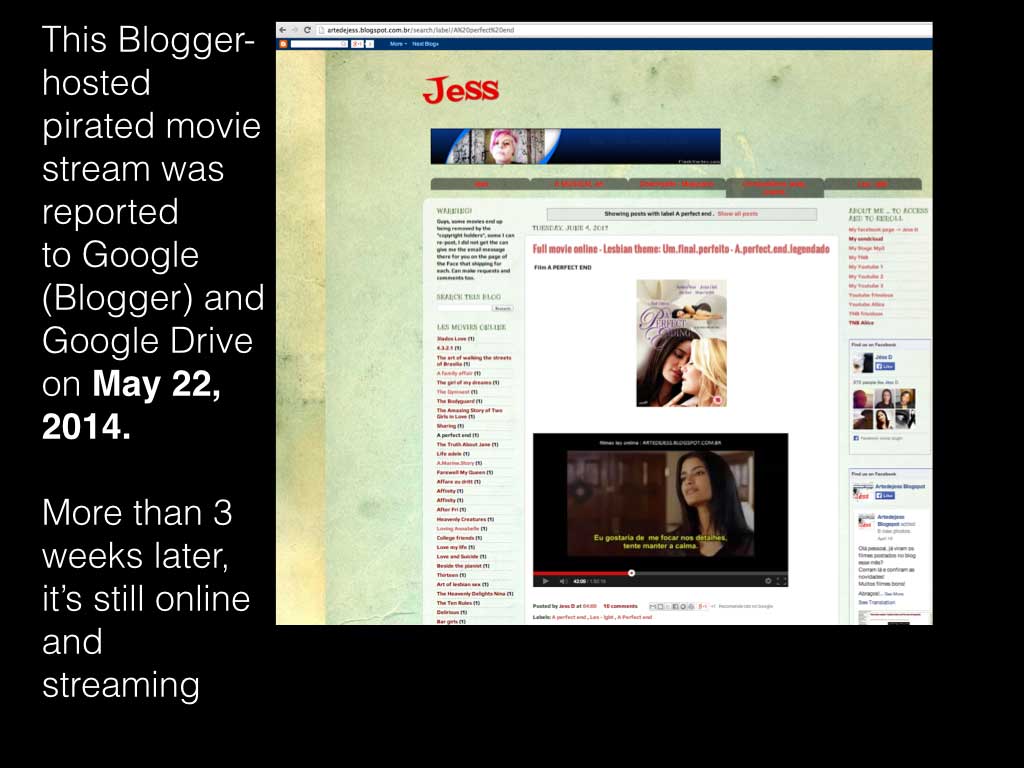
To dramatize just how flagrant Google’s DMCA foot dragging is I created a clock to track the company’s (lack of) action when it comes to efficient removal of pirated content from Blogger-hosted pirate sites. The clock below began started clicking on April 24th when 2 links were reported for copyright infringement. As of today, June 17th, nearly 2 months later, both pirated movies remain online as does the pirate Blogger-hosted website (see graphic below)
UPDATE: The site was removed July 10th, 2014, nearly 3 months after the first DMCA takedown notices was sent to Google.
[/vc_column_text][/vc_column][/vc_row][vc_row][vc_column width=”1/1″][/vc_column][/vc_row][vc_row][vc_column][vc_column_text]


Remember, this is just ONE example of Google’s slow as molasses (or non-existent?) takedown work-flow. Remember this promise?
1.) Streamlined submission tools for rightsholders.
Working alongside industry representatives, we’ve built a better submission and handling system for our high-volume DMCA takedown submitters that simplifies the reporting process and reduces our average response time to less than 24 hours. [emphasis added]
When it comes to Google, broken promises are merely its modus operandi. When Google flacks claim the company cares about copyright infringement, it’s just a lie.
[/vc_column_text][/vc_column][/vc_row][vc_row][vc_column][vc_column_text][vc_column_text]
[/vc_column_text][/vc_column][/vc_row]