by Ellen Seidler | Copyright, Film, Law, Piracy, Tech
 Finally, after weeks–actually months–of repeatedly reporting (and waiting) the pirate movie website videolez.blogspot.com, a site featuring more than 100 pirated movies streamed via Google Drive-hosted embeds of stolen movies), finally bit the dust.
 Why after all this time and repeated violations did Google finally remove this site?
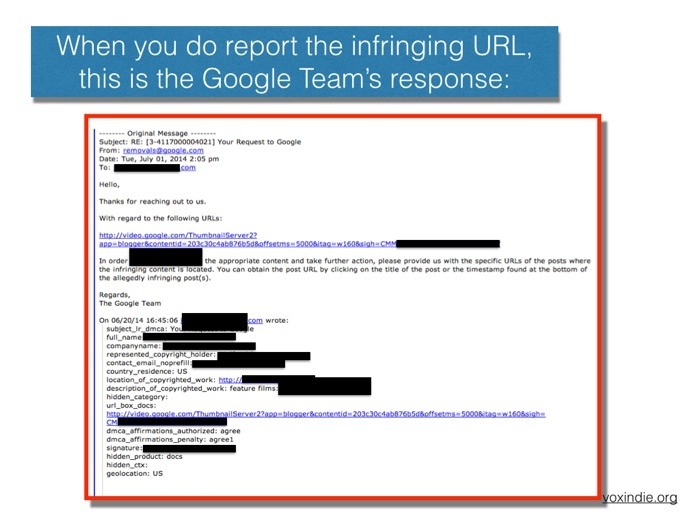
I think what finally turned a lightbulb on in the Google Team’s HQ was my response to a lame email they sent me as follow up to DMCA notices I’d issued (on behalf of myself and film distributors/producers I do anti-piracy work for). This is the email the Google Team sent to me in response to one (of many) DMCA notices sent via their online form:
Hello,
Thanks for reaching out to us.
You can obtain the post URL by clicking on the title of the post or the timestamp found at the bottom of the allegedly infringing post(s).
Regards,
The Google Team
The reason the Google Team’s email was ridiculous was because it was WRONG. It’s painfully clear that those employed by Google to respond to DMCA notices don’t truly understand their own products and just how pirates use them. This was my response:
Hello,
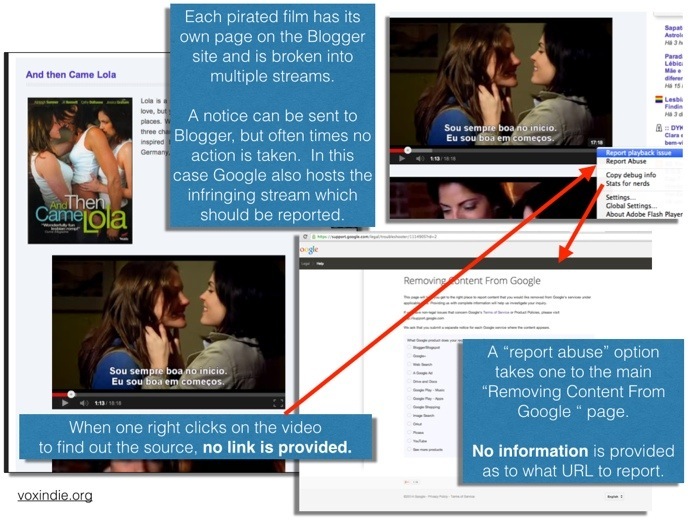
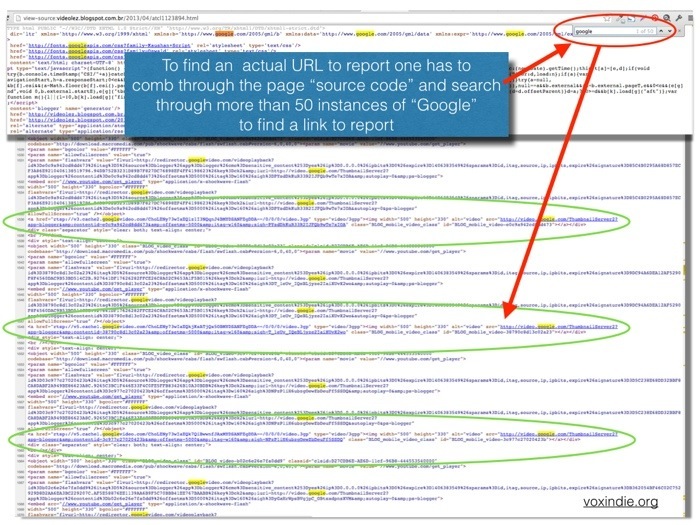
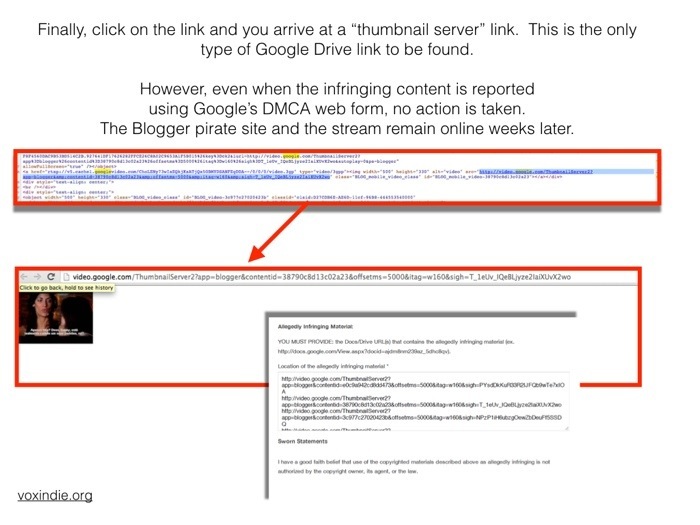
Actually we cannot determine the URL by clicking as you suggest….this requires going into the actual source code for an embedded stream.
I’ve attached a PDF highlighting the issue with one of the films we reported. The URLS are not easily available. Right click on the video embed and get “report abuse” and you are taken to Google web takedown form with NO information about the offending URL.
PS-There are many more pages…in fact this entire blog is dedicated to pirating indie films and Google does zilch!
Here’s the
PDF I attached with my email sent to the Team in an effort to explain just what was going on with this particular Blospot.com pirate. Below are the graphics included in the PDF. They demonstrates, step-by-step, how Google could (and should) better understand its own products and respond appropriately upon receipt of DMCA notices rather than send out erroneous emails asking for more information; information that’s actually neither available nor relevant.


Unfortunately, this small victory is but a blip in the sea of Google-sponsored pirate sites. Moments after I discovered the VideoLez site had been removed, I checked another, similar pirate site that I’ve also reported multiple times. It remains alive and well. The countdown clock can be seen here.

I’ve asked it before, but I’ll ask it again. Why can’t Google clean up its act? Does it really deserve protection from liability under the DMCA “safe harbor” provision if it routinely fails to remove content and sites, despite repeated (and clear) requests? Title 17 › Chapter 5 › § 512 states outlines one aspect of Safe Harbor as follows:
(c) Information Residing on Systems or Networks At Direction of Users.—
(1) In general.— A service provider shall not be liable for monetary relief, or, except as provided in subsection (j), for injunctive or other equitable relief, for infringement of copyright by reason of the storage at the direction of a user of material that resides on a system or network controlled or operated by or for the service provider, if the service provider—
(A)
(i) does not have actual knowledge that the material or an activity using the material on the system or network is infringing;
(ii) in the absence of such actual knowledge, is not aware of facts or circumstances from which infringing activity is apparent; or
(iii) upon obtaining such knowledge or awareness, acts expeditiously to remove, or disable access to, the material;
(B) does not receive a financial benefit directly attributable to the infringing activity, in a case in which the service provider has the right and ability to control such activity; and
(C) upon notification of claimed infringement as described in paragraph (3), responds expeditiously to remove, or disable access to, the material that is claimed to be infringing or to be the subject of infringing activity. [underline added]
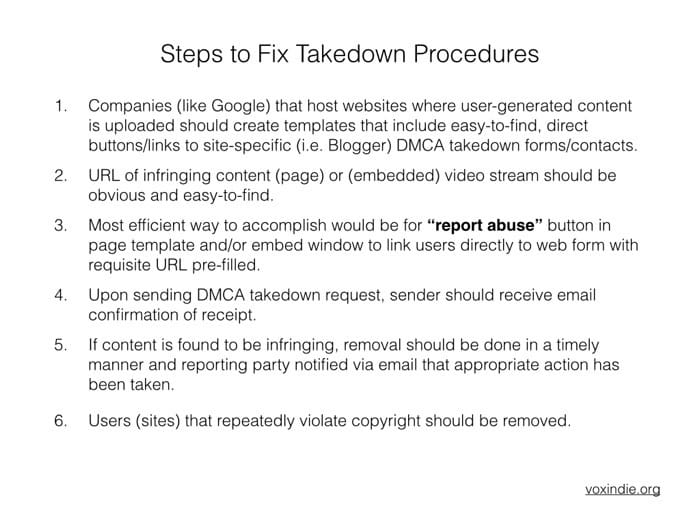
6 Easy Steps the Google Team could take to fix their DMCA takedown process
To allow Google’s web crawlers to find read my list of suggestions 😉 here it is again in text form:
-
Companies (like Google) that host websites where user-generated content is uploaded should create templates that include easy-to-find, direct buttons/links to site-specific (i.e. Blogger) DMCA takedown forms/contacts.
-
URL of infringing content (page) or (embedded) video stream should be obvious and easy-to-find.
-
Most efficient way to accomplish would be for “report abuse” button in page template and/or embed window to link users directly to web form with requisite URL pre-filled.
-
If content is found to be infringing, removal should be done in a timely manner and reporting party notified via email that appropriate action has been taken.
-
If content is found to be infringing, removal should be done in a timely manner and reporting party notified via email that appropriate action has been taken.
-
Users (sites) that repeatedly violate copyright should be removed.
Next “expeditious” move is Google’s…I’ll be waiting.

by Ellen Seidler | Law, Music, Tech

Google Trying to Force Indie Record Labels into Submission
(Updated June 17, 2014)
This post was originally published in late May, but with news breaking that Google is pushing ahead on its plan to block indie labels from its new music service I’m reposting. Here’s the latest from The Guardian:
Adele, Arctic Monkeys and Jack White could disappear from YouTube “in a matter of days” after the Google video service confirmed it was dropping content from independent labels that have not signed up for its upcoming subscription music service…
…The company’s head of content and business operations, Robert Kyncl,told the Financial Times that the service – previously rumoured to be called YouTube Music Pass – will launch more widely later in the year.
His confirmation that YouTube will block videos from labels that do not sign licensing deals for the new premium tier will be hugely controversial among indie labels, with trade body WIN already filing a complaint to the European Commission about its negotiating strategy.
Here’s my original post from May 24th, 2014:
Excuse me while I choke back the bile rising in my gut. Our pal Google, the worldwide protector of free speech on the web, is showing its true colors as it reportedly goes toe to toe with indie record labels in negotiations over its new streaming music service. According to the New York Times, representatives from Google/YouTube are trying to strong arm the labels into crying “uncle” by blackmailing them into submission over contract terms:
Negotiations between independents and YouTube, which is owned by Google, have dragged on for months. But according to several people with direct knowledge of the talks, the indies’ decision to speak out was driven by a recent warning that if labels failed to agree to YouTube’s licensing terms, music on the indies’ official YouTube channels would be blocked. In addition, those labels would be unable to collect advertising revenue from user-uploaded videos that included their music.
The Worldwide Independent Network published a statement on their website taking Google to task:
YouTube is expected to launch a new music streaming service. The service has apparently negotiated separate agreements with the three major labels – Sony, Warner and Universal – but according to WIN’s trade association colleagues has yet to reach any substantive agreement with their members.
At a time when independent music companies are increasing their global market share WIN has raised major concerns about YouTube’s recent policy of approaching independent labels directly with a template contract and an explicit threat that their content will be blocked on the platform if it is not signed.
According to WIN members, the contracts currently on offer to independent labels from YouTube are on highly unfavourable, and non-negotiable terms, and undervalue existing rates in the marketplace from existing music streaming partners such as Spotify, Rdio, Deezerand others.
WIN has held extensive talks with YouTube at their instigation over the last 24 hours to try and resolve this issue but no progress has been made. WIN’s request for YouTube to rescind the termination letters sent to its members has not as yet been agreed to.
Google representatives have repeatedly pulled out the “free speech” card as rationale for allowing Google to run rough shod over artist’s rights (human rights) online and its lobbyists often employ the “protect free speech” argument as a sacred sword to move politicians and the public to its side during policy debates regarding its online business practices. That dearly held corporate concept seems to have gone out the window during these discussions demonstrating that ultimately, it’s not a matter of principle for Google, but profits.
Every time an artist sends a DMCA takedown request for any Google-hosted content (YouTube, Blogger, Search, Drive, etc) they are warned that a copy of the notice will be sent to the “Chilling Effects” website which, according to its “about” page, exists in order to, “support lawful online activity against the chill of unwarranted legal threats.”
Please note that a copy of each legal notice we receive is sent to a third-party which may publish and annotate it (with your personal information removed). As such, the content submitted in this form will be forwarded to Chilling Effects (http://www.chillingeffects.org) for publication. You can see an example of such a publication athttp://www.chillingeffects.org/dmca512/notice.cgi?NoticeID=861. For products like Google Web Search, a link to your published notice will be displayed in Google’s search results in place of the removed content.
I wonder if the folks at Chilling Effects would consider whether YouTube’s negotiating tactics are having a “chilling effects” on indie musicians?
More irony can be found on Google’s own policy blog the company touts how it “promotes free speech on the internet.”
Google’s commitment to freedom of expression is at the core of everything we do — whether it’s independent media organizations using YouTube to express themselves in Venezuela, or citizen journalists using Blogger to chronicle Myanmar’s crackdown last year on Buddhist monk protests. Unfortunately, many governments around the world impose limits on their citizens’ freedom of speech, and that often leads them to block or limit access to our tools and services.
Hypocrisy seems too gentle a term in characterizing Google’s current stance with indie labels on YouTube. Agree to our terms or we’ll block your work? Seems their “commitment to freedom of expression” doesn’t count if you refuse to add profits to their piggy bank.

by Ellen Seidler | Ad Sponsored Piracy, Copyright, Law, Piracy, Politics

Kim Dotcom, megalomaniac mastermind of Megaupload
Kim Dotcom sued by Hollywood studios
The legal woes for Megaupload’s founder Kim Dotcom continue with today’s news that six movie studios including Fox, Disney, Paramount, Columbia, Universal and Warner have filed a lawsuit in federal court charging Dotcom and his site with “massive” copyright infringement. From the complaint filed in federal district court in Virginia:
1. Until January 2012, when defendants were indicted on federal charges, defendants operated the notorious website and service located at www.Megaupload.com (“Megaupload” or �”Megaupload website”) as a commercial online hub for publicly providing popular copyrighted content, including thousands of plaintiffs’ copyrighted works, over the Internet to millions of Megaupload users without authorization ox license. On a daily basis, defendants intentionally infringed plaintiffs’ copyrighted motion picture and television programs on a massive scale and for a substantial profit. Defendants carried out this intentional, large-scale theft of plaintiffs’ intellectual property primarily through the operation of the Megaupload website, as well as associated websites like the video streanning service located at www.Megavideo.com (“Megavideo”).
2. Defendants intentionally and actively encouraged theix users to upload to the Megaupload computer servers infringing copies of the most popular entertainment content, including plaintiffs’ copyrighted television shows and movies. For example, through Megaupload’s “Uploader Rewards” program, defendants openly paid Megaupload users money to upload popular unauthorized and unlicensed content, including plaintiffs’ copyrighted television shows and movies, onto Megaupload’s computer servers. Pursuant to the Uploader Rewards program, the more often an uploaded file was downloaded by other users, the more money the uploader made.
3. Once a Megaupload user uploaded a file, defendants provided that user with a “link” to the infringing content and encouraged the user to disseminate the “link” as broadly as possible on the Internet so that as many people as possible would find the link and use it to download the infringing content from Megaupload’s servers.
4. Defendants profited handsomely from this copyright infringement in at least two ways: by selling users “premium” subscriptions, which enabled rapid, unrestricted downloading; and by selling online advertising space to advertisers.
The complaint goes to describe the site’s business model–one built on piracy whereby the more content uploaded, the more traffic for the site, and the more ad and subscription revenue earned–more than 25 million according to the complaint. It also pokes holes in the claims of Dotcom, and his apologists, that the site was a legitimate enterprise that merely provided storage for its users:
Contrary to some of defendants’ public assertions, Megaupload was not designed to be a private data storage provider. Users without premium subscriptions were restricted not only in their downloading capabilities, but also in their ability to store files on the site. Any content they uploaded would be deleted if it was not also downloaded within a certain period of time —after 21 days in the case of unregistered, anonymous users and after 90 days in the case of registered users who were not premium subscribers. Only premium subscribers (estimated to be 1% of users) could use Megaupload for long-term file storage. Thus, by design, Megaupload functioned not as a private online storage locker, but rather as a hub for uploading and downloading infringing copies of popular movies and television shows, including plaintiffs’ copyrighted works.
With this latest legal salvo fired against Megaupload and its founder perhaps it’s worth taking a moment to examine why YouTube, another site dependent on user-generated content (UGC) managed to survive and thrive, despite early accusations (and a major lawsuit) that labeled it a piracy cornucopia. Why did Megaupload end up on the dust bin of history while YouTube has become a web video (and music) juggernaut?
The early growth and popularity of both sites was dependent on the public’s general disregard for copyright law. Sure, some of the traffic to YouTube was generated by cute cat videos gone viral, but much of the site’s popular content included clips and often entire copies of tv shows and movies–content uploaders certainly had no right to disseminate. Like Megaupload, YouTube hid behind the shield of “safe harbor” and monetized the content with advertising but unlike Megaupload, the site did not offer cash or other incentives to uploaders, not directly anyway.*
In 2007 Viacom filed suit against YouTube and like today’s filing against Megaupload, the charge was “massive” and “brazen” copyright infringement. After seven years of legal back and forth, the parties finally announced they had settled the case in March, one week before they were scheduled to again face off in court. The companies issued a joint statement which characterized the resolution this way: “The settlement reflects the growing collaborative dialogue between our two companies on important opportunities, and we look forward to working more closely together.”
 Ultimately what separates YouTube/Google’s success versus Megaupload’s demise lies with the fact that the head honchos at Google determined that respecting copyright ultimately provided a better business model than ignoring it. On the heels of Viacom’s infringement suit, YouTube introduced its Content ID (digital fingerprinting) system in 2008 which gave rights holders a (relatively) efficient way to deal the massive copyright abuses that plagued the site. Rather than send hundreds, if not thousands of DMCA takedowns, musicians and filmmakers could claim content they own and be proactive in blocking, removing, or monetizing it. The key was that Content ID allowed the creators to determine if and how their content could be viewed on YouTube, not the other way around.
Megaupload paid lip service to honoring DMCA takedown requests, but in actuality was playing a shell game, removing infringing links but not removing the actual files. If you read the 70 page federal indictment against notorious pirate cyberlocker website Megaupload, you will find this charge on page 10, section 22:
When a file is being uploaded to Megaupload.com, the Conspiracy’s automated system calculates a unique identifier for the file (called a “MD5 hash”) that is generated using a mathematical algorithm. If, after the MD5 hash calculation, the system determines that the uploading file already exists on a server controlled by the Mega Conspiracy, Megaupload.com does not reproduce a second copy of the file on that server. Instead, the system provides a newand unique URL link to the new user that is pointed to the original file already present on the server. If there is more than one URL link to a file, then any attempt by the copyright holder to terminate access to the file using the Abuse Tool or other DMCA takedown request will fail because the additional access links will continue to be available.
During my dealings with Megaupload I’d long suspected as much. Time after time, I’d remove links using Megaupload’s content management tool only to see a duplicate file reappear (with a new link) minutes later. Of course, unlike federal authorities, I did not have access to the actual content residing on Megaupload’s servers, so I couldn’t really prove it.
In the fall of 2011 while I was researching a pirate blog that offered illegal downloads to LGBT films, I saw that the film “Kyss Mig” was being pirated. Since it’s a film distributed by the same company (Wolfe Video) that distributes our film I notified them of the infringing link. A DMCA notice was sent and, as expected, the link was disabled. However, when I went back to the website the following day I noticed that the disabled link had been replaced by a new one. That led me to again notify Wolfe and the exercise in futility was repeated. A few days later I noticed that the link was alive yet again, but the blog owner had changed things up (to protect her download) and the link now took me to an intermediate site “undeadlink.com.”
Essentially the site offered a convenient way to regenerate links to supposedly “dead” files on Megaupload (and apparently Fileserve). If Megaupload had actually removed the infringing file when it was originally reported, this wouldn’t have been an option. However, because Megaupload apparently did exactly what is spelled out in the indictment, it was very possible (and efficient). When I discovered what was going on last fall, and that it verified my suspicions, I decided to record the process. This video documents what I found.
[fve]http://vimeo.com/35648310[/fve]
Dotcom likes to pontificate (to anyone who will listen) and claims he’s “…at the forefront of creating the cool stuff that will allow creative works to thrive in an Internet age. I have the solutions to your problems. I am not your enemy.” Were that really true, why didn’t Mr. Dotcom use technology to transform Megaupload.com into legitimate UGC site by implementing a Content ID system like Youtube’s? Oh right, he would have had to share the profits. Despite disingenuous rhetoric to the contrary, unlike YouTube, Megaupload actually employed technology to ensure that copyright infringement continued rather than prevent it.
It’s an ethos that has allowed online piracy for profit (under the guise of innovation) to propagate across the globe. Why invest in a product when it’s just as easy to steal (and monetize) it? Of course Dotcom and Michael Robertson (founder of MP3tunes who was found liable and hit with a 41 million dollar verdict last month in a copyright infringement suit) have both discovered there are consequences to such theft, but this should be the norm, not the exception. Dotcom’s unbridled hubris and greed got the better of him. One can only imagine what he could have achieved had he crossed over from the dark side and followed YouTube’s lead.
Moving forward, preventing such businesses from taking root in the first place should be one goal in Congressional efforts to update the Digital Millennium Copyright Act for the 21st century. For all its faults, YouTube’s Content ID system lights the way for a possible path forward in redefining “safe harbor.” If a website’s business model to is predicated on “sharing” creative work, providing content creators with technological tools to safeguard their work should be a requirement for meeting the “safe harbor” provisions of the law. Such a requirement would not “break” the internet. It actually would could go a long way in fixing what’s currently broken.
Meanwhile, while YouTube has thrived where Megaupload has failed, businesses like YouTube can and should better reward the creators on whose work they depend. As online distribution options grow and improve, hopefully many will say goodbye to the opaque revenue “sharing” model imposed by YouTube (and others) and take their content to sites/businesses where formulas for compensation are more transparent, and more generous to those who actually create the content.

A download link to a pirated copy of our film on Megaupload.com
BTW, is there a way indie artists could jump on board the lawsuit filed by the studios? Why not make it a class action affair? There are plenty of indie musicians, filmmakers and authors around the world whose works (and livelihoods) were ripped off by Kim Dotcom’s enterprise. In their lawsuit the studios are asking for maximum statutory damages of $150,000 per infringement plus the profits the defendants generated. Just imagine how many new works might be in the offing if those thousands of creators whose works were pirated on Megaupload were awarded damages along with the studios?
*To this day there are still some YouTube users ‘s that earn ad revenue by uploading dubious content. Of course YouTube/Google earns income off these uploads too.

by Ellen Seidler | Copyright, Law, Piracy, Politics, Tech
 Creativity ‘Continues to Thrive,’ in spite of SOPA’s defeat, not because of it
In a post marking the anniversary of SOPA’s defeat (Stop Online Piracy Act) Google asks users share a graphic to celebrate. “Since we combined our voices to stop SOPA, creativity has continued to thrive — both on and off the web.” Their celebratory note also includes this caveat:
Of course, piracy remains a major concern and Google does its part to fight it, but, two years after SOPA, it’s clear that the Internet has been really good for creativity and entertainment.
Frankly, I’ve never heard artists or entertainers make the argument that the internet isn’t “good” for creativity or entertainment. Yet, during the SOPA debate, as red herrings flew, content creators became the enemy in and us vs. them debate as hyperbolic and often mendacious rhetoric echoed across the web.
SOPA anniversary aside, this week marked another milestone– 100 Million takedown requests to remove search links to pirated music have been sent to Google. Note this total only includes takedown notices sent by the music industry. Don’t forget to add those millions sent to Google for pirated movies, photographs, books, and more.
If piracy is really a “major concern” for Google why do illegal sites still dominate in searches for music and movies? Here’s a graphic that is a tad more “balanced” than the one Google wants you to share.

Below is another graphic that worth considering when reading about Google’s rather disingenuous statements about their concerns re: online piracy. Yes, creativity continues to thrive online, but just image what could happen if Google actually took serious steps to stop supporting online piracy? It would be nice to see the trend lines in the chart below going down rather than steadily climb.


 Finally, after weeks–actually months–of repeatedly reporting (and waiting) the pirate movie website videolez.blogspot.com, a site featuring more than 100 pirated movies streamed via Google Drive-hosted embeds of stolen movies), finally bit the dust.