by Ellen Seidler | Copyright, Google, Piracy
Googl e’s updated piracy report offers the some well-worn excuses
It’s that time of year. The time of year where Google rolls out a shiny update on its “How Google Fights Piracy” report. Google began the tradition in 2013. At the time I noted that Google’s claim to be a “leader” in the fight against piracy was its first mistake. With today’s update, it appears the Silicon Valley giant hasn’t backed down from that dubious claim (or many others).
Katie Oyama, Senior Policy Counsel, Google asserts that, “We take protecting creativity online seriously, and we’re doing more to help battle copyright-infringing activity than ever before.” Yet, in spite of Oyama’s rosy quote, in truth the reality (for creators) battling online piracy continues to be a bleak one.
Google search continues to list pirate links at the top of results
For the moment I’ll focus on Google search. The report claims, “…Google does not want to include any links to infringing material in our search results, and we make significant efforts to prevent infringing webpages from appearing.” It goes on to outline what Google’s doing to remedy the issue including this nugget:
Google believes that providing convenient, compelling, legitimate alternatives is one of the best means of fighting piracy. Accordingly, Google has launched a number of initiatives to present legitimate alternatives to users as part of search results, including providing advertisements on queries for movies and music to link users to legitimate means of purchasing content.
 The reports also notes that it has focused on providing, “Clean results for media-related queries users actually type: Thanks to the efforts of Google’s engineers, the vast majority of media-related queries that users submit every day return results that include only legitimate sites.”
Oh Yeah, I’ve heard this line before, but unfortunately it isn’t true. This morning, after taking a gander at the report I went to Google search to search for the recent indie film Carol. I typed in a pretty logical query–the kind “users submit every day” — choosing the phrase “watch Carol online.” The VERY TOP RESULT took me–instantly–to a full, high-quality, pirated, illegal stream of the film.

Top result leads to full, pirated stream of the movie
Ok, so maybe the word “online” is too linked to piracy….so let’s drop the term and use only the terms, “watch Carol,” the first result was identical and led to the same pirated stream. Yeah, there was was ad offering legit links at the top (which is a good thing) but unfortunately pirated versions remained front and center and at #1 in the actual search results.. 
So much for their well-oiled talking point. The fact is that Google search still provides a direct path to pirated content.
If some innocent person is simply looking for a way to (legally) watch Carol uses Google search instead of wheretowatch.com, why does the FIRST link in Google’s results offer a pirated version? I didn’t say I wanted to “watch Carol free” I said merely that I wanted to “watch Carol.” Is that a pretty standard approach to consuming movies??? Watching them???
Does Google really believe that watch isn’t a term people use every day to search for a movie online?
Google’s auto-complete suggests piracy-linked search terms
The only time I found somewhat clean results was by using the term “Carol movie.” Now, forgive me, but it someone is looking to “watch” a film doesn’t it make sense they’d use that same term in a search query? Apparently Google’s engineers didn’t think so. For them it seems that using the term “watch” is not a word worthy of inclusion amid their “vast quantity of media-related queries” when it comes to searching for a film title?
It’s also important to note that when I started typing in the terms “Carol mov…” Google’s own auto-complete provided the suggestion (carol movie online) which leads directly to the same pirated stream of Carol listed at #1 (see below).

Google auto-complete offers up a term that leads directly to pirated copy of the film
Didn’t Google’s engineering wizards notice this when they supposedly tweaked their algorithms to “return results that include only legitimate sites?”
I’ll be examining Google’s report further and will follow up with another post, but I couldn’t let the announcement of this update slide by with nary a mention. There’s much more to sift through, but I’d venture to guess it will be more of the same old, same old. As I noted in my analysis of an earlier version of this Google report:
After reading it I think a more accurate title would be “Why Google Shouldn’t Have to Fight Piracy Because it Offers so Much Other Good Stuff.”
While the report does outline various positive steps Google’s taken (under duress) to mitigate its role in incentivizing and enabling piracy, most of the document reads more like an evangelical tome as to how their innovations have benefited content creators, blunting any collateral damage that may have occurred. In other words, let’s overlook the bad in favor of the good…
I have a feeling not much will have changed…If there’s any truth in the claim that Google is “doing more” it’s because it’s allowing more pirated content than ever on its products.

by Ellen Seidler | Copyright, Google, Law, Piracy
 Hop aboard for another spin on Google’s DMCA Merry-Go-Round
It’s not news that Google-hosted Blogger websites are a favorite storefront for online pirates. It’s also not news that Google does its best to obstruct DMCA takedowns by setting up various roadblocks along the way. Today I discovered yet another example of just how difficult Google makes the DMCA process–this time with Blogger-hosted sites that use custom domain names.
When you create a blog using Blogger you’re given a domain that ends in blogspot.com. However users are free to use a custom domain name instead. That’s all well and good, unless the website distributes pirated content. In that case, if you’re a creator trying to get your pirated content removed (by Google), you’re likely to run into problems.
Usually, when one of these pirate entrepreneurs creates a site on blogspot.com a rightsholder can send a DMCA by using Google’s annoying web form (or annoy them by sending an email: [email protected]). However, if you use the same DMCA form to report a blogger-hosted site with a custom domain, Google won’t remove it. They’ll just send you back to the beginning.
I found out about this twist when I sent several DMCA notices this week on behalf of an indie film distributor. I requested the removal several pages of pirated movies I found on a Blogger-hosted website with a custom domain. The claim was rejected and the response on the Google Removals Dashboard read: Inappropriate for TCRP. Please submit through the standard web form.
TCRP stands for “Trusted Copyright Removal Program” but the problem is that I didn’t use any sort of TCRP…I wish I could, but I’m just a lowly commoner who doesn’t have access to this program. I USED THE STANDARD WEB FORM!!!!
Why–when there’s no doubt that this website is streaming a full copy of the film on a Google-hosted website–do they send me back to the same standard web form I used to send the original request? It’s an endless loop. Follow along below:


A DMCA request was sent using Google’s own web form (for Blogger) yet the claim is rejected and I’m told to send the takedown again using the very same form?
Apparently, even though Google hosts the pirate site, it refuses to remove infringing content the pirate is using a custom domain, not a blogspot.com domain. Welcome to the Google DMCA Merry-Go-Round. 🙁
When I researched the issue further I discovered I’m not the only one running into this problem. On Google’s own Blogger Help Forum there’s a recent thread about the issue. Last month a user DeeLite310 posted a question after receiving the same— Inappropriate for TCRP. Please submit through the standard web form–response to a DMCA s/he sent reporting a Blogger site pirated games.
Once again the not-so-helpful Google response was to send DeeLite310 (who’s not part of the TCRP) back the beginning of the Google Blogger DMCA merry-go-round. Here’s part of the exchange (but I suggest reading the entire thread to fully appreciate just how frustrating dealing with Google can be):


Welcome to the Google Merry-Go-Round…DeeLite310 is sent back the beginning…again and again…

Google loves to throw the word “transparency” around a lot in discussions around how it handles DMCA requests. Too bad it doesn’t provide more transparency when creators, victimized by pirates using Google products, make good faith (legal) efforts to request the removal of infringing content. As I’ve said before, the DMCA is broken…
*Update 5/16/16: During May’s Section 512 hearings in San Francisco I spoke with Fred von Lohmann, Google’s senior copyright counsel, about my blog post. He told me that I had indeed discovered a “bug” and that Google staff was working to fix the issue. I was happy to hear that Google was responding in a positive manner to this problem. I’ll test out whether it has been fixed by resending the original DMCA notice that prompted this post. Stay tuned…
Update 6/28/16: According to Mr. Von Lohmann, the bug has been fixed.

by Ellen Seidler | Copyright, Google, Piracy
 Google-funded report generates desired headlines and conveniently downplays the role of DMCA counter-notices–ignoring fact the system is weighted against rights holders
A new report on the DMCA notice and takedown system, Notice and Takedown in Everyday Practice, was released yesterday. Co-authored by researchers at Berkeley Law and Columbia University (collaborators for The Takedown Project), the release is clearly timed to generate buzz to coincide with the April 1st deadline for comments to the U.S. Copyright Office on the state of the 512 statute.
The study is said to offer, “a rare, in-depth, empirical look at ways online copyright disputes are handled between Internet companies, such as Google and YouTube, and content creators, such as movie, music, and publishing companies.” Hmmm, color me a tad suspicious of any piracy-related report funded by Google*.
You can read the full 160 page document here, and despite the fact Google is a main funder, I was hopeful that the report would provide an honest look at the current sad state of the DMCA notice and takedown system. What initially encouraged me was this paragraph in the Berkeley Law announcement:
The co-authors reveal how online copyright issues have led to problematic practices that threaten free expression, but they also highlight methods that effectively protect both content creators and providers.
However, my hopes for a fair examination of the issues were (mostly) dashed by this tidbit:
Although there are “counter notice” procedures for users, it is unclear if they work well.
Of course, I really shouldn’t be surprised by this intentional oversight, particularly when the research is conducted through the generosity of Google. How can one purport to do an, “in-depth, empirical look at ways online copyright disputes are handled between Internet companies, such as Google and YouTube, and content creators, such as movie, music, and publishing companies” without finding clarity on a major piece of the current notice & takedown process?
Drilling down into the actual report I found summary regarding counter-notices on page 128:
Study 1 OSPs described hesitating to encourage targeted users to send counter notices, even when it seemed appropriate, for fear of creating liability risk for targets and themselves. Unbalanced liability standards—fear of suit by copyright holders but not users—creates incentives for OSPs to take down material. Moreover, some of the main targets of large-scale requests— search services—have no service relationship with targets or any duty to inform them that links are being removed, making it highly unlikely that the target would know to send a counter notice. Further, as we discuss in recommendations, section 512 currently leaves unclear whether search engines are protected for putback like hosting entities, exacerbating the challenge. Overall, the counter-notice process’s procedural features make it difficult for OSPs to use it as intended. The counter notice process contains other flaws. In Study 1, OSPs described it as intimidating and confusing for targets.
I am not an attorney, but in my anti-piracy work I’ve repeatedly found the counter-notice system to be weighted against the rights-holder. I ran the above statement by a couple of copyright law experts and they agreed the concerns regarding OSP’s (online service providers) increased liability seems suspect. The only thing required by a counter-notice is that the sender provides real contact information (a good thing). The Takedown Project touts the need for “greater transparency” in the notice & takedown system so it would seem that identification of the parties involved in a copyright dispute is only fair.

Once YouTube receives counter-notice, pirated movie goes back online unless rights holder goes to federal court to enforce takedown.
I’ve written about my experience with sending a takedown notice on YouTube (for the removal of a full-length feature film that uploaded) and having the sender respond with a counter-notice. BTW, in contrast to the report’s characterization of the process, YouTube makes it very easy. Once the counter-notice (claiming “fair use”) was sent, I was powerless because the law requires the sender of the DMCA takedown to go to court to enforce a request. Since the filmmaker I represented didn’t have the financial resources to do that, YouTube reposted the ENTIRE FILM 10 days later. You tell me, who is the loser in this scenario? It’s one that’s happened to me multiple times on YouTube. Why does the report downplay the frequent abuse of the counter-notice system?
I’m also curious as to why researchers had such difficulty finding examples of counter-notices? Obviously the vast majority of takedown notices are valid and would be unlikely to generate a counter-notice but if takedown abuse is as rampant as researchers claim, there must be enough to cull meaningful data from. Yet, according to the researchers, “…all available evidence suggests that counter notices are simply not used. It is indicative of the problem that the most memorable uses of counter notices for our rightsholder respondents were a few bad-faith, bogus counter notices from overseas pirates.”
It’s worth noting that the Lumen database (previously Chilling Effects) that provided researchers with the takedown notices used in the study offers a tool for generating a counter-notice. Why doesn’t Lumen offer a database for counter-notices too? Did researchers simply give this issue short shrift because data was more difficult to come by, or because it would be an inconvenient truth, or both?
I brought up my concerns about counter-notice abuse with Berkeley researchers in 2014
In fact, in October of 2014 I participated in the USPTO’s ongoing series of public multi-stakeholder forums on improving efficiency the DMCA Notice & Takedown system. At the time Brianna Schofield, a teaching fellow at the clinic who assisted with the report’s research, gave a presentation about the study. As part of the Q & A follow-up I raised the issue of invalid/inaccurate counter-notices with her, hoping to bring attention to the issue. I’m disappointed to see that this issue didn’t garner a more rigorous look.
Although I haven’t had time to give the report a thorough reading, even with a cursory review I found more cause for skepticism.
The report makes for good (false) headlines, but the data is suspect
Berkeley Law’s story announcing the report’s findings claims that a study “found nearly a third (28.4%) raised at least one question about their validity.” Of course this characterization is intended to raise eyebrows, details of which can be found on page 2 of the research summary:
Study 2’s quantitative analysis revealed deficiencies in notice and takedown procedures, especially automated requests, as all takedown requests in the sample appeared to be automated. Nearly 30% of takedown requests were of questionable validity. In one in twenty-five cases, targeted content did not match the identified infringed work, suggesting that 4.5 million requests in the entire six-month data set were fundamentally flawed. Another 15% of the requests raised questions about whether they had sufficiently identified the allegedly infringed work of the allegedly infringing material. The analysis further identified significant questions related to the availability of potential fair use defense, complaints grounded on improper (non-copyright) claims, and requests sent to defunct web sites.
Note amid this gobbledygook that phrases like one in 25 actually equals only 4.2% but meanwhile that means 4.5 million over six months…sounds like a lot until you remember that Google handles 2 million requests per day. Adding to the confusion over results is that this “report” actually consolidates 3 separate studies making it difficult to figure out which end is up and what percentage means what…purposeful chaos. In study number 3 one bad actor was responsible for 53% of problematic takedowns tallied. Throw out a bunch of percentages hoping they stick somewhere, somehow…
Strikingly, nearly 53% of the Google Image Search takedown requests were from one individual sender, Ella Miller.17 All of these requests appeared to be improper subject matter for DMCA takedown—none were copyright complaints.
BTW, she’s described as a “European individual who is embroiled in an online dispute about modeling photographs taken of her.” Along with eye-popping percentages, the report includes a myriad of pretty charts to display this colorful, yet dubious data. Why bother to include this particular red herring’s notices in the study when the report notes they weren’t copyright complaints?
More striking is the question, why did researchers include this outlier’s data in their results?
It’s also ironic so much weight is given to notices sent by Ms. Miller given researchers’ glib dismissal of false counter-notices with the observation that “the most memorable uses of counter notices for our rightsholder respondents were a few bad-faith, bogus counter notices from overseas pirates.” Meanwhile, the majority of problematic takedowns highlighted in the report were bad faith, bogus takedown notices from one overseas model.
If Ms. Miller is such a problem, take her to court. After all, a legal counter-notice requires a sender to be truthful and to swear, under penalty of perjury, that the document is correct. Talk about blowing something out of proportion. One confused, overzealous  individual with a grudge is not representative of the millions who send legit DMCA takedown notices.
Of course, for folks in the Googlesphere these bogus numbers generated by the study had the desired effect…prompted, as if on cue, screaming headlines in Variety that read, Policing the Pirates: 30% of Takedown Requests Are Questionable (Study). Google lobbyists in Washington are no doubt quite pleased as they circulate this particular press clipping around town.
Personal blogs and social media sites are often used (knowingly) to promote piracy
Bogus headlines aside, the report also predictably raises the oft-used canard of free speech, that the DMCA is used as a nefarious cudgel against those poor bloggers et al (never mind that it was apparently the notorious “less sophisticated” Ms. Miller who was doing most of the targeting).
The third study, which focused on notices from less sophisticated senders, raised still greater concerns. These notices often targeted social media, blogs, and personal websites, raising questions about their effect on freedom of expression—and more than seven out of ten (72%) presented questions about their validity. Strikingly, more than half (all problematic) were from one individual sender. Of the rest, 36.8% were still questionable.

This Google-hosted pirate site offered dozens of free
streams to indie films
Again, my experience fighting piracy has repeatedly led to personal blogs and social media accounts with Google’s Blogger platform and Facebook leading the way. In fact, blogs hosted by Google (Blogspot sites) seem to offer pirates an easy and affordable way to set up shop to distribute their stolen movies and music. I can state without hesitation that all the DMCA notices I sent to remove pirated movies off Blogger’s Blogspot.com sites (and there have been hundreds) were accurate.
Everyone agrees that the DMCA is in dire need of an overhaul for the 21st century, but to conveniently ignore the fact that it currently puts content creators at a distinct disadvantage is disingenuous. It’s also worth reminding this report’s readers to remember who’s behind it, where the money comes from, and what types of entity finds support via its legal advocacy. Let’s just say that indie artists whose works are routinely stolen and monetized (aided by companies like Google) aren’t included.
There are some positives in this report, particularly the suggestion to improve access to takedown technology for indie artists. From page 149 of the report:
In Congressional testimony, 359 representatives of independent artists and other smaller senders also criticized a lack of meaningful access to the more sophisticated enforcement methods (including automation, REO contracts, and monetization strategies) available to larger copyright holders. Although we did not speak with small senders directly, we note that the competition issues that arise with content filtering and monetization issues (see Section III.E.) also affect independent artists, smaller labels, and other individual creators. Further information-sharing and research efforts would also be beneficial:
- Exploring ways to make monetization models more available to independent artists, smaller labels, other individual creators, and follow-on users.360
- Exploring how to make automated tools to search for potential infringements more available to independent artists, smaller labels, and other individual creators.361 Crucially, these tools must follow the best practices outlined above in order to avoid exacerbating the issues we observed with mistake and abuse. In general, any expansion of automated systems should occur in combination with the liability-balancing measures suggested in Section V.D.1 in order to ensure that mistaken or abusive notices are minimized.
In my view this should be a key part of any effort to update the DMCA. There’s no reason OSPs cannot implement technology designed to offer a more efficient and effective takedown process. Making such tools available to creators of all stripes could help mitigate the negative impact of online piracy and copyright infringement.
One of the report’s authors, Joe Karaganis, vice president of The American Assembly at Columbia University, pulls out another favorite anti-copyright meme when he offers this summation that suggests a “rebalancing” is in order.
Ideally, I hope that our work convinces policymakers that some rebalancing of responsibilities is required so that the senders of notices are a bit more on the hook for bad takedown requests.
Sorry Joe, but there’s already a “hook” in place to deter “bad” takedown requests….the counter-notice. Of course, as I explained earlier in this post, that discussion was conveniently side-stepped by these studies.
And so it goes…overblown data, fancy charts, Google talking points, suspect timing….
 Clearly there are ways to update the DMCA that will benefit consumers and creators alike, but making false claims about how the law does or doesn’t work won’t accomplish much beyond reinforcing well-worn tech talking points in advance of efforts to remake the DMCA.
In the meantime I can suggest one very simple way to lower these questionable takedown numbers…companies like Google should do more to prevent online piracy and copyright infringement.
*Here’s what the report says about its funder in its acknowledgements on page 5:
We are grateful for funding support from Google Inc. as a gift to The American Assembly and from the Sloan Foundation for its support through the Berkeley Law Digital Library Copyright Project. Neither funder directed our approach in any way, and neither funder reviewed any methods, data, results, or reporting before public release.

by Ellen Seidler | Copyright, Google, Piracy
The Google team doesn’t seem to appreciate email as a form of communication
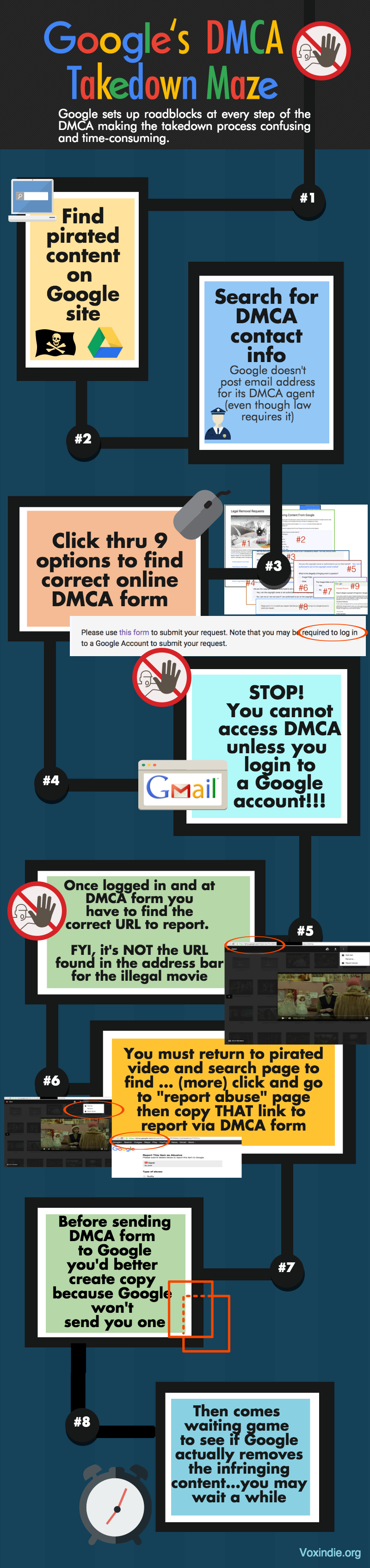
I’ve written about Google’s laborious and time-consuming DMCA takedown maze, a process that forces creators to find, then fill out cumbersome online forms. I’ve also written about the fact that Google makes it difficult, if not impossible, to find the email address for its DMCA Agent–in apparent violation of the law’s requirements.
Even when you do find the correct email address for Google’s DMCA agent (via the U.S. Copyright Office), the Google team’s correspondence makes it clear that you will be penalized for taking this legal, more efficient approach. Sending a DMCA takedown request via email is far less burdensome for a couple significant reasons:
- Sending a DMCA via email is fast and easy in contrast to Google’s online form
- You have a copy of the DMCA notice you send, making record-keeping and follow-up much easier
Of course, if you do send a DMCA takedown notice to Google via email it seems to really annoy the Google “team.” Take a look at the email responses to a DMCA notice I recently sent via email. Note that the DMCA template I used was crafted by my attorney.

In response to this perfectly legal and accurate DMCA notice, I received this email asking me to be sure that my original notice complied with the law. I was forced to send a second email confirming that yes, I do know what the heck I am doing when I send a DMCA takedown notice.

Google makes you send a second email
Ok, after all this, Google still isn’t happy. Yes, they eventually end up complying with the law and sending me confirmation that they are acting on my takedown request…but, but….next time, you’d better do it the Google-way using their online takedown maze.

 No thank you. I prefer to send my DMCA notices in a way that benefits ME, not Google. It’s not my fault that Google’s business model is such that attracts a tsunami of takedowns every day.
The fact is that Google has the technology to process DMCA notices via email just as easily those sent via its web form(s). While submitting DMCA requests via an online form may be helpful for those individuals who aren’t familiar with the process–or creators who send them infrequently–Google’s convoluted online takedown process serves simply as a time- sucking deterrent.
Maybe if I sent the DMCA via a GMAIL account they’d be more receptive? 😉

by Ellen Seidler | Copyright, Film, Google, Law
YouTube will pay copyright court costs for a few users–not because it’s right–but to protect Google’s bottom line
According to a story in the NY Times, the folks at YouTube are ready to pony up cash to support some of its users “fair use” claims in court.
YouTube said on Thursday that it would pick up the legal costs of a handful of video creators that the company thinks are the targets of unfair takedown demands. It said the creators it chose legally use third-party content under “fair use” provisions carved out for commentary, criticism, news and parody.
You’ve probably read a lot about “fair use” lately. It’s the Google-funded (EFF) Electronic Frontier Foundation’s mantra and if the folks there had their way, pretty much everything and anything would be considered “fair use.” Fair use an important legal doctrine and when applied properly (criticism, comment, news reporting, teaching, scholarship, or research) is not an infringement of copyright. However, these days, too often it’s used as a disingenuous defense for copyright theft.
The tech-funded campaign to turn villains into victims
When a court recently ruled that a snippet of a Prince song playing in the background of a YouTube video in the notorious Dancing Baby case was indeed “fair use,”it gave a boost to efforts to use fair use as a cudgel against rights holders who legitimately assert their rights using the DMCA takedown process.
Note that the actual video at the center of this case was reposted after the uploader sent a counter-notice. The only reason the case ended up in court was because the uploader, Stephanie Lenz, filed suit and the only reason she did so was because she was bankrolled by the EFF. The EFF saw it as an opportunity to advance its Google-funded agenda. As Terry Hart noted in 2010 on his Copyhype blog:
Luckily, our society has survived the brief time when Lenz’s video was not available to the world. But does this episode only highlight the DMCA’s sword of Damocles hanging over free speech and creativity? Or is it just another example of the cries of internet freedom fighters that the sky is falling as content industries adapt to technological changes? I think it’s the latter: despite the elevation of this dancing baby video to a cause célèbre, our freedom to speak is not threatened, and any “burden” the DMCA places on users uploading content is almost illusory.
With this YouTube gambit–which Jonathan Bailey breaks down in a blog post on Plagiarism Today–one can imagine that EFF is chomping at the bit to find yet another test case to take to court in an effort to expand the definition of fair use beyond those prescribed by current copyright law.
At last weeks House Judiciary committee copyright roundtable in Santa Clara the term “fair use” was bandied about repeatedly. At some point a panelist complained that bogus DMCAs made up more than half the takedowns sent. NOT TRUE!
Legit DMCA takedowns on Google outnumber false ones by a huge margin–97% to 3%.
The EFF and their compatriots routinely like to assert that every day, everywhere, poor innocent uploaders are being damaged by DMCA takedowns on YouTube and elsewhere. Give me a break. The fact is that creators victimized by piracy, forced into the time-consuming process of sending DMCA notices to protect their work, FAR outnumber users victimized by erroneous DMCA takedowns. According to the most recent numbers I could find (via Google’s transparency report) the company “removed 97% of search results specified in requests that we received between July and December 2011.”
I have to give the EFF and its well-paid attorneys credit though. They have successfully made the victims into villains through an ongoing campaign of carefully crafted rhetoric. Never mind the actual truth–that for every “bogus” and “absurd” takedown sent there are thousands that are legit. Sadly it’s a fact that gets lost on most of the public and very likely some of the politicians considering copyright reform that were sitting in that room.
Hey YouTube! What about covering legal costs of creators who receive bogus counter-notices?
Yes Virginia, not every counter-notice in response to a DMCA takedown sent is legitimate. It’s a fact that creators who send a legitimate DMCA notice, to remove full copies of a film from YouTube for example (no debate about fair use here) have received a counter-notice from the uploader.
I wrote about this specific scenario in a blog post “How DMCA Abuse Hurts Creators” in 2013. In this case the uploader had zero right to upload the film, but because she sent a counter-notice, YouTube put the full copy of the film back online.

This film was reposted (in its entirety) to YouTube after the uploader sent a counter-notice. The filmmakers’ only recourse is to go to court. Will YouTube cover those costs?
What now? The only recourse the user has is to go to court. Is YouTube willing to cover those court costs? Will YouTube step up to protect rights holders whose work is ripped off on their site? The answer is a simple, NO.
YouTube’s move is not about doing what’s right, or protecting legal rights. It’s about protecting Google’s bottom line. YouTube depends on fresh content to drive traffic to its site. From a business perspective, it makes total sense to streamline that path from any speed bumps along the way, including those pesky copyright claims.

DMCA does not work well for creators trying to protect their work from online theft
The DMCA is broken, but not in the way the EFF would have you think. It’s broken because it does a lousy job protecting the work of filmmakers, musicians, photographers, and authors.
Over these past few years I’ve written plenty on the subject so if you’re so inclined, you can a sampling of some of my other posts that explore why the DMCA needs fixing:
Dancing around DMCA Takedowns on YouTube
Using DMCA to fight Ashley Madison hackers is poor use of copyright law
Google lives on tech’s cutting edge–but in DMCA takedown Luddite-land
Why does Google play a DMCA piracy shell game?
Does Chilling Effects make a mockery of the DMCA?
Etsy uses DMCA “safe harbor” to protect photography pirates
Google and the Art of the DMCA Dawdle
Google’s Blogger DMCA takedown procedures a hot mess
Everyone hates the DMCA
Is this really what Congress had in mind when it created the DMCA?
How DMCA Abuse Hurts Content Creators
Hollywood and Silicon Valley talk distribution, DMCA, and more during panel on piracy
The RIAA Explains Why DMCA doesn’t work
Nickel and Dimed to Death? Pirates Profit off DMCA Requests
Anti-copyright Astroturf gangs, fertilized with tech cash, suddenly sprout
Google’s downranking of pirate sites is a big, fat, LIE
Google’s 100 Million Takedowns-A Mess of its Own Making
Chilling Effects (still) makes searching for pirate links easy
Pirate Bay shut down-Is it a sign of progress against piracy’s “free for me” mantra?
Piracy for profit-YouTube’s dirty secret
Electronic Frontier Foundation (EFF) uses copyright law as censorship canard again
Google’s demotion of pirate search results earns a FAIL so far
Should we trust Google’s piracy report? Probably not….
Google gets called out (again) for its laissez faire attitude on piracy
Google’s “We fight piracy” Gobbledygook
Raise your hand if you’re tired of EFF tech-funded talking points
Google’s piracy profit machine continues unchecked
Busting Piracy on Google’s Blogger Barnacle Sites
Free Speech According to Google? Blackmailing Indie Music Labels Over YouTube Streaming?
Piracy’s Potpourri of Profit and Prevarication
Record Share Price Aside, Google Still has a Piracy Problem
Search Engines = G.P.S. for Online Piracy
How Google (Doesn’t) Fight Piracy
LGBT Cinema, Diverse Voices Quieted by Piracy’s Punch?
Google and friends spin search piracy study
YouTube’s Paid Channels are Here and a Counterfeit Cleanup is Past Due

by Ellen Seidler | Copyright, Film, Google, Law, Piracy, Politics
 Google continues to dodge responsibility for its role in promoting online piracy
This past week members of the House Judiciary Committee traveled to California to hold a pair of roundtable discussions on the future of copyright. On Monday committee members were in Santa Clara, the heart of Silicon Valley, and on Tuesday traveled to Los Angeles to hear from a variety of stakeholders discussing everything from overhauling an out-dated U.S. Copyright Office to DMCA circumvention for tractor repairs.
As a participant in the Santa Clara event I offered up my observations on updating the copyright office and the need for a copyright small claims process.
Though I wasn’t at the LA event, I read with great interest a report in Variety by Ted Johnson that documented an exchange between Google’s legal director for copyright, Fred von Lohmann and Richard Gladstein, founder of Film Colony:
“Why couldn’t we find a way, in all of your wonderful genius, to prevent being directed to illegal activity,” Gladstein said…
“We are not in a position to decide what is legal and what is illegal online,” Von Lohmann responded.
Then Gladstein asked, “Is it legal or illegal to download a movie that you don’t own?”
Von Lohmann answered, “I agree. Downloading a movie, in order to watch it without paying for it, is infringing. That is not the problem. The problem is when you have over a trillion websites, you have hundreds of thousands of film titles, millions of song titles, not just in English but every language around the world … as a search engine there is no magic way for us to know in advance what is legal and what is illegal online. We rely on copyright owners to inform us.”
[Von Lohmann] noted that Google has been demoting sites based on the number of takedown notices they receive from copyright owners. He also said that such sites don’t pop up when users simply put in the name of the film title without the word “watch” before it. [emphasis added] —Variety
 Von Lohmann’s posturing on Google’s piracy problem is nothing new, but it is worth pointing out how his statements are carefully crafted to dovetail with Google’s own (vague) propagandistic promises.
In 2014 Google announced that it had updated its “How Google Fights Piracy” report (first published in 2012). In it, Google once again gave lip service to its down ranking (not removal) of pirate sites in its search results:
Google also factors in the number of valid copyright removal notices we receive for any given site as one signal among the hundreds that we take into account when ranking search results. Consequently, sites with high numbers of removal notices may appear lower in search results. This ranking change helps users find legitimate, quality sources of content more easily.
Note that in its glossy report Google didn’t mention exactly what types of search terminology would trigger a down ranking of results. Apparently, if we are to believe Mr. von Lohmann, we should only expect pirate link demotions to take place when searching using the movie’s title only, not when using terms like “watch” and “download” in the hunt for pirated copies?
I did my own quick research today using a recently released indie film The Overnight. When I searched using the title only, Google does offer up a page full of legit links.

However, when I add the term “watch” to the mix and search for “watch the overnight” take a gander at what results lead the pack….The top result led directly to a notorious pirate site and 6 out of 10 gave me links to pirated versions of the film.
I checked Google’s transparency report to see how many times this particular domain had been reported for infringement. Note, the Solar Movie’s domain suffix has changed multiple times over the years. It’s latest incarnation, solarmovie.ac, seems to have come online only last month. Already its been reported for copyright infringement more than 600 times.
Why won’t Google down rank sites found in actual searches for pirated content?
I’d like to ask Mr. von Lohmann why Google can’t seem to manage down ranking pirate sites for ALL its search results–not just results found when using the film’s title. After all, folks looking for pirated movies aren’t idiots….adding the term “watch” or “free download” to a search is standard operating procedure if one is seeking pirated copies. It makes no sense for Google to ignore these search terms if it’s truly serious about how it “fights” piracy.
Sure, total searches for legit links may far outweigh overall searches for pirated ones, but in the end what we’re talking about when we are discussing “fighting piracy” are search terms like “watch” and “download free.” Look what shows up at the bottom of the results for “watch The Overnight”search… Google continues to offer handy suggestions for other search terms users could use to find more (pirate) links.

Google pretends to be working on its piracy problem, but when you drill down it’s clear that the tech giant is doing everything it can to avoid taking action or responsibility. I hope those House members who sat and listened to Mr. von Lohmann will not take him at his word, but instead, examine actual facts.
Google still has a very long way to go when it comes to fighting piracy.


 The reports also notes that it has focused on providing, “Clean results for media-related queries users actually type: Thanks to the efforts of Google’s engineers, the vast majority of media-related queries that users submit every day return results that include only legitimate sites.”