by Ellen Seidler | Ad Sponsored Piracy, Copyright, Film, Piracy

Yes Charles, online piracy does pose a threat to the health of independent film
Charles Judson, a self-described “Writer, Film Critic/Consultant,” raised some eyebrows–mine included–with a piece published this week on cinematlmagazine.com which featured the headline, ” Is Piracy a Danger to Independent Film? Part 1: The Search-In Which I Can’t Find Much of Anything” It’s a (sort-of) rebuttal to the recent post on indiewire.com “Here’s How Piracy Hurts Indie Film,” co-authored by Creative Future’s Executive Director Ruth Vitale and Tim League Founder/CEO of Alamo Drafthouse Cinema in which they examined how online piracy undermines independent filmmakers:
The fact is: pirate sites don’t discriminate based on a movie’s budget. As long as they can generate revenue from advertising and credit card payments—while giving away your stolen content for free—pirate site operators have little reason to care if a film starts with an investment of $10,000 or $200 million. Whether you’re employed by a major studio or a do-it-yourself creator, if you’re involved in the making of TV or film, it’s safe to assume that piracy takes a big cut out of your business.
In his piece Mr. Judson appears to be skeptical of their assertions and goes to great lengths to prove them wrong. He recounts conducting his own (unscientific) online research to determine the extent to which independent films are pirated online. His first mistake was limiting his searches for listings on Kickass Torrents:
Let’s start with something easy to test that first claim, we’ll do that by using Kickass Torrents to search for films that screened at Sundance this year. We’ll use the films from the U.S. Documentary (16), U.S. Dramatic (16), and Premiere (19) sections. With 51 films listed and this being six months after their initial screenings, it should give us a strong picture.
His findings lead him to draw this questionable conclusion with a caveat: “So far though, it doesn’t appear that pirates have much interest in indie films. Not to the extent they do mainstream releases.” 
Mr. Judson also asks, “ If piracy is a threat, why is [it] so hard to find films that have been screening and available in various forms since January?”
The answer to Judson’s query is simple: he’s looking in the wrong place.
Aside from the fact Judson’s focus on Sundance-screened films is myopic (a selection that fails to reflect a true cross-section of American independent film) his use of KickAss Torrents as a bellwether for online piracy is simply naive. Though torrents garner much attention, it’s a big mistake to view this type of pirated download as the only game in town. 
In fact, for many niche indie films the threat of piracy comes not from torrents, but from cyber-locker (and even Google-hosted) pirated movie downloads and streams that provide a viewing experience akin to Netflix. On this blog I’ve documented numerous examples of online pirates who ply their wares by providing consumers with convenient (and free) movie watching experiences.
Why use Wolfeondemand.com when you can find your favorite LGBT films on a Blogger-hosted pirate site that offers hundreds of titles for free?
As a matter of fact I searched for a few of the titles on Judson’s list (those he found torrents for, and some he did not) and easily found dozens of non-torrent links to pirate streams and downloads. A few links had already reported for “copyright infringement.”

Streams and download links to indie films are easy to find if you know where to look
In those cases, the filmmakers or their distributors were obviously working to protect their productions. But links for other movies on his list (see graphic above) were still active and ripe for download or streaming. While I don’t claim my results are scientific, they do lend credence to the fact hat today’s piracy has moved beyond torrents.

Finding Cyberlocker downloads for films Judson found no torrents for was easy
Mr. Judson’s conclusions about piracy’s (non) impact based on searching for torrents is not only questionable, but also relies on fuzzy math.
It’s a given that indie films aren’t pirated to the same extent that major Hollywood releases are, but so what? That’s really beside the point isn’t it? The financial hit piracy can have on an indie film made on a shoe-string budget can be just as great, percentage-wise, as piracy on a blockbuster film like Expendables 3.
Indie filmmakers don’t generally have deep pockets and have often begged from others and borrowed from themselves in order to make their films. Every penny earned on the backend counts. Just this week filmmaker Zach Forsman wrote a piece for FilmSchoolRejects.com where he recounted his experience with online piracy and the damage it caused:
Six weeks after Down and Dangerous was released domestically on iTunes and VOD, our distributor estimated that it had sold 10,000 streams and downloads, topping out at number 13 on the iTunes Thrillers Chart. Not too shabby. By that time, torrents of the movie had been downloaded at least as many times. Now it would be ridiculous to count all 10,000 downloaded torrents as lost revenue. But if only 10% of those could have been converted to legit sales, that’s another $7,000 we could have grossed. Not a massive amount of money, but to an outfit that crowd funded a $38,000 budget to make the sucker, it’s significant.

The piracy of “Raid 2” is not limited to torrents
Judson tries to split hairs a bit acknowledging that , “Having someone pick your pockets to the point you are losing money isn’t a good. It’s a path that will make funding that next feature, and making a living while developing that feature, impossible.” Yet, based on his research, he appears to be skeptical that online piracy is damaging to indie filmmakers:
Shouldn’t it be a concern that every minute a filmmaker spends policing piracy, is a minute they aren’t promoting their film to the audience that will pay for their film? If piracy is a threat, why is so hard to find films that have been screening and available in various forms since January?
…If indie filmmakers are going to be recruited to join a battle against illegal downloads, if doing this “better serves audiences and artists,” we better be damn sure it’s time well spent.
Of course an indie filmmaker’s time would be better spent making new films, BUT if your work is being ripped off right and left by online pirate profiteers, the sad truth is that it does impact the bottom line. Views lost to piracy can be the difference between paying off production debts or not. Those losses can mean the difference between making another movie or finding a day job.
I’d suggest that the skeptical Mr. Judson take a look at the video embedded below to learn just how pervasive online piracy is, even for small indie films (btw, none of the pirate links mentioned in the video are torrents). Frankly, it doesn’t take a rocket scientist to figure out that piracy takes a toll on filmmakers both large and small.
Follow the Money: Who Profits from Piracy?

by Ellen Seidler | Copyright, Film, Piracy

The movie Lyle is being streamed online for free
This week I’ve come across two pieces written by indie filmmakers that discuss distribution options in the age online piracy. While it’s good to see the issue being addressed, the dichotomy between the two reveals that differences remain developing distribution models in an age where revenue streams are undermined by online profiteers.
The first piece published on filmmakermagazine.com by Stewart Thorndike and Alex Scharfman, “Why We Are Giving Our Feature Away for Free at LYLEmovie.com,” presents the filmmakers’ plan to give the movie away for “free” in order to engender good will and drive donations for their next project in a planned horror trilogy:
We wanted to stick with the idea that got us to Lyle: the desire to control our film’s destiny and not wait for permission.
It is in that spirit that we’re giving Lyle away for free at LYLEmovie.com. Sure, we could send the film out on the festival circuit and hope for a more traditional distribution offer, but that would take months or even years.
While the goal to “control the destiny” of one’s film is a laudable one, it’s also not one that will work for every indie film.
In this case, the filmmakers see giving their film away as smart marketing explaining, “By giving Lyle away, we’re inviting that audience to come find us and help us make more movies for them.” It’s a laudable plan and I wish them well in their efforts. After all, how one distributes one’s film should be a matter of personal choice. However, in explaining their approach they seem to view the digital world through slightly rose colored glasses:
The music industry, whose models seem to be a few years ahead of film, has already seen artists like Radiohead make their work available in exchange for whatever a fan wants to give. In the comedy world, Louis CK had enormous success when offering a pay-what-you-want (with a $5 minimum) deal on his standup special in 2011. In our case, we’re inviting Lyle’s viewers to donate what they want to our next film, Putney. Through this model, we hope to disrupt the traditional financing and distribution paradigms by tying the distribution of one project to the financing of another, democratizing both to create an audience and a brand on which we will build with Putney.
To point to the pay-what-you-like (one-time) distribution efforts used by Radiohead and Louis CK as a workable model for distributing small indie films, while sincere, seems a tad simplistic. After all, even Radiohead referred to the stunt as a “one off.”
Many music fans had hoped that the band’s now famous pay-what-you-want promotion was an attempt by the group to discover a new way to sell music. Now it appears Radiohead at best was after publicity.
While giving their film away for free to finance a second low-budget film might be the right choice for them, it certainly won’t “disrupt the traditional financing and distribution paradigms.” Those paradigms have already been radically disrupted by online piracy and, despite good intentions, not every feature film can be made via crowd-funded micro-budgets.
The latter point is one that filmmaker Zak Forsman raises in “I Made a Movie Worth Stealing: My Experience with Piracy,” posted this week on filmschoolrejects.com. Forsman recounted his experience with online piracy following the release of his feature, Down and Dangerous:
The movie has been uploaded in its entirety to YouTube about a dozen times now. Most recently, I issued a takedown for a Vietnamese-subtitled version.
As I filed that first copyright violation and takedown request, I wondered, “Is this going to be part of making movies now? Chasing down pirated copies and jumping through hoops to get them removed?”
Forsman notes there may be a difference between micro-budget productions and indie films with bigger budgets:
…if I were releasing the movie myself, directly to fans, I’d be happy to see people steal it and share it. Truly. Working in microbudgets affords me the opportunity to be a bit of a gambler when it comes to raising a movie’s profile. But in this case, I had a responsibility to protect the movie’s potential sales on behalf of our distributors.
Forsman also attempts to quantify the actual toll piracy took on his film’s revenue making a conservative estimate that if 10% of 10,000 illegal downloads were converted into legit sales it would add an additional $7,000 to their gross. As he points out, it’s not an insignificant figure for a film that cost $38,000. Having experienced the reality of online piracy firsthand, he also outlines steps filmmakers can take to prepare.
In contrast, the Lyle filmmakers have made the choice to attempt to sidestep piracy entirely by giving the film away. As writer/director Thorndike noted in an interview with tribecafilm.com, ” Instead of paying to see the movie, you pay, if you liked the movie, to see the next movie get made.” It will be interesting to see how this approach plays out, but given the fact that online pirates don’t give a darn where they steal films from, the movie will most likely still be pirated. Within days the (free) streamed film will be stolen from the filmmaker’s own website and pirated elsewhere, reducing visitors to their own Kickstarter campaign. Meanwhile, per usual, online pirates will be generating income off the stolen movie via their own sites.
Given the low amount of funding sought ($35,000), in this instance the piracy is unlikely to prevent a successful fundraising campaign, but moving forward, will these filmmakers want to limit themselves to only produce micro-budget films? At some point those who work on these films will want to make a living doing so. Does this approach really sustain a robust indie filmmaking culture? Is this really the “paradigm” filmmakers want for their future?
In any case it’s good to see indie filmmakers acknowledge online piracy’s impact on distribution and engage in discussions about ways to dull the damage. Here’s hoping we can learn from their experiences and see more films from them in the future.

by Ellen Seidler | Ad Sponsored Piracy, Copyright, Film, Google
 Watch Disney’s hit Frozen online for free, thanks to Google
Google says it’s trying…really…to get tough with online piracy, but actual evidence continues to tell a different story.
When is enough really enough? When will Google really do something to stop the flow of tainted money into its coffers? Why does the Silicon Valley behemoth still get a free pass when it comes to profiting off content theft? Why is OK that the company not only profits from piracy, but, in order to ensure the continued flow of money, actually PROVIDES online pirates with (free) infrastructure from which to operate their illegal businesses?
How is Google’s business model–by any measure–OK? When will authorities step in to strip Google of its “safe harbor” protections? Isn’t there ample evidence that, despite the lip-service and lobbying to the contrary, the company grows fat by stealing from the hard work of others? I suppose the current trend of inertia and avoidance will likely continue as politicians in Washington will be too busy playing games at Google’s new DC lobbying offices to actually take overdue action against the greedy Goliath.
Google dares to applaud its efforts in the fight against piracy boasting, “Google is a leader in rooting out and ejecting rogue sites from our advertising and payment services, and is raising standards across the industry.” Makes for a good talking point, but should score a big time four Pinocchio #FAIL.
If Google’s efforts against piracy constitute “leadership” then we really are in trouble. Google’s “leadership” on this issue is a charade, and actually should be characterized as this  . If Google really wanted to raise standards across the industry it wouldn’t be difficult. If it can spend millions to build a shiny new lobbying center in Washington and spend millions more to wine and dine politicians, it can certainly spend a few bucks to hire more staff to review and remove Blogger sites engaged in online piracy and vet AdSense account holder’s regularly to make sure they are meeting “terms of service.” It could also easily provide advertisers with real data as to which sites displayed their advertising so these companies could be held accountable and provide a further line of defense against piracy profiteers.
For now, in case you need any reminder about just what a lousy job Google’s doing “raising standards across the industry” here’s just one more example of a Google-hosted Blogger website I came across today that features Google advertising alongside stolen movies. Google makes money. The advertisers gain customers. The creators get ZERO. It’s absurd.


by Ellen Seidler | Film, Piracy, TV
 LGBT pirate blogs that claim to love the films and shows that reflect their lives, yet undermine creators ability to make more
It’s bad enough seeing indie LGBT films pirated via torrent sites like Pirate Bay and cyberlockers like Mega, but it’s particularly galling to see supposed fans of LGBT films operating websites that think nothing of undermining filmmakers from their own community. Time after time fans of LGBT films ask why more films reflecting their lives aren’t made, yet many of those same fans think nothing of pirating the LGBT films that are made effectively cannibalizing their own filmmakers.
LGBT films are usually made outside the Hollywood system and depend entirely on grassroots funding efforts to cover production costs. When these films are pirated, recouping expenses is made more difficult and threatens the filmmaker’s ability to create more films.
Much is made about the democratization of filmmaking through increasingly affordable technology. Yet no matter whether a film is shot on 35 mm or digital, it still costs money to create. Money–to pay for cast and crew, equipment and permits, insurance and meals–does not fall from the heavens. There’s also the cost of pre-production: planning, script development and completion, casting, location scouting, scheduling, hiring a crew, etc. After the film is shot, taking weeks or months, there are post-production costs to consider. These include editing, sound-mixing, music, special FX, color-correction and mastering. This entire process takes time and money. People who create indie films aren’t in it to get rich. They are driven by a passion to create and give voice to untold stories but it doesn’t come free. There are debts to be paid.
Unfortunately, this disconnect between those who create and those who consume threatens to gradually the diversity of voices (and choices) available. Fans may not miss what’s not made until it’s too late…As they say, actions speak louder than words. You can’t claim to support LGBT indie film yet download or stream illegal copies of those same films. However, as I surf the web and explore the many blogs dedicated to LGBT film, too often I find this hypocrisy in full bloom
The blog “Popcorn ‘N Tits” is part of the PNT Tv Network, “a femqueer entertainment website where you can find webseries, movies, music and literary articles that reflect our lives.” It’s beyond ironic, and rather sad that operators choose to exploit the very content they claim to love. Ironically one of their partner blogs features this plea,
This blog is dedicated to support the art of filmmaking. You love watching our movies, shorts, and web-series but filmmakers need money to make that happen. You can do this by donating to these projects, no matter how small the sum.
So true, yet this same blog network apparently doesn’t see the disconnect when it includes a site that apparently pirates movies and tv shows at will (see graphics below). Note this is only one example of many I’ve found during my web wanderings.


by Ellen Seidler | Copyright, Film, Law, Piracy, Tech
 Finally, after weeks–actually months–of repeatedly reporting (and waiting) the pirate movie website videolez.blogspot.com, a site featuring more than 100 pirated movies streamed via Google Drive-hosted embeds of stolen movies), finally bit the dust.
 Why after all this time and repeated violations did Google finally remove this site?
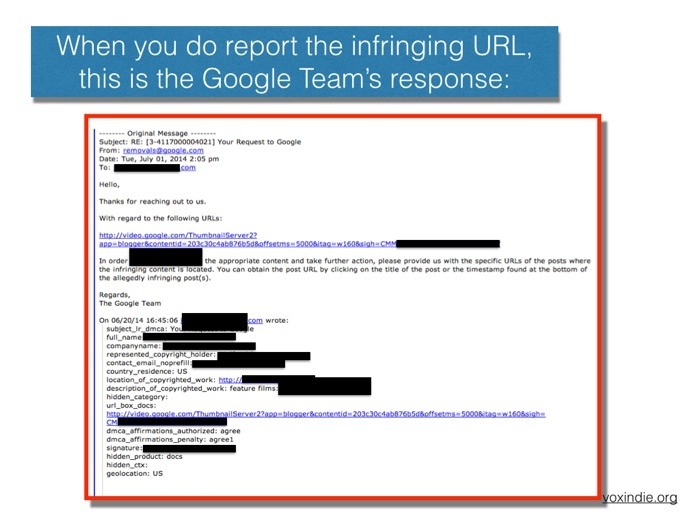
I think what finally turned a lightbulb on in the Google Team’s HQ was my response to a lame email they sent me as follow up to DMCA notices I’d issued (on behalf of myself and film distributors/producers I do anti-piracy work for). This is the email the Google Team sent to me in response to one (of many) DMCA notices sent via their online form:
Hello,
Thanks for reaching out to us.
You can obtain the post URL by clicking on the title of the post or the timestamp found at the bottom of the allegedly infringing post(s).
Regards,
The Google Team
The reason the Google Team’s email was ridiculous was because it was WRONG. It’s painfully clear that those employed by Google to respond to DMCA notices don’t truly understand their own products and just how pirates use them. This was my response:
Hello,
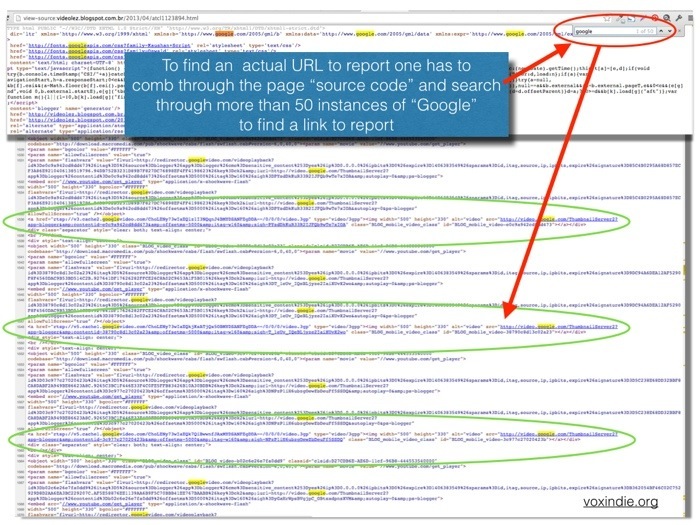
Actually we cannot determine the URL by clicking as you suggest….this requires going into the actual source code for an embedded stream.
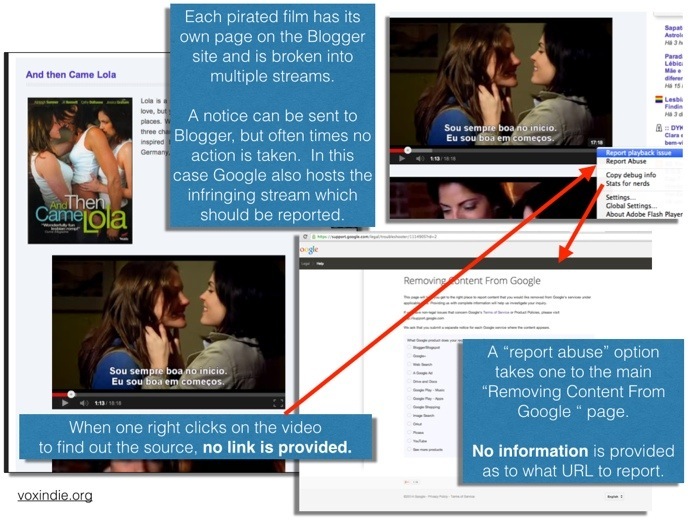
I’ve attached a PDF highlighting the issue with one of the films we reported. The URLS are not easily available. Right click on the video embed and get “report abuse” and you are taken to Google web takedown form with NO information about the offending URL.
PS-There are many more pages…in fact this entire blog is dedicated to pirating indie films and Google does zilch!
Here’s the
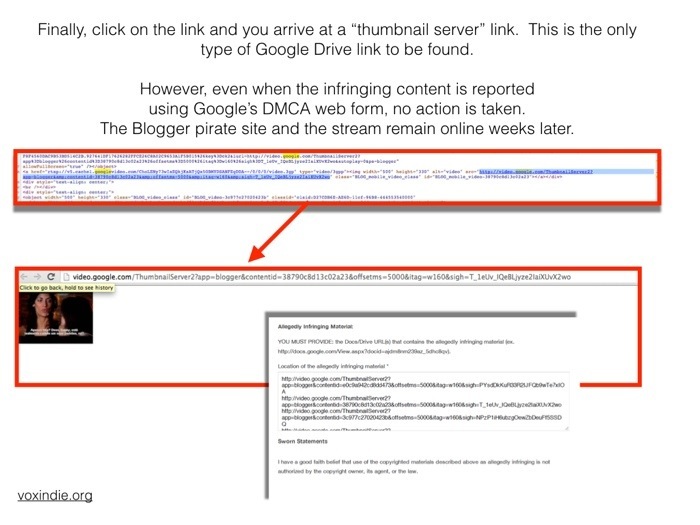
PDF I attached with my email sent to the Team in an effort to explain just what was going on with this particular Blospot.com pirate. Below are the graphics included in the PDF. They demonstrates, step-by-step, how Google could (and should) better understand its own products and respond appropriately upon receipt of DMCA notices rather than send out erroneous emails asking for more information; information that’s actually neither available nor relevant.


Unfortunately, this small victory is but a blip in the sea of Google-sponsored pirate sites. Moments after I discovered the VideoLez site had been removed, I checked another, similar pirate site that I’ve also reported multiple times. It remains alive and well. The countdown clock can be seen here.

I’ve asked it before, but I’ll ask it again. Why can’t Google clean up its act? Does it really deserve protection from liability under the DMCA “safe harbor” provision if it routinely fails to remove content and sites, despite repeated (and clear) requests? Title 17 › Chapter 5 › § 512 states outlines one aspect of Safe Harbor as follows:
(c) Information Residing on Systems or Networks At Direction of Users.—
(1) In general.— A service provider shall not be liable for monetary relief, or, except as provided in subsection (j), for injunctive or other equitable relief, for infringement of copyright by reason of the storage at the direction of a user of material that resides on a system or network controlled or operated by or for the service provider, if the service provider—
(A)
(i) does not have actual knowledge that the material or an activity using the material on the system or network is infringing;
(ii) in the absence of such actual knowledge, is not aware of facts or circumstances from which infringing activity is apparent; or
(iii) upon obtaining such knowledge or awareness, acts expeditiously to remove, or disable access to, the material;
(B) does not receive a financial benefit directly attributable to the infringing activity, in a case in which the service provider has the right and ability to control such activity; and
(C) upon notification of claimed infringement as described in paragraph (3), responds expeditiously to remove, or disable access to, the material that is claimed to be infringing or to be the subject of infringing activity. [underline added]
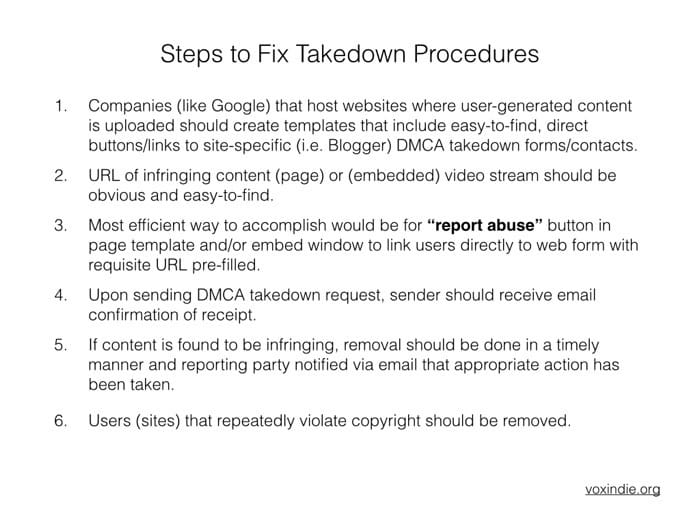
6 Easy Steps the Google Team could take to fix their DMCA takedown process
To allow Google’s web crawlers to find read my list of suggestions 😉 here it is again in text form:
-
Companies (like Google) that host websites where user-generated content is uploaded should create templates that include easy-to-find, direct buttons/links to site-specific (i.e. Blogger) DMCA takedown forms/contacts.
-
URL of infringing content (page) or (embedded) video stream should be obvious and easy-to-find.
-
Most efficient way to accomplish would be for “report abuse” button in page template and/or embed window to link users directly to web form with requisite URL pre-filled.
-
If content is found to be infringing, removal should be done in a timely manner and reporting party notified via email that appropriate action has been taken.
-
If content is found to be infringing, removal should be done in a timely manner and reporting party notified via email that appropriate action has been taken.
-
Users (sites) that repeatedly violate copyright should be removed.
Next “expeditious” move is Google’s…I’ll be waiting.

by Ellen Seidler | Ad Sponsored Piracy, Copyright, Film, Piracy, Tech
 Google comes in a close second to word-of-mouth in path to piracy poll
A while back one of the world’s most popular pirate websites, LetMeWatchThis went through tumultuous times as its domain name was hijacked and cloned by other not-so-nice pirates. According to torrentfreak.com the hijacking, and general confusion led to the domain switching to an entirely new domain, primewire.ag:
One of the largest unauthorized streaming movie websites on the Internet is at the center of what is probably the most confusing mess ever to hit the sector. Various hackings, hijackings, domain changes and nefarious happenings have turned 1Channel, LetMeWatchThis, PrimeWire.ag and Vodly.to into a maze of smoke and mirrors through which no regular user has a hope of navigating.
While it’s not clear if the dust as settled, what is clear is that someone operating the domain name primewire.ag is running a website full of illegal links to thousands of stolen movies. The pirate site, as mentioned in my earlier post today, makes money via advertising (mostly major American brands) but as I was researching the site for my post, I noticed another feature worth highlighting. In its sidebar, the website has posted a poll asking this question: How did you find us through our new name?
According to the results users turned, in large numbers, to that tried and true source for pirated content worldwide, Google search. Nearly 200,000 (29.88 %) users chose Google as their path to the site, second only to word of mouth which took top honors at 43%. While the poll is not scientific, it does provide more anecdotal evidence to what most believe to be true, Google is a major sign post on the path to online piracy. Even when pirate sites run into trouble with other pirates hacking and stealing their domains (ironic isn’t it), leave it to Google to come to the rescue.