by Ellen Seidler | Copyright
“Oh what a tangled web we weave, when first we practice to deceive.”
— Sir Walter Scott
 Surprise, surprise–Google announced today that its profits “surged” this quarter thanks to an increase in online advertising revenue. A company press release heralded the report:
We ended 2012 with a strong quarter,” said Larry Page, CEO of Google. “Revenues were up 36% year-on-year, and 8% quarter-on-quarter. And we hit $50 billion in revenues for the first time last year – not a bad achievement in just a decade and a half. In today’s multi-screen world we face tremendous opportunities as a technology company focused on user benefit. It’s an incredibly exciting time to be at Google.”
The company’s stock price jumped nearly 5% on the news. So, while Google executives and its shareholders are happy, one has to ask–how much of that “revenue” continues to come from not-so-ethical sources? I hate to sound like a broken record, but until Google gets its act together, I will continue to point out its duplicity with regard to online piracy and its ad revenue.
In the wake of this bullish news from Google I thought I’d point out a recent case study that demonstrates the myriad of ways Google supports (and profits from) piracy. This particular pirate movie website (shown below) is hosted on Google’s free “Blogger” platform. As with most other posts on the site, this one (published 1-18-13) features an embedded movie (a complete version of the indie film David’s Birthday) hosted via Google’s YouTube. The advertising above, and to the right of the embedded film, is served up by Google’s AdSense. Oh, and I found this site using Google’s search engine.

This Google-hosted blog features pirated films hosted on YouTube as well as AdSense advertising.
What makes this situation particularly troubling is that this blog had already been reported to Google (via their DMCA system) in December of 2012.

After receiving a takedown notice from Google the site’s owner posted a response, saying that he was considering closing it.

Blogger site owner received this notice from Google. Despite the warning and repeated violations of Blogger “Terms of Use” the site remains online.
He apparently had a change of heart, and within a few days, resumed posting (infringing) content on his site –including (ironically) the aforementioned “David’s Birthday” despite its having been cited in the December DMCA notice. This time, instead of posting infringing download links, he’s chosen to embed movies streamed via YouTube, each coupled with AdSense ads.

So, despite having been reported for multiple infringing links, the site remains up and running. In the meantime, Google appears to be in no hurry to take it offline. Don’t they have an obligation to remove the site? The language in Blogger’s Terms of Service outlining their “content policy” is conveniently vague. When a site violates its policy Google promises to take action “based on the severity of the violation” but it’s not really clear what criteria is used to measure the “severity” of a reported violation.

Blogger’s terms of service
As for the AdSense, its “Terms of Service” seem pretty straightforward. Well, sort of…
Prohibited Uses. You shall not, and shall not authorize or encourage any third party to…
(v) display any Ad(s), Link(s), or Referral Button(s) on any Web page or any Web site that contains any pornographic, hate-related, violent, or illegal content;
6. Termination; Cancellation…Google may investigate any activity that may violate this Agreement. Google may at any time, in its sole discretion, terminate all or part of the Program, terminate this Agreement, or suspend or terminate the participation of any Property in all or part of the Program for any reason.
Since Google seems to have “investigated” this website in response to multiple DMCA notices, why is this AdSense account allowed to remain active? Does the aggrieved party have to file a DMCA with Blogger and with AdSense over and over again? It’s hard to imagine that Google’s copyright “team” isn’t aware these violations. Does Google not have the money to hire staff to follow-up on reported sites to enforce compliance? Is Google complying with U.S. law? What is meant by the caveat “its [Google’s] sole discretion?”
Does looking at the actual law clarify matters? According to Title 17 of U.S. Copyright Law, “conditions for eligibility” for “limitations on liability” include:
(i) Conditions for Eligibility.—
(1) Accommodation of technology. — The limitations on liability established by this section shall apply to a service provider only if the service provider —
(A) has adopted and reasonably implemented, and informs subscribers and account holders of the service provider’s system or network of, a policy that provides for the termination in appropriate circumstances of subscribers and account holders of the service provider’s system or network who are repeat infringers; (emphasis added)
How exactly does Google define a “repeat infringer?” They apparently don’t.
In a post published in September of 2011 on its own Public Policy Blog entitled “Making Copyright Work Better Online-A Progress Report,” Google gave itself a pat on the back, asserting that the company had made great strides in discouraging ad-sponsored piracy.
Improving our AdSense anti-piracy review. We have always prohibited the use of our AdSense program on web pages that provide infringing materials, and we routinely terminate publishers who violate our policies. In recent months, we have worked hard to improve our internal enforcement procedures. In April, we were among the first companies to certify compliance in the Interactive Advertising Bureau’s (IAB’s) Quality Assurance Certification program, through which participating advertising companies will take steps to enhance buyer control over the placement and context of advertising and build brand safety. In addition, we have invited rightsholder associations to identify their top priority sites for immediate review, and have acted on those tips when we have received them.
Sounds good right? On paper perhaps, but given the continued and pervasive presence of Google-sponsored advertising on pirate sites throughout the web, the reality is that Google’s public pledge appears to be carefully crafted lip-service designed to obfuscate the facts, rather than a representation of any meaningful progress.
Over the past two and a half years I’ve written extensively about Google’s ongoing link to ad piracy profits. Earlier this month USC’s Annenberg Innovation Lab released a report documenting the fact that search giant is at the head of the pack when it comes to monetizing (and subsidizing) online piracy via its ad networks. The relationship between Google and online piracy seems clear as day.
Yet, in the meantime–Google apparently plays fast and loose with the DMCA’s “safe harbor” provision. Given the fact they have teams of lawyers, one has to assume the company is careful to follow the letter of the law, but certainly not the spirit of it. Did the legislators who crafted the DMCA really intend for the law to enable entities like Google to hide behind the shield of safe harbor, under the guise of “innovation and free expression”–while simultaneously make (lots of) money monetizing stolen content? I doubt it.
Even the advertising industry recognizes that this is a area of concern. In May of last year The Association of National Advertisers (ANA) and the America Association of Advertising Agencies (4A’s) issued a statement entitled, “Best Practices to Address Online Piracy and Counterfeiting.” The statement included the following:
(i) All such intermediaries shall use commercially reasonable measures to prevent ads from being placed on such sites;
(ii) All such intermediaries shall have and implement commercially reasonable processes for removing or excluding such sites from their services, and for expeditiously terminating non-compliant ad placements, in response to reasonable and sufficiently detailed complaints or notices from rights holders and advertisers;
(iii) All such intermediaries shall refund or credit the advertiser for the fees, costs and/or value associated with non-compliant ad placements, or provide alternative remediation.
So, back to Google. Would a “reasonable measure” include removing AdSense ads from a site reported for piracy? What about reimbursing the advertiser who paid Google for these “non-compliant” ads and how does the fact Blogger is a Google-hosted site factor in? Should ad services do business with hosts that routinely serve pirated ads? In other words, should Google (AdSense) do business with itself (Blogger) if they are to honor these “best practices?”
My head is spinning. I guess that’s just the way the powers that be at Google like it.

by Ellen Seidler | Copyright
 Kim Dotcom’s much ballyhooed new venture, Mega, has gone live. and is, according to a tweet from the mastermind himself, already wildly popular, “250,000 user registrations. Server capacity on maximum load. Should get better when initial frenzy is over. Wow!!!” It’s no great surprise that there’s a lot of early interest in site, but the real question going forward is whether anti-piracy activists should be running scared? For now, it seems too early to tell. The key to whether this new cloud-based file-sharing site will become the new nexus for online piracy depends on what business model is used, and at this point, it’s difficult to decipher exactly how this will all play out.
 There are already various cloud-based file-sharing sites, similar to the “new” Mega–sites DropBox and YouSendIt that already allow users to easily share large files across the web. However, unlike Kim Dotcom’s now-defunct Megaupload site, these services do not incentivize uploads. In other words, in contrast to cyberlocker favored by pirates, these legit sites don’t offer cash rewards based on the number of times a file is downloaded. As a result, most people who use these cloud-based file-sharing services do so because they have actual business to conduct, or seek to share files with family or friends.
Certainly some file-sharing that’s technically “illegal” takes place, but without cash carrots offered to uploaders, it’s relatively inconsequential in terms of the big picture. The success of DropBox and YouSendIt is not predicated on the need to draw traffic and generate ad clicks. Theirs is a business model that does not incentivize piracy on a viral scale.
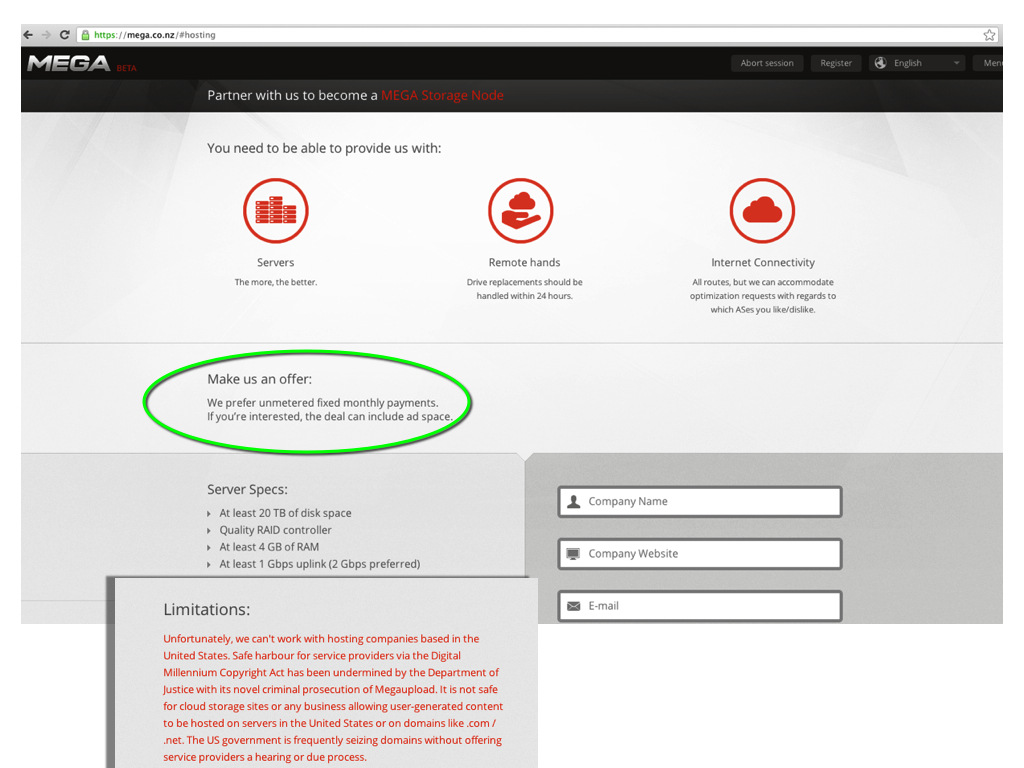
Perusing the new Mega website, I found some references to its planned business model, but no mention (yet) of any individual “partner” rewards programs like those found in its previous incarnation. Below is a solicitation for “Mega Storage Node” partners (located outside the United States). This program seems focused on attracting additional host companies that wish to integrate Mega’s infrastructure into their own businesses.

The new “Mega” is seeking partners to become a “storage node.”
Like Megaupload, Mega also offers tiered “Pro-memberships” which offer users greater storage and speed options. Prices range from $9.99 per month to $29.99 per month.

Although the new site has established its operations (and servers) outside of the United States, Mega’s “Terms of Service” does feature boilerplate language regarding intellectual property and copyright.

Note that Mega’s terms also includes language that includes references to protecting its own IP.
Our IP
13. The license that we give you to use the website and our services does not give you the right, and you can’t reproduce or use any of our copyright, intellectual property or other rights other than for the purposes of using the services and the website or as allowed under any open source licences under which we use intellectual property provided by others. The open source code that we use, where we obtained it, and licences for that code are all referenced in our FAQ.
14. You are not allowed to, and you can’t let anyone else, copy, alter, distribute, display, licence, modify or reproduce, reverse assemble, reverse compile (whether digitally, electronically, by linking, or in hard copy or by any means whatsoever) or use any of our copyright, intellectual property or other rights without getting our permission first in writing, unless in order to use our services and the website or as allowed under any open source licences under which we use intellectual property provided by others. The open source code that we use, where we obtained it, and licences for that code are all referenced in our FAQ.
At the moment the new site, not surprisingly, is running as slow as molasses due to heavy traffic. It remains to be seen if, and how, its presence will impact the online piracy landscape going forward. Right now this new site doesn’t seem all that revolutionary. For the end-user, it’s just another cloud storage solution.
No matter what transpires, Dotcom is clearly relishing his moment back in the spotlight. He’s already busy tweaking Hollywood posting this Tweet and image a couple of days ago. Despite his self-important cockiness, in the grand scheme of things, I don’t think he’ll be getting the last laugh.

Though Dotcom would likely disagree, when U.S. law enforcement took his popular Megaupload offline a year ago, it marked a significant turning point in the battle against online piracy. Since then real progress has been made. Copy-cat sites that modeled the success of Dotcom’s business model closed their doors. At the same time, more options for timely and legitimate online distribution of movies and music emerged–options both profitable for creators and affordable for consumers. Advertisers and payment processors have also stopped partnering with some remaining pirate cyberlocker sites, diminishing their profits and popularity. Other companies, such as Google, have also had to address their role in aiding, abetting and profiting from piracy. Overall, the lure of online piracy as a cottage industry has been greatly diminished.
Maybe Dotcom’s new Mega will be legit, maybe not. The world will be watching, but I’m not too worried. At least not yet.

by Ellen Seidler | Copyright
 I was on YouTube recently and came across another, not so surprising, downside to their content monetization. At first I’d noticed some movie trailers that were uploaded, claimed, and monetized by entities other than the studios/rights holders. Now it’s not surprising that folks upload trailers that aren’t theirs, claim it and make money off it. However, it doesn’t stop there.
How about uploading an entire movie and earning money off it even if you don’t own the rights? Well, on YouTube it’s apparently pretty easy. Here’s an example of a Canadian feature film called “Lost and Delirious” that I discovered on YouTube—the entire film, all 95 minutes of it, conveniently offering subtitle options in multiple languages. Take your pick: Czech, French, German, Polish, English, Portuguese, Spanish and Turkish…

Full stream of “Lost and Delirious” complete with subtitles in multiple languages monetized on YouTube by someone other than copyright holder.
When I checked to see what entity “claimed” the film I found that it wasn’t the director Lea Pool or the studio that had claimed it. It was claimed by YouTube user __u1DkXdYlQ6__. It’s not a user name per se, the actual uploader seems to be attached to a channel aptly titled “Art Cinema” with the YouTube user name: myArtCinema3. However, by the looks of it, it appears that __u1DkXdYlQ6__ is the “Partner” (i.e. monetization account) that has “claimed” the film on behalf of “Art Cinema.” Since there is advertising on this upload, one can assume that the clip was indeed claimed for the purpose of monetizing it.
Here’s the ownership information for this movie viewed via my CMS dashboard. The user “asserts ownership” worldwide. I wonder what the film’s legit distributor thinks about that claim?

Notice that the film was uploaded on October 15th, 2012 and in less than four months, has already attracted nearly 1.5 million views. What that means is lots of ad money for YouTube/Google and lots of money for the pirate who uploaded the film. The filmmaker and her production company apparently get nothing.
This is not an isolated example. It appears that this same YouTube user has uploaded other complete films, using several accounts, with varying degrees of success. In November, “myartcinema4” uploaded and claimed another popular indie film from the 90s, “The Incredibly True Adventures of Two Girls in Love.” It’s already attracted more than 2 million views, worth nearly $6,000, a tidy pirate profit.*

YouTube user “artcinema4” has uploaded and “claimed” this film. Uploaded in November it’s already attracted more than 2 million views.
Another upload “Antonia’s Line”, has attracted more than 400,000 views but can’t be monetized since it’s labeled “age restricted” under YouTube community guidelines (meaning some user tagged it, probably for sexual content).

Zoosk ad appears at the beginning of this pirated film, despite its “R” rating.
“Lost and Delirious,” also rated “R,” seems to have slipped under the “community” censorship radar–for the time being anyway, but it’s probably why this user uploaded a duplicate copy of the film. In case the first cash cow gets tagged as having “age restricted” content, the second copy can fill viewer demand and earn clicks and cash for this industrious pirate’s coffers.
Uploaded a month later on November 15th, this second version has garnered more than 119,000 views. Adding the two together, that’s more than 1.6 million total views. It’s impossible to know exactly how much income that generates, but it’s likely somewhere around $3,000 so far.
Overall, not a bad payday considering the uploader didn’t do a lick of work…well, unless you count uploading the films and, in profound bit of hubris, adding a customized “art cinema” graphic (below) to the opening credits of the stolen films. Of course we’ll also never know how much YouTube/Google makes on these illegal uploads since the company is notoriously opaque when it comes to providing specifics on its billions in advertising income. I’ve attempted to contact a representative from YouTube for comment on this story and will update if any response is forthcoming.

YouTube pirate adds his/her own fancy graphic to pirated films.
It also appears that this uploader has created a number of other similarly theme YouTube accounts, four of which (created in September, October and November 2012) under the user names: myArtCinema, myArtCinema2, myArtCinema3, and myArtCinema4. All four “channels” offer uploads of complete films, some of which are older foreign titles and may be in the public domain. The uploaded films seem to be linked to various YouTube “Partner” accounts including (__OkhXVt6c-7__) and (__BnxrHCbbK2__), but I suspect they all link back to the same individual, or group of individuals. Though I haven’t yet been able to confirm this with YouTube, given the way the channels are presented, organized and linked, it’s hard not to believe otherwise.
There’s also an account, presumably by the same individual, with the moniker artcinema4. Not sure what happened to artcinema1, 2, and 3…but I would guess they were removed due to repeated copyright infringement. This thief certainly believes in multiple layers of redundancy to protect his/her scheme.

This YouTube pirate has opened multiple accounts using variations on the moniker “art cinema” –all feature full-length movies monetized with advertising
One might ask what YouTube should do about this situation? After all, the films’ distributors don’t seem to have set up Content ID matching to protect these title, or perhaps they just slipped through (Content ID matching is not infallible). Should the onus be on them to prevent this kind of theft–theft that benefits the uploader and the host? By allowing uploads for longer content, including feature length films, YouTube has opened the door to this activity.
I’m all for allowing users to upload works that exceed 20 minutes in length, as long as it’s their own work. For uploads with running times longer than 20 minutes, why not put the burden on YouTube users to prove that they, in fact, own the rights to such material before it’s approved for upload? Of course, until recently, YouTube restricted upload lengths for most users, so pirates would often break films into multiple, 10-minute parts….still piracy, but at least that format created a disincentive to watch a pirated movie.
As of now, YouTube seems to place few obstacles in the path of pirates and their profits. Let’s also not forget that it’s the lure of profits, not altruism, that encourages users like “myArtCinema” to upload this type of stolen content in the first place. This is but one example of a very calculated, and all too common crime. A crime, that for the time being, has little apparent risk and much potential reward. These examples are just the tip of the iceberg. Perhaps the films’ rights holders will go to court and ask for the income to which they are entitled. I hope so.
*My income estimate is based on a similar title that earned $700+ for 250,000 hits on YouTube. Google/YouTube does not release specific information regarding Youtube monetization income.
Update: 9:12 p.m.
Well, apparently the film’s rights holders weren’t pleased with this situation either. Here’s the result:

One of Art Cinema’s accounts (myArtCinema2) was terminated due to repeated copyright infringement

by Ellen Seidler | Copyright
 I came across a story published on today’s Torrent Freak highlighting the conflict between content creators and Google over the search giant’s search results that routinely point to pirated content. As I pointed out in a blog post last week, despite Google’s much ballyhooed August announcement that they would downgrade (not remove) search results for sites routinely reported for piracy, not much has changed.
Per TorrentFreak, and in typical Google fashion, Google’s Legal Director Fred von Lohmann, employs the oft-used boilerplate, disingenuous refrain that the rise in takedown requests could be considered an attack on free speech:
“As policymakers evaluate how effective copyright laws are, they need to consider the collateral impact copyright regulation has on the flow of information online.”
Von Lohmann goes on to complain that when Google instituted their “new” search ranking policy, they received more than 250,000 takedown requests per week and that number has grown to more than 2.5 million. While von Lohmann characterizes this trend as evidence that “flow of information online” is being obstructed, I see it as evidence that there is a ton of infringing content/product online that has, until now, efficiently flowed (via Google search) from thief to consumer, impervious to any limit or law. Why should we have sympathy for sites linking to pirated or counterfeit goods? How is that an attack on free speech? It’s not.
Why is that the rights of piracy’s victims–the content creators large and small who work to create films, music, books and more–are discounted in favor of thieves who profit from their crimes? Check out those reported search results and you will find hundreds of websites that make money by distributing access to pirated/stolen goods, some in digital form, some as tangible (counterfeit) products. Marc Miller, MPAA’s Senior Vice President for Internet Content Protection points out this inconsistency in TorrentFreak:
“Google’s reading of the data is missing some critical perspective: if the process is cumbersome for Google, it is even more cumbersome for the creators and makers who must constantly be on the lookout to protect their work from theft,”
Piracy apologists like to focus on erroneous takedowns and highlight stories whereby a 9 year-old in Finland had her computer confiscated, or a grandmother in Colorado had her ISP account wrongfully suspended. Certainly mistakes happen, and when they do it’s unfortunate, but they are few and far between when compared with the cumulative harm being done to those whose livelihoods are damaged by rampant online theft. For every search result removed in error there are thousands, if not hundreds of thousands, removed for valid reasons. Sensationalistic anecdotes make for splashy headlines and provide convenient red-herrings for those who defend the piracy status quo–big bad Hollywood versus the grandmothers of the world–but meanwhile the genuine stories documenting piracy’s ruin are routinely minimized or ignored.
Also lost in this debate is the fact that if one takes the time to read the DMCA, it’s easy to see that the law actually favors the reported party, not the other way around. If a site has been removed in error, the owner can use the Google website to file a counter-claim with a click of a mouse. That immediately puts the onus on the party that filed the original DMCA request to go to court and prove the legitimacy of their claim. If that next step isn’t taken, the takedown becomes moot. Filing a court case is a costly endeavor so it’s unlikely that those whose file false DMCA claims, whether in error or purposely, would bother to spend money to enforce a bogus DMCA. Conversely, those content creators who don’t have deep pockets have little recourse when it comes to enforcing a valid DMCA takedown if the other party, representing an infringing (pirate) website, chooses to file a counter-claim.
There’s no denying the current process is rather unwieldy and somewhat broken, but when it comes to rights being at risk, I don’t believe Google has much to complain about. Sure it costs time and money to process the takedowns and remove offending search results–but isn’t that just the cost of doing business? There’s a price paid by those who create content–why should it be any different for those who profit by disseminating it?

by Ellen Seidler | Copyright, Film, Google, Piracy, Tech
It’s been a few months since Google announced a new initiative designed to lower search results for web-sites reported for piracy. According to Google, legitimate sites would move up and pirate sites would move down:
We aim to provide a great experience for our users and have developed over 200 signals to ensure our search algorithms deliver the best possible results. Starting next week, we will begin taking into account a new signal in our rankings: the number of valid copyright removal notices we receive for any given site. Sites with high numbers of removal notices may appear lower in our results. This ranking change should help users find legitimate, quality sources of content more easily—whether it’s a song previewed on NPR’s music website, a TV show on Hulu or new music streamed from Spotify.
Since we re-booted our copyright removals over two years ago, we’ve been given much more data by copyright owners about infringing content online. In fact, we’re now receiving and processing more copyright removal notices every day than we did in all of 2009—more than 4.3 million URLs in the last 30 days alone. We will now be using this data as a signal in our search rankings.
At the time, Google’s announcement seemed encouraging, despite their careful use of the more flexible phrase “may appear lower” as opposed to “will appear lower.” Now that some time has passed, I thought I’d do a random search to see how well Google’s new algorithm is working to thwart piracy. I decided to do a fairly generic search using the terms “watch free movies online.” I did not specify a time frame or put the search terms in quotes. This was the result.

Result for search “watch free movies online”
The first two results were “sponsored results” (shaded in pink) which direct users to legitimate sites Yideo and Netflix. However, the top two non-sponsored sites are sites offering pirate links. I clicked “LetMeWatchThis” the second non-sponsored result. That took me to this landing page which entices users with an array of movie poster thumbnails from current releases (many haven’t even been released on DVD). I chose to click on a thumbnail for film that is scheduled to be released next week on December 4th, 2012–The Odd Life of Timothy Green.

Below a short summary of the film, there’s a list of 30 links to watch/download it. I did not examine each and every link, but aside from several “sponsored” links, most point to sites known to host pirated films.

Ignoring the first one (it’s a sponsored link that leads to an illegal pay-to-watch site) I clicked on the link to “Sockshare” a popular cyber-locker site (one of many to flourish in the vacuum left by Megaupload’s shutdown). After clicking the link, and navigating past an ad (remember these pirate sites are in the business of making money off stolen content) I arrived at an embedded, full stream of the film.

Remember, according to Google’s explanation of its new policy, “we will begin taking into account a new signal in our rankings: the number of valid copyright removal notices we receive for any given site. Sites with high numbers of removal notices may appear lower in our results.” With this in mind, I decided to check Google’s “transparency report” to see how often this particular domain had been reported for copyright violations. According to these results, there had been more than 10,000 requests for the URL to be removed.

I also checked the value of this website using and found this:

If these Alexa statistics are accurate, it’s safe to say that operating this particular pirate site is a lucrative endeavor indeed. It’s long been notorious for its illegal links. The fact this site comes up second in a Google search for to “watch free movies online” is certainly a factor in their robust income. Despite Google’s pledge to begin “using this (copyright infringement reporting) data as a signal” to adjust search rankings, their new algorithms don’t seem to be penalizing this site in the least. To the contrary, it seems this site is being rewarded with a plum ranking resulting in plump profits.
The only conclusion I can draw from this is that, despite lip-service to the contrary, not much has changed when it comes to Google aiding and abetting websites that profit from piracy.

 Surprise, surprise–Google announced today that its profits “surged” this quarter thanks to an increase in online advertising revenue. A company press release heralded the report: