by Ellen Seidler | Ad Sponsored Piracy, Copyright, Piracy, Politics
Once a thief, always a thief
 Last night 60 Minutes ran a segment featuring a Bob Simon interview with the now-defunct Megaupload’s Kim Dotcom. Much has already been written, and debated, about the German pirate entrepreneur who currently resides in New Zealand as he fights extradition to the United States on charges of copyright infringement. So did we learn anything new from last night’s broadcast that billed Kim Dotcom (predictably) as “Hollywood’s Villain?”….the short answer–nope.
Per usual, explanations were limited as to how Megaupload operated (and launched a business model that many others would follow), Mr. Simon explained it this way:
Here’s how it worked. If you wanted to send a friend a file that was too large to email– a wedding video, for example– you could just upload it onto Mega Upload’s servers and your friends could click a link to download it. It was a virtual warehouse where people stored and shared digital files. By selling advertisements and premium subscriptions, Mega Upload brought in an estimated $175 million. It became one of the most frequented sites on the internet. How did it get so popular and profitable? According to federal authorities, by also allowing users to illegally share the hottest new movies, or hit songs, or TV programs, including some CBS shows.
Unfortunately Simon failed to explain probably the most important factor to Megaupload’s financial success, its affiliate program. What good is hosting tons of pirated content if no one know where to find it? If there’s a genius to Dotcom’s acumen as a black market businessman, this is it. Basically the cyberlocker (cloud-based storage) site’s business model was that of multi-level marketing style pyramid scheme. Instead of selling cosmetics or cleaning products, his company “sold” access to stolen movies, songs and e-books.
As with all pyramid-style companies, Megaupload depended on attracting armies of underlings to “sell” its offerings. It did so by offering incentives to users who signed up to become “affiliates.” Upload stolen content, spread the download links far and wide like a virus, and the more downloads you attracted, the more cash you would earn. Affiliates could also earn cash for recruiting more affiliates. This army of mini-pirates was the key to Dotcom’s success and fueled piracy’s rampant growth beyond the traditional, more cumbersome torrent sites like Pirate Bay. The internet was suddenly filled with forums where users “shared” their download links over and over and over again.
Those who clicked on a Megaupload download link would find that they could generally stream or download a favorite film, or song, with a mere click of the mouse. For those who wanted faster download speeds they could subscribe to “premium” services and by doing so dump more cash into Dotcom’s coffers.
By having others do their dirty work uploading stolen content, Megaupload attempted to skirt copyright law by claiming refuge under the “safe harbor” provisions of the DMCA (Digital Millennium Copyright Act). Dotcom reiterated this excuse in his interview with 60 Minutes:
Am I the one who is at fault if users upload that kind of stuff and up… re-upload it again? Do I have to go to jail for that? Because I didn’t do it. I didn’t upload these things to Mega Upload.
Dotcom also blamed his flamboyant lifestyle and his nationality as reasons for his targeting by U.S. officials not the 2 and a half billion his company was worth at its peak when he left Hong Kong for New Zealand—a valuation built by pirating the hard work of others—musicians, filmmakers, authors and more. Too bad the folks at 60 Minutes didn’t think it worth interviewing any of those (beyond Hollywood) whose livelihoods suffered thanks to Megaupload and sites like it.
At this point, whatever happens with Dotcom is pretty much irrelevant. The key truth is that with the demise of Megaupload the entire piracy for profit industry was finally put in the spotlight. Why did so many other cyberlocker sites immediately shut down after the Megaupload indictment? If Filesonic, Wupload, Fileserve and other sites’ business models were legit, why did their operators scurry like cockroaches exposed to bright lights. The answer is simple. They, like Megaupload before them, were engaged in (illegal) theft for profit.
The shuttering of Megaupload marked an important shift for the landscape of online piracy. Just as cyberlockers’ illegal business models were being called into question, legitimate online options were gaining steam. The sudden vacuum allowed legal alternatives like Netflix, Hulu and their ilk to gain traction. Consumers who’d sought out pirated content out of convenience suddenly found that using their Roku or Apple TV box was a better option than scouring the internet for torrents or Russian streaming sites.
I for one don’t care much about what the future holds for Mr. Dotcom. I’m sure he’ll figure out another way to game the system and make money at the expense of others, but in the meantime I’ll be happy that content creators were the victors this time ’round.
P.S. for more analysis on the case against Kim Dotcom and copyright law I suggest Robert Parloff’s excellent piece published in Fortune Magazine in 2012: Megaupload and the twilight of copyright

by Ellen Seidler | Copyright, Film, Law, Music, Piracy, Tech
 Megalomaniac Kim Dotcom is at it again. With a launch of a new campaign announced via an all caps headline screaming that “THE TRUTH WILL COME OUT!” on his website, he’s ratcheted up his assault on the big, bad U.S. government, the so-called “copyright lobby” bogeyman and everyone else who views him as the criminal thug that he is.
As part of his campaign to get out his (version of the) truth he’s published a “white paper” called “Megaupload the Copyright Lobby and the Future of Digital Rights.”
In it he claims the case against him “represents one of the clearest examples of prosecutorial overreach in recent history.” He takes particular aim at the White House, claiming his arrest was “propelled by the White House’s desire to mollify the motion picture industry in exchange for campaign contributions and political support.”
He goes on to claim that it’s a case of him and “digital rights advocates, technology innovators and ordinary information consumers on the one side, and Hollywood and the rest of the Copyright Lobby on the other.” He characterizes his highly profitable pirate website as a wonderful public service, with piracy only a minor concern.
Megaupload operated for seven years as a successful cloud storage business that enabled tens of millions of users around the world to upload and download content of the users’ own choosing and initiative. The spectrum of content ran from (to name just a few) family photos, artistic designs, business archives, academic coursework, legitimately purchased files, videos and music, and – as with any other cloud storage service – some potentially infringing material. [emphasis added]
How about some real truth about Megaupload? Until its takedown in January of 2012 it was the largest and most profitable repository of pirated content in the world. Contrary to claims made in his “white paper” Dotcom’s business model was dependent on content theft to drive traffic to, and generate income for, the site. The pirated content on Megaupload included music, movies, e-books and more–and represented the creative work of artists, filmmakers, authors and musicians across the spectrum.
For Kim Dotcom it’s easy to create propaganda that points to the big, bad MPAA or RIAA as the enemy…after all they are in the business of making money right? Well, the fact is, so is Mr. Dotcom and, unlike Hollywood, he doesn’t play by the rules. Why invest in content (and employ thousands to make it) if you can just steal it?
As an independent filmmaker I’ve had plenty of opportunities to witness first hand the piracy supported by Mr. Dotcom’s illegal enterprise, and it wasn’t pretty. Our film, like thousands of others, was easy to find on Megaupload as a free download or streaming in HD, complete with subtitles in various languages. Meanwhile it could be also be streamed or downloaded (with subtitled versions) on legit sites like iTunes, Amazon, Netflix, Busk Films and others portals worldwide.
The difference between these legit online distributors and Dotcom’s Megaupload was that we earned income from our film’s distribution on the legit sites while it was Mr. Dotcom (and his uploading minions) that profited from our film on Megaupload. For indie filmmakers like us who don’t have theatrical releases, back-end distribution is the only way to recoup expenses. Megaupload’s pirated offerings forced filmmakers like us and other content creators to compete against FREE versions of their own creations. How crazy is that?
Despite his splashy spin minimizing the amount of “infringing material” disseminated through Megaupload (and Megavideo), the fact is that without stolen content, he would not be the “Mega” millionaire he is today.

How did the illicit Megaupload business model become a profit machine? Well, it’s helpful to think of a company like Amway. Amway’s business success popularized the multi-level marketing style pyramid business model (or scheme ) whereby the operators at the top of the pyramid recruit people to work for them. They, in turn, recruit more workers who, in turn, sell products to the public. Those at the top make money only if they can recruit, and keep, enough people below to do the actual work. Those doing the bulk of the work earn money, but at a much lower rate than those at the top. It’s the trickle up theory of profits.
 Megaupload’s business was predicated on offering enticements to users (uploaders) to join this type of piracy-4-profit pyramid. This approach was essential to maximizing the number of visitors to the site. Another essential part of this equation was making sure the UCG (user generated content) that would attract eyeballs. Sorry, but your ” family photos, artistic designs, business archives” wouldn’t do the trick. No what better UGC carrots than popular movies, books or music? Dotcom didn’t seem too worried about copyright thanks to the “safe harbor” provision of the DMCA that allow UGC sites to easily look the other way (plead ignorance) when it came to vetting infringing content.
In order to set this eco-system into motion, Megaupload lured its worker bees. Simply put, the more downloads users generated for each file, the more money/rewards they earned. These rewards precipitated the next, and most insidious stage of piracy—the viral spread of infringing links. With dollar signs in their eyes, Megaupload’s affiliate armies took their links and posted them on web Warez forums far and wide. The more Megaupload links they “shared” across the web, the more money they made.

Pirate forum search results for new indie film showing more than 300 posts “sharing” download links.
In other words, Megaupload created, and was dependent on, an army of affiliates to do the dirty work for them. The scenario enabled Megaupload (and dozens of cyberlockers modeled after them) to shield themselves from legal liability, while their servers were simultaneously receiving thousands of (stolen) files every day–fresh content sure to attract new (and returning) customers.
Though the site claimed to respond to takedown requests, Megaupload was in fact playing a shell game, by not removing the actual infringing files and instead generating fresh links to replace those removed via the DMCA process. When Megaupload was first taken down in 2012 I wrote a blog post about this and put together a short video demonstrating how this worked (below).
[vimeo 35648310 w=500 h=375]
Megaupload Unmasked from fastgirlfilms on Vimeo.
It’s also important to remember the impact Megaupload’s business model had on encouraging and sustaining piracy profiteering across the web. It’s takedown marked a significant turning point in the fight against online piracy profiteering. As I wrote in an earlier post in response to the launch of Kim Dotcom’s new site Mega:
…when U.S. law enforcement took his popular Megaupload offline a year ago, it marked a significant turning point in the battle against online piracy. Since then real progress has been made. Copy-cat sites that modeled the success of Dotcom’s business model closed their doors. At the same time, more options for timely and legitimate online distribution of movies and music emerged–options both profitable for creators and affordable for consumers. Advertisers and payment processors have also stopped partnering with some remaining pirate cyberlocker sites, diminishing their profits and popularity. Other companies, such as Google, have also had to address their role in aiding, abetting and profiting from piracy. Overall, the lure of online piracy as a cottage industry has been greatly diminished.
Kim Dotcom is not Robin Hood and he’s not a hero. He’s a (wealthy) thief who, thanks to technical know-how and a black market business acumen, was able to exploit the work of content creators across the globe for his own, personal gain. Dotcom’s lies cloaked as “truth” may gain him sympathy from his acolytes, but it won’t change the fact that stealing from others isn’t sharing, it’s theft.

by Ellen Seidler | Copyright
 Kim Dotcom’s much ballyhooed new venture, Mega, has gone live. and is, according to a tweet from the mastermind himself, already wildly popular, “250,000 user registrations. Server capacity on maximum load. Should get better when initial frenzy is over. Wow!!!” It’s no great surprise that there’s a lot of early interest in site, but the real question going forward is whether anti-piracy activists should be running scared? For now, it seems too early to tell. The key to whether this new cloud-based file-sharing site will become the new nexus for online piracy depends on what business model is used, and at this point, it’s difficult to decipher exactly how this will all play out.
 There are already various cloud-based file-sharing sites, similar to the “new” Mega–sites DropBox and YouSendIt that already allow users to easily share large files across the web. However, unlike Kim Dotcom’s now-defunct Megaupload site, these services do not incentivize uploads. In other words, in contrast to cyberlocker favored by pirates, these legit sites don’t offer cash rewards based on the number of times a file is downloaded. As a result, most people who use these cloud-based file-sharing services do so because they have actual business to conduct, or seek to share files with family or friends.
Certainly some file-sharing that’s technically “illegal” takes place, but without cash carrots offered to uploaders, it’s relatively inconsequential in terms of the big picture. The success of DropBox and YouSendIt is not predicated on the need to draw traffic and generate ad clicks. Theirs is a business model that does not incentivize piracy on a viral scale.
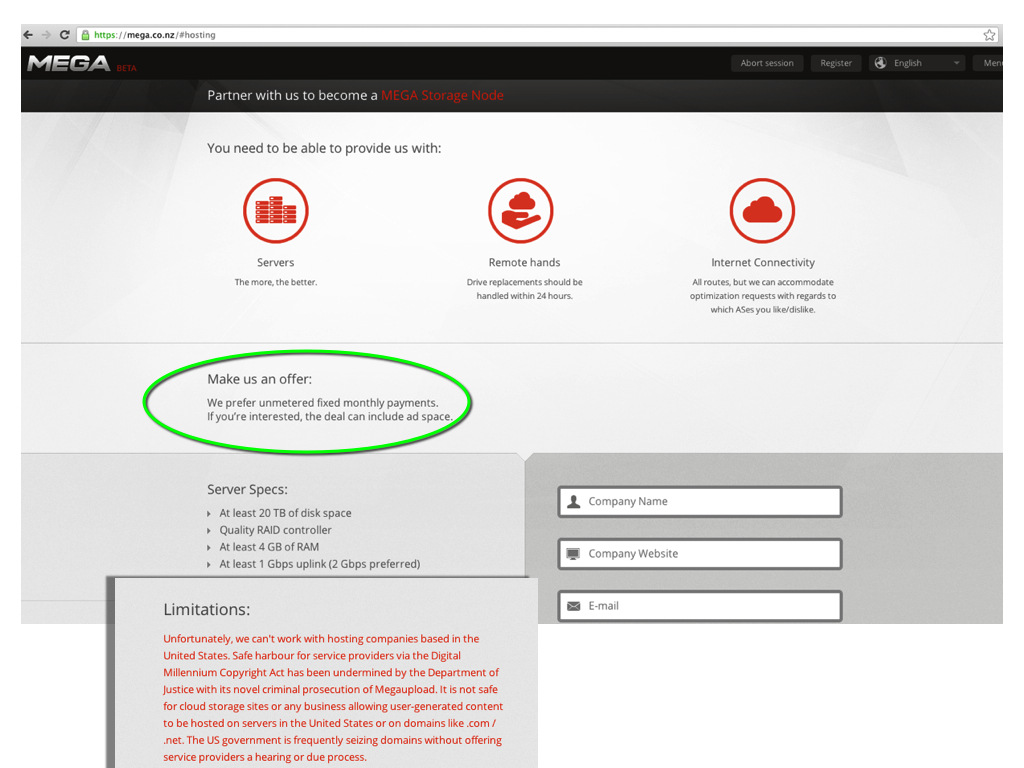
Perusing the new Mega website, I found some references to its planned business model, but no mention (yet) of any individual “partner” rewards programs like those found in its previous incarnation. Below is a solicitation for “Mega Storage Node” partners (located outside the United States). This program seems focused on attracting additional host companies that wish to integrate Mega’s infrastructure into their own businesses.

The new “Mega” is seeking partners to become a “storage node.”
Like Megaupload, Mega also offers tiered “Pro-memberships” which offer users greater storage and speed options. Prices range from $9.99 per month to $29.99 per month.

Although the new site has established its operations (and servers) outside of the United States, Mega’s “Terms of Service” does feature boilerplate language regarding intellectual property and copyright.

Note that Mega’s terms also includes language that includes references to protecting its own IP.
Our IP
13. The license that we give you to use the website and our services does not give you the right, and you can’t reproduce or use any of our copyright, intellectual property or other rights other than for the purposes of using the services and the website or as allowed under any open source licences under which we use intellectual property provided by others. The open source code that we use, where we obtained it, and licences for that code are all referenced in our FAQ.
14. You are not allowed to, and you can’t let anyone else, copy, alter, distribute, display, licence, modify or reproduce, reverse assemble, reverse compile (whether digitally, electronically, by linking, or in hard copy or by any means whatsoever) or use any of our copyright, intellectual property or other rights without getting our permission first in writing, unless in order to use our services and the website or as allowed under any open source licences under which we use intellectual property provided by others. The open source code that we use, where we obtained it, and licences for that code are all referenced in our FAQ.
At the moment the new site, not surprisingly, is running as slow as molasses due to heavy traffic. It remains to be seen if, and how, its presence will impact the online piracy landscape going forward. Right now this new site doesn’t seem all that revolutionary. For the end-user, it’s just another cloud storage solution.
No matter what transpires, Dotcom is clearly relishing his moment back in the spotlight. He’s already busy tweaking Hollywood posting this Tweet and image a couple of days ago. Despite his self-important cockiness, in the grand scheme of things, I don’t think he’ll be getting the last laugh.

Though Dotcom would likely disagree, when U.S. law enforcement took his popular Megaupload offline a year ago, it marked a significant turning point in the battle against online piracy. Since then real progress has been made. Copy-cat sites that modeled the success of Dotcom’s business model closed their doors. At the same time, more options for timely and legitimate online distribution of movies and music emerged–options both profitable for creators and affordable for consumers. Advertisers and payment processors have also stopped partnering with some remaining pirate cyberlocker sites, diminishing their profits and popularity. Other companies, such as Google, have also had to address their role in aiding, abetting and profiting from piracy. Overall, the lure of online piracy as a cottage industry has been greatly diminished.
Maybe Dotcom’s new Mega will be legit, maybe not. The world will be watching, but I’m not too worried. At least not yet.

by Ellen Seidler | Copyright
 As promised, Megaupload’s Kim Dotcom continues to work on a new cloud-based storage service called “Mega.” He’s even released some screen shots to gin up expectations. Of course the files featured on the example reflect a benign use of the site as a place to store medical records and family photos. According to Examiner.com’s Michael Santo, key to the new site is an encryption methodology controlled entirely by the user, not the site itself.
By using 2048-bit RSA encryption for files uploaded to the service, Mega will keep itself safely ensconced within the DMCA Safe Harbor provisions, which places any legal issues for content on the end user, not the site.
The question that remains unanswered is what business model will Mega use? How exactly does Kim Dotcom plan to make money? After all, given his track record, I imagine he’s developing this new business with profits in mind. The reason Megaupload was so insidious was not because it offered a convenient way to upload, store and “share” big files (like pirated movies). Rather, it was because its business model incentivized users to do so with cash rewards and other perks. There are plenty of cloud-based services out there that already do what Dotcom is proposing to do with his new site. And, while there are surely pirated copies shared via those channels, the problem is minimal because those sites aren’t designed to profit from piracy.
At any rate, I suppose we will have to wait a bit longer to see what pirate king Kim Dotcom has in mind for this new “Mega” venture. Somehow I expect that the profiting from piracy will remain a fundamental part of his business model. At least that’s my bet.

 Last night 60 Minutes ran a segment featuring a Bob Simon interview with the now-defunct Megaupload’s Kim Dotcom. Much has already been written, and debated, about the German pirate entrepreneur who currently resides in New Zealand as he fights extradition to the United States on charges of copyright infringement. So did we learn anything new from last night’s broadcast that billed Kim Dotcom (predictably) as “Hollywood’s Villain?”….the short answer–nope.