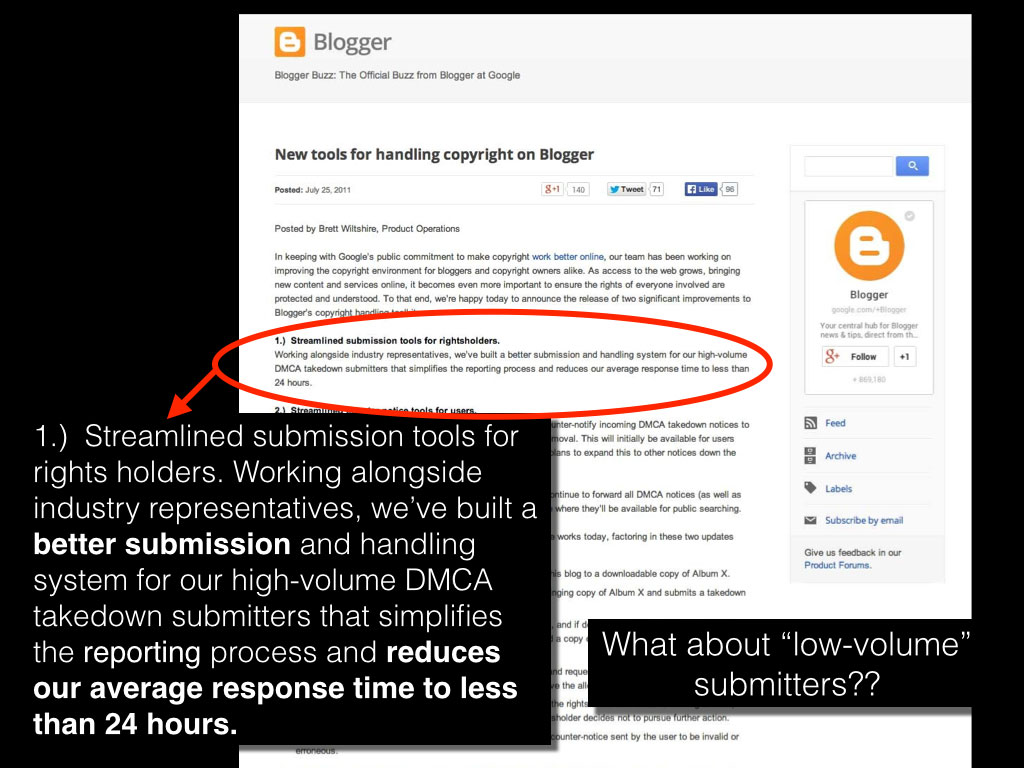
Google’s claim that it’s doing a great job streamlining its response to DMCA takedown notices on its Blogger-hosted websites doesn’t jibe with the truth. This year the U.S. Patent and Trade Office (USPTO) has been holding a series of hearings with the goal of “improving the operation of the DMCA notice and takedown policy.”
The first public meetingwas held this past March in Alexandria, Virginia and second took place May 8th in Berkeley, California. I was able to attend the Berkeley hearing in person and heard representatives from content creation industries and service providers give their perspectives on the current state of “notice and takedown” for infringing content and what could/should be done to “fix” it.
Each speaker presented a PowerPoint, links to which can be found here and a video archive here. As with the initial hearing in March, Google was represented by its Legal Director for Copyright, Fred von Lohmann who walked the audience through Google’s “DMCA notice and takedown tools” and highlighted what he called the company’s “trusted submitter program.” In his PowerPoint, Mr. von Lohmann referenced Google blog post from 2011 “New tools for handling copyright on Blogger” that supposedly highlighted the great progress that’s been made in streamlining the process.
Listening to Mr. von Lohmann it seemed clear that his words were designed for an audience made up of government officials and industry representatives and not indie artists. He (carefully) described a two-tiered system in which “trusted” submitters have access to a wealth of takedown mechanisms to remove infringing content from Google affiliates. However, aside from YouTube, access to these “trusted” programs seems limited to the big film and music entities.
Specifically, with regard to Blogger, the criteria as to how one becomes a part of this so-called “trusted submitter” program remains murky and ill-defined. Immediately following the event I searched Google to find out more (and how to apply) I only came across a link to Mr. von Lohmann’s USPTO PowerPoint. There was nothing on any Google site to answer the question as to how indie rights holders could utilize this so-called “tool.” Since there was no more information to be found, shortly after the event I took to Twitter to ask @flohmann directly for a clarification on his presentation. The response thus far, only crickets…
In addition to this lack of clarity as to who exactly can take advantage of certain tools, Mr. von Lohmann’s careful characterization of his company efficient takedown system did not match my user experience, particularly with regard to Blogger. Over these past few years I’ve documented time and time again the many ways Blogger--and therefore Google–fails to live up to its promises to remove infringing content from its platforms.
Yet, according to Google’s self-published, self-serving report, “How Google Fights Piracy,” (that I’ve criticized in a previous post) the company continues to insist that it’s proactive fighting piracy on its Blogger web-publishing platform:
We remain vigilant against the use of the Blogger platform by pirates looking to set up a free website…we will remove infringing blog posts when properly notified by a copyright owner, and will terminate the entire blog [emphasis added] where multiple complaints establish it as a repeat infringer.
Sorry, but the facts clearly don’t match up with this corporate hyperbolic PR spin. Truth be told, Blogger’s takedown system is, in reality, a hot mess. Add Google Drive to the mix and company claims of a “streamlined” takedown process seem even more absurd.
Blogger content that is reported as infringing takes weeks, not days to remove.
Blogger hosted blogs that are in the business of promoting pirated movies remain online despite multiple, repeated DMCA notices and despite clear evidence they exist to pirate films.
The Google DMCA takedown procedure is not easy to navigate. Once users find it, they must repeatedly choose options in order to (eventually) get to the correct takedown form, even someone well versed in the procedure. Why not offer direct links to the correct forms for each platform?
Blogger’s website templates offer no direct links to Google’s (streamlined) takedown form. Why can’t Blogger hosted sites automatically provide a button/link in their menu bar or footer, designed as part of any page template to enable easy and direct access to Google’s “streamlined” takedown form?
Google Drive takedown procedures are convoluted and unclear. No easy way to determine file’s URL to report and no direct link to report.
When a file is reported on Google drive it can take weeks, not days, to remove the infringing content.
Rather than fulfill its promise to expedite takedowns for copyright infringement, it seems that the “Google Team” does everything within its power to make the process convoluted, cumbersome and difficult–particularly for individual artists who don’t have the deep pockets to hire help and/or automate the takedown workflow. Please take some time to review the graphics that I’ve created that illustrate just how badly Google is doing when it comes to Blogger (and Google Drive) takedowns.
Given the complexity (and hilarity) of attempting to remove pirated stream of our film “And Then Came Lola” (seen in the example above) hosted on Google Drive I made the following video that will walk viewers through the process. Weirdly I was able to find the URL (that was not the case with some of the other examples I’ve provided) yet that didn’t help much since pirated copy is still, as of today, June 1st, available on line–more than two weeks after I sent a DMCA takedown notice to Google.As far as I’m concerned, when Google characterizes itself as doing a good job with this process I can only shake my head. No matter how many ways Google spins it, it’s not true.
Google Trying to Force Indie Record Labels into Submission
(Updated June 17, 2014)
This post was originally published in late May, but with news breaking that Google is pushing ahead on its plan to block indie labels from its new music service I’m reposting. Here’s the latest from The Guardian:
Adele, Arctic Monkeys and Jack White could disappear from YouTube “in a matter of days” after the Google video service confirmed it was dropping content from independent labels that have not signed up for its upcoming subscription music service…
…The company’s head of content and business operations, Robert Kyncl,told the Financial Times that the service – previously rumoured to be called YouTube Music Pass – will launch more widely later in the year.
His confirmation that YouTube will block videos from labels that do not sign licensing deals for the new premium tier will be hugely controversial among indie labels, with trade body WIN already filing a complaint to the European Commission about its negotiating strategy.
Here’s my original post from May 24th, 2014:
Excuse me while I choke back the bile rising in my gut. Our pal Google, the worldwide protector of free speech on the web, is showing its true colors as it reportedly goes toe to toe with indie record labels in negotiations over its new streaming music service. According to the New York Times, representatives from Google/YouTube are trying to strong arm the labels into crying “uncle” by blackmailing them into submission over contract terms:
Negotiations between independents and YouTube, which is owned by Google, have dragged on for months. But according to several people with direct knowledge of the talks, the indies’ decision to speak out was driven by a recent warning that if labels failed to agree to YouTube’s licensing terms, music on the indies’ official YouTube channels would be blocked. In addition, those labels would be unable to collect advertising revenue from user-uploaded videos that included their music.
The Worldwide Independent Network published a statement on their website taking Google to task:
YouTube is expected to launch a new music streaming service. The service has apparently negotiated separate agreements with the three major labels – Sony, Warner and Universal – but according to WIN’s trade association colleagues has yet to reach any substantive agreement with their members.
At a time when independent music companies are increasing their global market share WIN has raised major concerns about YouTube’s recent policy of approaching independent labels directly with a template contract and an explicit threat that their content will be blocked on the platform if it is not signed.
According to WIN members, the contracts currently on offer to independent labels from YouTube are on highly unfavourable, and non-negotiable terms, and undervalue existing rates in the marketplace from existing music streaming partners such as Spotify, Rdio, Deezerand others.
WIN has held extensive talks with YouTube at their instigation over the last 24 hours to try and resolve this issue but no progress has been made. WIN’s request for YouTube to rescind the termination letters sent to its members has not as yet been agreed to.
Google representatives have repeatedly pulled out the “free speech” card as rationale for allowing Google to run rough shod over artist’s rights (human rights) online and its lobbyists often employ the “protect free speech” argument as a sacred sword to move politicians and the public to its side during policy debates regarding its online business practices. That dearly held corporate concept seems to have gone out the window during these discussions demonstrating that ultimately, it’s not a matter of principle for Google, but profits.
Every time an artist sends a DMCA takedown request for any Google-hosted content (YouTube, Blogger, Search, Drive, etc) they are warned that a copy of the notice will be sent to the “Chilling Effects” website which, according to its “about” page, exists in order to, “support lawful online activity against the chill of unwarranted legal threats.”
Please note that a copy of each legal notice we receive is sent to a third-party which may publish and annotate it (with your personal information removed). As such, the content submitted in this form will be forwarded to Chilling Effects (http://www.chillingeffects.org) for publication. You can see an example of such a publication athttp://www.chillingeffects.org/dmca512/notice.cgi?NoticeID=861. For products like Google Web Search, a link to your published notice will be displayed in Google’s search results in place of the removed content.
I wonder if the folks at Chilling Effects would consider whether YouTube’s negotiating tactics are having a “chilling effects” on indie musicians?
More irony can be found on Google’s own policy blog the company touts how it “promotes free speech on the internet.”
Google’s commitment to freedom of expression is at the core of everything we do — whether it’s independent media organizations using YouTube to express themselves in Venezuela, or citizen journalists using Blogger to chronicle Myanmar’s crackdown last year on Buddhist monk protests. Unfortunately, many governments around the world impose limits on their citizens’ freedom of speech, and that often leads them to block or limit access to our tools and services.
Hypocrisy seems too gentle a term in characterizing Google’s current stance with indie labels on YouTube. Agree to our terms or we’ll block your work? Seems their “commitment to freedom of expression” doesn’t count if you refuse to add profits to their piggy bank.
Sunday’s Washington Post featured a story, “Google, once disdainful of lobbying, now a master of Washington influence” that examined the company’s rise to become a top dog among Washington influence peddlers. For Google watchers revelations in the piece, authored by Tom Hamburger and Matea Gold, come as no surprise. However, for those who continue to regard Google as the web’s guardian angel of “free speech,” the story should add a bit of tarnish to its halo, illuminating the company’s extensive back-door maneuverings — the new normal in DC’s world of political puppeteering.
The behind-the-scenes machinations demonstrate how Google — once a lobbying weakling — has come to master a new method of operating in modern-day Washington, where spending on traditional lobbying is rivaled by other, less visible forms of influence.
That system includes financing sympathetic research at universities and think tanks, investing in nonprofit advocacy groups across the political spectrum and funding pro-business coalitions cast as public-interest projects.
The rise of Google as a top-tier Washington player fully captures the arc of change in the influence business.
It wasn’t too long ago that Google was leading the charge against Washington insiders, those who deigned to file legislation that would target online content theft, the notorious Stop Online Piracy Act (SOPA). Of course its ginning up hysteria among web users with the rallying cry “don’t break the internet” is simply just another strategic slice of the same (lobbying) pie the company is currently feasting on in Washington. While the contrivances employed differ, the ultimate goal of protecting the company’s interests (and bottom line) lies at the core both of both.
Of course it’s not particularly surprising to find that one of the nation’s most successful and influential company has invested heavily (more than 15 million in 2013) to influence policy by any means necessary. What is important is to see that Google’s anti-SOPA efforts for what they were–skillful lobbying that engaged web users as foils in a much larger game of chess. After the SOPA web blackout, a headline in Tech Crunch gleefully declared, “SOPA Scorecard: Internet 1, Lobbyists 0.” In his story David Binetti gave this appraisal of the (so-called) grassroots efforts that led to SOPA’s defeat.
Think about that for just a second: A well-organized, well-funded, well-connected, well-experienced lobbying effort on Capitol Hill was outflanked by an ad-hoc group of rank amateurs, most of whom were operating independent of one another and on their spare time. Regardless where you stand on the issue — and effective copyright protection is an important issue — this is very good news for the future of civic engagement.
Looking back, such assessments seem almost quaint in their naivety. Following the web blackout, in a post-mortem published on 3digital.com David Rodnitzky got it right:
The SOPA blackout was about as organic as the masses of North Koreans crying in the streets upon hearing of Kim Jong Il’s death. Behind the scenes, the SOPA protest was a well-organized campaign, fueled by the lobbying arms of major Internet corporations.
Moving forward, let’s hope that more people take note. Google is out to protect Google’s interests, not ours.
According to an article published in by Kate Tummarello in The Hill today, Zoe Lofgren doesn’t think much of Congressional efforts to reform copyright law.
Rather than trying to rewrite copyright law, the content industry is working with the tech community to curb online piracy, Lofgren said.
“They’re trying to do collaborative deals with the tech world,” she said. “They’re not asking for a big review of the copyright law.”
Hmmm, last time I checked a number of people representing a wide swath of the creative industries (indie and otherwise) have become very invested in copyright reform efforts believing that it’s long past time to update the law for the 21st century/digital age. Of course, when digesting anything Ms. Lofgren has to say about copyright it’s important to remember that according to opensecrets.org Google is her #1 corporate campaign donor and the company’s general distaste for laws that protect creator’s rights is well established.
Marvin Ammori pens a (laughingly) disingenuous anti-copyright screed
This week Google-backed attorney (and fellow at the New America Foundation) Marvin Ammori wrote a piece for Slate, “Hollywood’s Copyright Lobbyists Are Like Exes Who Won’t Give Up” bashing efforts by the rights holders and their representatives to build voluntary consensus to fight online piracy. Ammori argues that such efforts are actually a veiled effort to reintroduce SOPA, the anti-piracy legislation that went down in flames two years ago.
Apparently Mr. Ammori believes (or those paying him do) that we shouldn’t address this issue at all. Legislation is bad and voluntary agreements are bad too. It seems that even talking about the subject is bad.
In his Slate piece Ammori condemned “copyright lobbyists” for discussing such agreements “in hearings and little information-gathering events—the equivalent of an ex just trying to catch up over drinks.” His lame “ex” analogy aside, I must say it’s beyond ironic to see a known confederate of the #1 lobbyist in DC actually condemn lobbying. Just pull back the curtain and you’ll see that Google’s former CEO Eric Schmidt is actually the Chairman of the Board for the New America Foundation. The foundation also lists Google as one of its funders.
According to the website Open Secrets, Google spent 15 million dollars lobbying in 2013. 14.6 million of that was for lobbying on issues related to “computers and the internet.” It’s likely that some of those expenditures included sending representatives to “hearings and little information-gathering events” in DC don’t cha think?
Initially Slate failed to disclose Mr. Ammori’s ties to Google, but was forced to “update” the piece with this disclaimer:
Update, March 11, 2014: Disclosure: The author represented Google and other companies fighting SOPA/PIPA in 2011 and 2012. He currently represents Google and other companies on several issues, including copyright reform. These views are his own.
The fact that Mr. Ammori neglected to initially mention his many ties to Google undermines the very gist of his arguments. Sons of Anarchy writer Kurt Sutter wrote a great rebuttal in Slate to Ammori’s piece which begins:
Let’s consider the March 11 anti-copyright rant in Slate by Marvin Ammori, a lawyer working for Google (which somehow he forgot to mention in the article). He compares Hollywood to that insidious “ex who won’t give up” pursuing you and making your life miserable. As a guy with more than a few exes, I have to tell you, Marv, the most insidious ex is the one who hides the truth, steals your money, and lies to all your friends. That’s what Ammori and Google are doing.
I recommend reading Sutter’s entire piece in which he lays bare the true motivations behind Ammori’s post (and Google’s lobbying efforts).
…when Hollywood tries to impede that thievery, it’s presented to the masses as a desperate attempt to hold on to antiquated copyright laws that will kill your digital buzz. It’s so absurd that Google is still presenting itself as the lovable geek who’s the friend of the young everyman. Don’t kid yourself, kids: Google is the establishment. It is a multibillion-dollar information portal that makes dough off of every click on its page and every data byte it streams. Do you really think Google gives a shit about free speech or your inalienable right to access unfettered content? Nope.
To blame Hollywood copyright lobbyists for trying to influence law when google does the exact same thing is either ignorant or hypocritical. And to ignore the fact it isn’t just “Hollywood Copyright Lobbyists” but entire countries that are reacting to what they see is Big Tech run rampant, suggests once again the narrative is being controlled in Big Tech’s favor.
Ammori whines about SOPA and he whines about new efforts to create “voluntary” agreements as a possible path forward in the ongoing battle against content theft. Apparently we are essentially damned if we do and damned if we don’t? What are content creators supposed to do? Are we supposed to sit on our hands and watch as tech behemoths like Google continue to enable (and profit from) an illicit online economy that is bleeding creators dry?
Ammori points to the fact that payment processors like PayPal have pulled their services from various websites and warns,
…copyright holders can starve websites of their funding, strip them of their domain names, and remove them from search. The sites at risk include those that enable users to store and share content—if even a fraction of those users might violate copyright. So these agreements can threaten free expression and innovation online for all of us, just to target a few infringers.
Oh please…he really doesn’t have a freakin’ clue does he? Has he ever actually researched online piracy and examined these websites and to see how they operate? Does he really that only a “fraction” of Megaupload or Filesonic’s users were violating copyright? At this point the poor guy is clearly trying to gin up the same tired, hyperbolic, deceitful anti-SOPA rhetoric the tech-industry employed to work web users into a lather. Problem is, it ain’t gonna work any more. As Sutter’s rebuttal makes clear, creators from all walks of life are fed up with piracy profiteers being propped up by companies like Google–tired of the b.s. We’re mad as hell and not going to take it any more.
We’re sick of companies like Google spending millions to defend their business model, acting like a wolf in sheep’s clothing. We’re tired of Google pretending this is about “free speech” when, in fact, it’s about their bottom line. We’re tired of the hypocrisy of a company that spends millions to undermine artist’s rights while being the first in line at the courthouse when it comes to protecting its own IP. We’re tired of watching our livelihoods whittled away while others steal our work to make millions. We’re tired of folks like Mr. Ammori pretending to defend the web’s users when they’re really defending the web’s oligarchy.
As an indie film and broadcast journalism veteran, I'll share my perspectives on issues of interest to the creative community and beyond--Ellen Seidler


 Google’s claim that it’s doing a great job streamlining its response to DMCA takedown notices on its Blogger-hosted websites doesn’t jibe with the truth. This year the U.S. Patent and Trade Office (USPTO) has been holding a series of hearings with the goal of “improving the operation of the DMCA notice and takedown policy.”
 Yet, according to Google’s self-published, self-serving report, “How Google Fights Piracy,” (that I’ve criticized in a previous post) the company continues to insist that it’s proactive fighting piracy on its Blogger web-publishing platform: