by Ellen Seidler | Copyright

YouTube account holders accounts are terminated for repeated violations of copyright policies
I have a question for the folks at YouTube. Usually, if a user receives multiple (3 or more) DMCA takedown notices, the associated account is suspended for repeated violations of their copyright policy.
Two weeks ago I wrote about a YouTube account holder, “MyTrailerIsRich,” who makes money piggy-backing off the work of others–uploading and monetizing movie trailers without permission from the rights holders. Since then, I know for a fact that at least four different distributors have submitted a total of at least 8 takedown notices for trailers uploaded (and monetized) by this user without permission.
Yet, as of this morning, the channel (with its 50 million plus views) is still online and earning income for YouTube and the user. Why? The user hasn’t filed a dispute (counter-notice) to protest the takedowns. Could it be because this particular channel has attracted so many views (and so much income)? Could it be that the intermediary that uploaded and claimed the content (Wizdeo) has a special relationship with YouTube? If you look at YouTube’s criteria for account termination you will note that it’s conveniently vague:
Accounts determined to be repeat infringers may be subject to termination. Users with suspended or terminated accounts are prohibited from creating new accounts or accessing YouTube’s community features.
It’s been my experience with YouTube that some users have had their account terminated for 3 violations. It’s also the figure bandied around in Google’s own product forums.
Yet, to date, MyTrailerIsRich’s has received at least 8 and remains online. I’d love to ask someone at YouTube about this, but unfortunately, they won’t respond to email queries. My guess, it’s all about the money. Perhaps YouTube should update its terms to clarify matters and say:
Accounts determined to be repeat infringers may be subject to termination (dependent on how much income they generate for us).

The YouTube channel for “MyTrailerIsRich” remains online despite multiple (at least 8) takedown notices.

by Ellen Seidler | Copyright
 I came across a story published on today’s Torrent Freak highlighting the conflict between content creators and Google over the search giant’s search results that routinely point to pirated content. As I pointed out in a blog post last week, despite Google’s much ballyhooed August announcement that they would downgrade (not remove) search results for sites routinely reported for piracy, not much has changed.
Per TorrentFreak, and in typical Google fashion, Google’s Legal Director Fred von Lohmann, employs the oft-used boilerplate, disingenuous refrain that the rise in takedown requests could be considered an attack on free speech:
“As policymakers evaluate how effective copyright laws are, they need to consider the collateral impact copyright regulation has on the flow of information online.”
Von Lohmann goes on to complain that when Google instituted their “new” search ranking policy, they received more than 250,000 takedown requests per week and that number has grown to more than 2.5 million. While von Lohmann characterizes this trend as evidence that “flow of information online” is being obstructed, I see it as evidence that there is a ton of infringing content/product online that has, until now, efficiently flowed (via Google search) from thief to consumer, impervious to any limit or law. Why should we have sympathy for sites linking to pirated or counterfeit goods? How is that an attack on free speech? It’s not.
Why is that the rights of piracy’s victims–the content creators large and small who work to create films, music, books and more–are discounted in favor of thieves who profit from their crimes? Check out those reported search results and you will find hundreds of websites that make money by distributing access to pirated/stolen goods, some in digital form, some as tangible (counterfeit) products. Marc Miller, MPAA’s Senior Vice President for Internet Content Protection points out this inconsistency in TorrentFreak:
“Google’s reading of the data is missing some critical perspective: if the process is cumbersome for Google, it is even more cumbersome for the creators and makers who must constantly be on the lookout to protect their work from theft,”
Piracy apologists like to focus on erroneous takedowns and highlight stories whereby a 9 year-old in Finland had her computer confiscated, or a grandmother in Colorado had her ISP account wrongfully suspended. Certainly mistakes happen, and when they do it’s unfortunate, but they are few and far between when compared with the cumulative harm being done to those whose livelihoods are damaged by rampant online theft. For every search result removed in error there are thousands, if not hundreds of thousands, removed for valid reasons. Sensationalistic anecdotes make for splashy headlines and provide convenient red-herrings for those who defend the piracy status quo–big bad Hollywood versus the grandmothers of the world–but meanwhile the genuine stories documenting piracy’s ruin are routinely minimized or ignored.
Also lost in this debate is the fact that if one takes the time to read the DMCA, it’s easy to see that the law actually favors the reported party, not the other way around. If a site has been removed in error, the owner can use the Google website to file a counter-claim with a click of a mouse. That immediately puts the onus on the party that filed the original DMCA request to go to court and prove the legitimacy of their claim. If that next step isn’t taken, the takedown becomes moot. Filing a court case is a costly endeavor so it’s unlikely that those whose file false DMCA claims, whether in error or purposely, would bother to spend money to enforce a bogus DMCA. Conversely, those content creators who don’t have deep pockets have little recourse when it comes to enforcing a valid DMCA takedown if the other party, representing an infringing (pirate) website, chooses to file a counter-claim.
There’s no denying the current process is rather unwieldy and somewhat broken, but when it comes to rights being at risk, I don’t believe Google has much to complain about. Sure it costs time and money to process the takedowns and remove offending search results–but isn’t that just the cost of doing business? There’s a price paid by those who create content–why should it be any different for those who profit by disseminating it?

by Ellen Seidler | Copyright, Social Media

If you’re an indie musician, filmmaker, artist etc. it’s likely that you have a Facebook Page to promote your work or business. Over time, through hard work and conscientious social media marketing, you’ve built up quite a following. When you post updates to your page you expect that fans will see them right? Well, think again. Thanks to a change in their algorithm (and need to bolster revenues) Facebook has quietly altered the way their fan pages work. If you want all your fans (not just 20%) to see a post in their news feed, you’ll have to pay the privilege. A recent story in the New York Observer explains this new reality.
It’s no conspiracy. Facebook acknowledged it as recently as last week: messages now reach, on average, just 15 percent of an account’s fans. In a wonderful coincidence,Facebook has rolled out a solution for this problem: Pay them for better access.
 Usenet, a website that offers (paid) subscribers access to a variety of “news groups” has long seemed immune from DMCA takedown notices. Could that be changing?

Content creators and ISPs (internet service providers) have come to agreement on a voluntary “Copyright Alert System” to begin at month’s end.
The progressive series of alerts is designed to make consumers aware of activity that has occurred using their Internet accounts, educate them on how they can prevent such activity from happening again (for example, by securing home wireless networks or removing peer-to-peer software), and provide information about the growing number of ways to access digital content legally.
“Six Strikes” aside, the ISPs involved have made it clear that no user accounts will be terminated. Let’s hope the goal of educating the public and reducing piracy is met. More information on the new alert system can be found here.
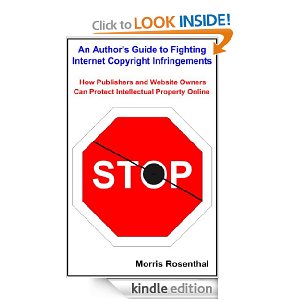
 A new kindle book by author Morris Rosenthal provides a how-to for those who find their work uploaded (illegally) online. The book “An Author’s Guide to Fighting Internet Copyright Infringements” He explains his motivation in writing the book on Amazon.com:
I’ve probably spent more time fighting copyright infringements than writing books over the last six years. In one case, I went as far as a two and a half year fight in Federal court. But the bulk of my time has been wasted sending DMCA notices to sites that take down one infringement only to put up another.
After years of frustration I had given up even trying, but when copyright infringements began appearing above my own pages in Google search following their 2011 Panda update, fighting infringements took on a new urgency.
I took a “look inside” and from what I read, it looks promising as a guide to navigating Google’s DMCA process and the web at large. You can purchase the book for a mere 99 cents on Amazon here.
 Alan D. Mutter looks at the decline in newspaper ad revenues on his blog Reflections of a Newsosaur:
With the objective evidence suggesting that the newspaper business is living on borrowed time, publishers should be using their residual economic power, brand power and marketing power to develop new digital products to protect and sustain their valuable franchises. Or else.

by Ellen Seidler | Copyright

Kim Dotcom, megalomaniac mastermind of Megaupload
While awaiting for the outcome of criminal proceedings against him in New Zealand–and never one to be deterred by law or conscience–Megaupload’s Kim Dotcom has been busy hatching plans for a brand new online, cloud-based offering called “Mega.” According to a story in Wired, Dotcom’s new venture will “allow users to once again upload, store, and share large data files, albeit by different rules.”
In a “letter to Hollywood” published earlier this year, Dotcom warbled on about how much he “loved” Hollywood and claimed his vision was merely an innovative next step in a new online frontier.
Businesses and individuals will keep looking for faster connectivity, more robust online storage and more privacy. Transferring large pieces of content over the Internet will become common — not because global citizens are evil but because economic forces leading to “speed of light” data transfer and storage are so beneficial to societal growth…Providing “freemium” cloud storage to society is not a crime.
Of course providing “freemium” storage is not a crime, but paying people to uploaded stolen content and earning a profit from it is. In reviewing the features of Dotcom’s new “Mega” offering, it’s not entirely clear just how the site will make money and therein lies the rub. Will its business model resemble that of its defunct predecessor Megaupload or will it be a legitimate site like Dropbox or Yousendit?
The distinction between the two types of sites is significant. For criminal cyber-lockers, content theft is the engine that generates traffic, and thus income, for the site. When cash rewards are offered, users are incentivized to spread download links far and wide via online forums as though unleashing a virus. They engage in piracy not out of altruism, but to make money. Part of the indictment against Megaupload describes this aspect of the operation:
Third, for much of its operation, the Mega Conspiracy has offered an “Uploader Rewards” Program, which promised premium subscribers transfers of cash and other financial incentives to upload popular works, including copyrighted works, to computer servers under the Mega Conspiracy’s direct control and for the Conspiracy’s ultimate financial benefit. The more popular content that present on Mega Conspiracy servers would increase the number of visitors and premium users that the Conspiracy could monetize. In total, the Mega Conspiracy directly paid uploaders millions of dollars through online payments.
Legitimate sites, on the other hand, provide a number of valid (and legal) services that end-users are willing to pay for. While it’s certainly possible to share illegal content via these sites, if there’s no financial upside, most won’t bother.
As for Kim Dotcom, despite protestations to the contrary, there’s little evidence that he’s is in business to do public service. For him, monetizing stolen content has provided an efficient way to make millions and fund a lavish lifestyle featuring multiple mansions, yachts, and more. This new enterprise will also undoubtedly be designed to make many more millions. What remains to be seen is exactly how that will happen.
Will this new site, like its predecessor, depend on content theft to drive its core business? Dotcom and his cohorts have reportedly developed a system whereby all uploaded files will be encrypted and only the uploader has access (or knowledge) of what that encryption key is. From their perspective, this absolves Mega from any responsibility as to what types of content users share (from pirated films to child porn). Another significant change will reportedly be the way files are stored on Mega servers. Like the new cloud-based Pirate Bay, this new Mega is being designed to operate beyond the reach of law enforcement. From Wired:
One of the more unique wrinkles of the new service may come from Mega’s decision not to deploy so-called de-duplication on its servers, meaning that if a user decides to upload the same copyright-infringing file 100 times, it would result in 100 different files and 100 distinct decryption keys. Removing them would require 100 takedown notices of the type typically sent by rights holders like movie studios and record companies.
Increased anonymity aside, why would someone want to upload 100 copies of a file unless there is some type of incentive to do so?
We’ll have to wait and see exactly how the new Mega will entice users to upload (and share) content in order to transform traffic into revenue. What’s past is prologue, and with cyber-lockers we’ve seen greed has a way of morphing into crime. Unfortunately, unless Mega utilizes a revolutionary new business model to match their revolutionary new cloud-based nexus, it’s likely content creators will be back to square one when it comes to fighting against the world’s preeminent online pirate.

by Ellen Seidler | Copyright
Much attention has been paid to Google’s role in supporting and profiting via online piracy through online advertising, but there’s another Google enterprise that bears further scrutiny–its “Blogger” hosted websites.
Google’s Blogger platform, like WordPress, offers users around the world a convenient, easy-to-use and free hosting platform to create a website/blog. Most sites are anchored by the Blogger domain blogspot.com although users can also use a custom domain name.
These Blogger-hosted sites are ubiquitous throughout the web and feature blogs offering a wealth of original content, from recipe ideas to personal journals. However, amid the multitude of legitimate users, with a quick (Google) web search, one can easily find a more nefarious use of Blogger websites–virtual emporiums for pirated content.
Of course it’s unreasonable to expect Google to police what could be millions of blogspot sites around the globe. But what happens when a copyright holder discovers a site that is offering illegal links and/or streams to their pirated work? According to Google, it’s a violation of their Blogger “Content Policy”:
Copyright: It is our policy to respond to clear notices of alleged copyright infringement. More information about our copyright procedures can be found here. Also, please don’t provide links to sites where your readers can obtain unauthorized downloads of other people’s content.
If a rights holder finds a Blogger site that violates this policy, Google offers this this online DMCA form to report the site.

It’s a relatively efficient and reasonable process. But what happens to these pirate sites once they are reported? Google explains the consequences for violating the policy as follows:
Our team reviews these flags for policy violations. If the blog does not violate our policies, we will not take any action against the blog or blog owner. If we find that a blog does violate our content policies, we take one or more of the following actions based on the severity of the violation:
- Put the blog behind a ‘mature content’ interstitial
- Put the blog behind an interstitial where only the blog author can access the content
- Delete the blog
- Disable the author’s access to his/her Blogger account
- Disable the author’s access to his/her Google account
- Report the user to law enforcement
What’s not clear is what criteria Google uses to measure the “severity of the violation.” At the bottom of the
online Blogger DMCA form Google explains account disabling:
Many Google Services do not have account holders or subscribers. For Services that do, Google will, in appropriate circumstances, disable the accounts of repeat infringers. If you believe that an account holder or subscriber is a repeat infringer, please follow the instructions above to contact Google’s DMCA agent and provide information sufficient for us to verify that the account holder or subscriber is a repeat infringer.
Is it up to the entity who files the DMCA to prove that the Blogger user is a “repeat infringer?” Doesn’t Google have a way to measure how many times a Blogger site has been reported? Exactly how many violations does it take before an account is disabled? What is Google’s definition of “appropriate circumstances?”
In my experience, upon receiving a DMCA, Blogger does remove pages that include the (reported) illegal links, but generally the blog itself (with dozens, if not hundreds of other illegal download links to other films) remains online, even after receiving multiple DMCAs. Note that these sites aren’t offering any original editorial content. They are sites dedicated solely to disseminating illegal links and streams to popular films, willfully disregarding Google’s stated policies. Yet even after receiving complaints, the “Google Team” allows these sites to remain in operation.
As with most pirate sites, it’s not an altruistic endeavor, but one driven by the profit-motive. These sites feature ads, often requiring users to click-thru an advertisement before reaching the “free” download most often hosted on a cyber-locker site.

Yet, as is often the case with Google products and services, transparency is an anathema. Why not be specific about the criteria used to “disable” these pirate blogs. How many violations does it take? Why not institute a 3-strike policy? The site operator would receive a warning on the first strike, advertising would be disabled on a second strike (this is an option in the Blogger dashboard) and a third strike would result in the site being removed. As with any DMCA complaint, the site operator should be able to counter any notice sent in error. Simple as that.
Google’s Blogger platform makes website creation easy. Why not do more to make operating a pirate site hard?