UPDATE: It seems that Lumen database has finally acknowledged that there is an issue and seen the light. Its operators have announced an important change, limiting access to actual infringing links. Per Torrent Freak:
In a nutshell, takedown notices presented in Lumen’s database will no longer list the precise URLs targeted by copyright holders. Instead, as the image below illustrates, the notices only list how many URLs were targeted at specific domains.
I’ve written about the Lumen, formerly “chilling effects” DMCA database in the past and how it “makes a mockery of the DMCA.” I’ve also pointed out that the site provides a repository for links to to pirated downloads and streams even after they’ve been reported for copyright infringement. Now, with the release of a new browser extension for Chrome and Opera, the database’s questionable practices are in the spotlight once more. The extension, aptly anointed “Google Unlocked,” makes it easy for users to once to bypass takedowns and once again use the search engine to find pirated links to their favorite movies. Its developers claim:
The extension scans hidden links that were censored on Google search results due to complaints. The tool scans those complaints and extracts the links from them, puts the links back into Google results, all in a matter of seconds.
Why are removed links still available online?
When Google removes a link reported for infringement from in its search results it conveniently (for would-be pirates) replaces the removed material with a disclaimer that, in turn, features a link to the original DMCA notice (on Lumendatabase.org) which includes infringing URLs.
Below is an example found today when searching for Captain Marvel downloads on Google.
Notice the Lumen link . Clicking that leads to the original DMCA notice and the list of reported infringing links which, when I chose one randomly, led me to an actual pirated download of the film. Piracy lives!
However, using this extension makes even such rudimentary mouse clicks moot. Basically it seems to, for all intents and purposes, undo Google’s tepid effort to comply with the DMCA. Since operators of Lumen Database refuse to redact any portion of the infringing URLs found in the DMCA notices in its database, this new extension easily restores the pirate links. According to Torrent Freak:
Since by its very nature the tool searches for allegedly infringing links, we aren’t going to demonstrate those here. Safe to say, however, the tool does scan LumenDatabase as advertised and all the removed links do get embedded in the search result page itself, very large numbers of links in some instances.
Lumen provides pirate links with eternal life online
Several years ago I actually tried to bring further attention to this problem by sending Lumen (then Chilling Effects) Database a DMCA notice for my own film. We went through the usual song and dance. I sent the notice, they sent a counter-notice, and when I couldn’t go to court to enforce the takedown, the DMCA notice containing the pirate links went be online. As a creator with no bevy of lawyers at my disposal, I had no alternative and I knew it. I did it to raise awareness.
I even raised this issue in front of various industry stakeholders (including Google) at a 2016 U.S. Copyright Section 512 roundtable discussion in San Francisco. Here’s part of what I said at the the time:
Google removes the link from the search results, yet provides a link to the document that actually has the same link in it. So it may be following the letter of the law. But I don’t think it follows the spirit of the law. And I’m not suggesting that the Lumen Database shouldn’t exist. I think it’s important and I know Berkeley Law used that extensively in their most recent study. But what I would suggest is maybe using technology to redact a little bit of the URL. And researchers who really want to go and look at the information could go to Lumen and actually get the DMCA notice. But it doesn’t need to be so convenient that a user looking for pirated content can find it so easily.
Per usual, my remarks were ignored and the LumenDatabase.org continued its dubious practice of listing all the infringing links in full. Perhaps this new extension, Google Unlocked, will cause some to rethink this approach and pay close attention to Google’s sleight of hand when it comes to compliance with the DMCA. Hey, how about revisiting the DMCA entirely while we’re at it? A girl can dream…..
The DMCA (Digital Millennium Copyright Act) was signed into law nearly 20 years ago….yet here we are today, same old tired law but with an online ecosystem vastly different from what existed 2 decades ago. Despite this, no one in Congress seems in any great hurry to update law and as they drag their feet, creative artists continue to pay the price.
For creators trying to safeguard their work from online theft this leaves them with only one option, the DMCA takedown notice. This antiquated process works ok in very limited instances, but for most filmmakers (and musicians) dealing with a large volume of infringements, it’s like using an umbrella to stay dry beneath Niagara Falls. Not only is it inadequate, but the truth is– it’s a joke. Why? Because the DMCA’s safe harbor provision provides loopholes allowing many of tech’s piracy enablers–U.S. based companies play a significant role in allowing pirates entrepreneurs to pimp their stolen content across the globe–to sidestep any legal liability and happily accept the tainted profits filling their cash drawers.
It’s not news that pirate websites are hosted offshore, hidden behind multiple layers of purposeful obfuscation. Most don’t offer a way to remove content via the DMCA and offer this disclaimer: “This site does not store any files on its server. All contents are provided by non-affiliated third parties.” Of course these sites make it nearly impossible to uncover the actual identity of these “third parties” while offering up streams (and earning ad revenue) off hundreds of pirated movies.
In fact, to find out the exact domain or IP where pirate servers are located requires some detective work, parsing through source code using something like Firebug or developer tools on Chrome. Even if one figures out the source, removing the pirated content is quite another matter since these shadowy sites also ignore the DMCA. Located offshore, behind privacy curtains, they stay outside the reach of U.S. law.
They may be outside the reach of U.S. law, but they seem to have no problem depending on U.S. companies for parts of their infrastructure. Peel back more layers of the onion and you’ll find that in fact, there are U.S. based companies that provide a crucial services to efficiently deliver the pirated movies to viewers around the world. One of the major players in this ecosystem is Cloudflare, a CDN (content delivery network) that currently handles about 10% of internet requests.
ILLEGAL PIRACY SITES DO THEIR BEST TO HIDE WHILE CLOUDFLARE HELPS KEEP THEM IN BUSINESS
What does Cloudflare do exactly? According to its website: “Here at Cloudflare, we make the Internet work the way it should.” Well, maybe….but just as it assists legit sites (like voxindie.org) in operating smoothly, it also aids and abets (and profits) from criminal sites that market in stolen goods, like pirated films.
Just in the last couple weeks, I’ve run across many pirate sites and streaming servers that depend on Cloudflare to deliver their pirated movies to visitors. For the purposes of this piece, I’ll focus on a couple examples…but it’s basically the same scenario with site after site I researched.
Let’s take a pirate site called Go Movies (I’ll refrain from providing the exact domain for obvious reasons). It features hundreds of pirated movies and TV shows including titles still in theaters like Blade Runner
and Mother. Though the site has a DMCA button that links to verbiage, it’s a sham. Nowhere does it actually give you a way to contact them to send a takedown notice. A WHOIS search reveals the domain owners hide behind privacy protection service based in Moscow. It also lists Cloudflare as providing its name servers.
The scenario is the same when it comes to the actual source of the streaming file. Using web developer tools, I determined the pirated movie I was investigating was hosted on lemonstream.me. Lemonstream.me doesn’t really have a website. If you try to go to there you’ll just get a 403 Forbidden error message, but that’s where the files originated. There’s a myriad of encrypted code sent from the pirate website (Go Movies) to call up the specific file (in pieces), but a WHOIS search for the domain, it reveals site owners hiding behind another Moscow-based privacy service. What do these sites have in common? The fact that U.S. based Cloudflare provides its name servers for both.
Cloudfare profits off piracy websites
Since these offshore pirate websites ignore the DMCA, will sending a DMCA notice to Cloudflare get you anywhere in a quest to remove the pirated movies? Well you can try, but in reality it’s an utter waste of time.
In a case involving another pirate site, vidzi.tv I tried getting 40 links removed. Vidzi.tv repeatedly ignored my DMCA email requests so I tried sending one to Cloudflare (its namerserver provider). When nothing came of the email, I tried using Cloudflare’s clunky web form (that limits you to 10 URLs at a time). I only received an acknowledgement that my request was received. It’s a worthless pursuit. Nothing changes. The pirated movie remains online…all 40 links, and Cloudshare still profits from the business of thieves.
CLOUDFLARE MADE HEADLINES BY TERMINATING NAZI WEBSITE’S SERVICES
Cloudflare recently made headlines after the company reluctantly terminated the account for the neo-Nazi website The Daily Stormer. The company explained their decision this way:
Earlier today, Cloudflare terminated the account of the Daily Stormer. We’ve stopped proxying their traffic and stopped answering DNS requests for their sites. We’ve taken measures to ensure that they cannot sign up for Cloudflare’s services ever again.
Our terms of service reserve the right for us to terminate users of our network at our sole discretion. The tipping point for us making this decision was that the team behind Daily Stormer made the claim that we were secretly supporters of their ideology.
Of course for Cloudflare, customers that offer up infringing content illegally are not subject to the same scrutiny. Included in its statement as to why it removed The Daily Stormer account was this nugget absolving the company of responsibility when its customers break laws:
…we’ve always said that our policy is to follow the guidance of the law in the jurisdictions in which we operate. Law enforcement, legislators, and courts have the political legitimacy and predictability to make decisions on what content should be restricted. Companies should not.
As tech comes under overdue scrutiny, perhaps its time to again ask the question as to why it’s OK for companies like Cloudflare to openly do business with sites engaging in illegal activity. I’m not the first one to raise this issue. The company was on the losing end of a recent court decision when a district court ruled that the companymust honor a permanent injunction awarded the RIAA against notorious pirate site MP3Skull and its CEO will also be deposed in another piracy related case so there’s hope that the company may be more responsive to DMCA requests.
REVISE THE DMCA TO CLARIFY THE ROLE AND LIABILITY OF INTERMEDIARIES THAT DO BUSINESS WITH PIRACY SITES THAT WON’T COMPLY WITH THE DMCA
Going forward, why leave it up to interpretation? Why not clarify the responsibility of intermediary companies in the DMCA notice and takedown process.
Why not update the DMCA to require that companies like Cloudflare that provide intermediary services be required to either comply with takedown notices (by cutting off services) or only do business with websites that do? After all, Cloudflare is a U.S. based business. Why shouldn’t companies that use its internet services be required to comply with the DMCA? Here are some Cloudflare’s customers, pirate sites that don’t comply with DMCA requests.
While predictable piracy apologists spout tired talking points about slippery slopes, the truth is that this isn’t about censorship or abuse…it’s about creators trying to use the DMCA to legally remove pirated copies of their work from pirate sites. Why should U.S. companies do business with piracy websites that flout U.S. law? The only folks being abused here are the creators whose work ripped off so that others can profit.
In its newest effort, the music industry has asked the federal government to change the Digital Millennium Copyright Act, saying that the law, which was passed in 1998 and protects sites like YouTube that host copyrighted material posted by users, is outdated and makes removing unauthorized content too difficult.
Cary Sherman, the chief executive of the Recording Industry Association of America, says that even when songs are taken down, they can easily be uploaded again.
“This is a new form of piracy,” he said. “You don’t have to go into dark corners and sell stuff out of your car. You can do it in plain sight and rely on the D.M.C.A. to justify that what you’re doing is perfectly legal.” –NY Times
Last month the U.S. Copyright Office held public roundtables in New York and San Francisco to hear testimony as part of its study to “evaluate the impact and effectiveness of the safe harbor provisions contained in section 512 of title 17, United States Code.”
As part of the study, the Copyright Office also solicited public comments. While I shared by thoughts with researchers at Mason Law’s Arts & Entertainment Advocacy Clinic for its submission, “Middle Class Artists Want a DMCA System that Works” I also drafted my own statement. Although my comments are part of the public record, I thought I’d share my them here as well. My hope is to generate further dialogue as to how we can advocate for a meaningful update to the DMCA so that moving forward, creators’ rights (and livelihoods) will be better protected.
Here’s my submission to the U.S. Copyright Office.
Updating the DMCA – Areas of Concern
Overwhelming volume
The DMCA is currently the only tool content creators have available to safeguard their work from online theft and profiteering. Unfortunately, these days, using the DMCA to fight piracy is about effective as standing under Niagara Falls holding an umbrella.
Within a few months of our independent film’s release in 2010 we’d found more than 56,000 illegal download links and streams for pirated copies. Those are only the ones we managed to uncover. There were likely thousands more.
Multiply that figure by hundreds, if not thousands, of downloads per link and one can begin to appreciate the scope of the problem. Of course not every illegal download equals a lost sale, but even looking at a fraction of the total, the income lost by diluting legit sales can represent the difference between paying off production debts and making another film, or not.
The time and effort spent in policing piracy on the web is time and effort most independent artists cannot afford. For larger entities that can engage takedown services to manage the work for them the process remains an expensive and daunting task.
Ultimately such efforts can only slow, not stop, the incredible tide of online piracy.
Overly complex takedown procedures
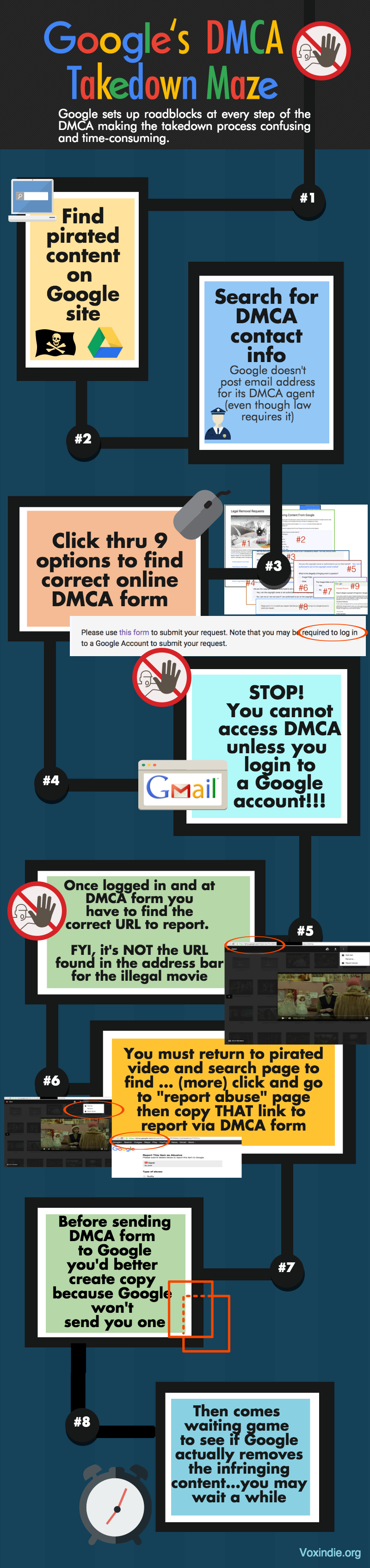
While that language required to craft a legal DMCA takedown notice is straightforward, the process for actually sending it to an OSP’s takedown agent is often not so clear. While some OSPs accept email notification (as required by law), other larger entities, like Google, prefer that requests be sent via a cumbersome and time-consuming online process.
Uploading infringing content to a Google site can be done with a mere click of a mouse, unfortunately removing it is not quite so simple. Because the email address for Google’s DMCA Agent is not posted on its websites, rights holders must jump through various hoops and navigate through a series of questions in order to arrive at the correct form. Once there it takes additional time to complete the 9-part form. Before one can actually send it one must be sure to create a Google account, then login and send.
Once the takedown request is sent, no copy of the actual takedown request is generated, only a brief acknowledgement of receipt. Then it’s a waiting game to see whether the infringing content gets removed.
Sending a simple DMCA takedown notice via email is simple, fast, and makes record keeping and follow up easy. Any update to the DMCA should continue to support email as an efficient way to send takedown requests and require that OSPs process emails with the same speed as those submitted via the web form.
Repeat infringement
Even if one sends a DMCA takedown notice to Google reporting a site for dozens of illegal links, Google allows the site to remain online. It takes multiple notices, sent 48 hours apart, to trigger any sort of account disabling.
Other sites employ varying degrees of punishment for repeat infringers and some do nothing. This is certainly an area of concern for rights holders as it adds to the overall ineffectiveness and inefficiencies of the DMCA notice and takedown process.
Any update to the DMCA should specify what constitutes a repeat infringement and require that OSPs publish this information on their website. The law should also require that the OSP be responsible for preventing any re-upload of content already reported as infringing. This can be achieved by employing technological solutions described in the following section.
Technological Solutions
Technology brought us to this point. It’s time technology be utilized to help safeguard copyrighted work. YouTube’s Content ID system, though not without problems, at least provides a way for rights holders to find and manage YouTube access for their music or films. Cloud storage provider Dropbox also employs technology to scan files for identifying hash data so that reported files cannot be uploaded repeatedly.
If an OSP’s (online service provider) business model is predicated on monetizing user-generated content (not vetted for copyright) then the OSP should be required, by law, to implement some form of digital fingerprinting to prevent infringing material from being uploaded in the first place. This type of technology would also help address enforce a takedown – stay down approach and prevent repeated uploads of pirated content to a site.
If an OSP does not have the resources to build its own proprietary tech like YouTube’s Content ID, there are a number of third-party vendors, like Vobile, that offer digital fingerprinting. While such 3rd-party services are not free, it seems only fair that cost of implementing a digital gatekeeper be considered a cost of doing business. Creators have long borne the “costs” of OSPs monetizing their content without permission. Having OSPs tap into profits to better protect copyright seems only fair.
Any update to the law should include a requirement that, in order to qualify for the limitations to liability that safe-harbor offers, certain user-generated content sites must implement reasonable technology to mitigate content theft.
Counter-notices and small claims process
Not only are creators burdened with having to play detective to find and remove their stolen content from various websites, but even the counter-notice system works against rights holders.
The counter-notice system allows recipients of an erroneous DMCA to prevent the removal of content and while such a system of checks and balances is important, problems occur when such counter-notices are themselves erroneous. Unless the sender of the DMCA notice files in federal court to enforce the takedown, following a 10-day waiting period, the reported content is reposted.
For most indie artists, the cost of filing in federal court to enforce a DMCA takedown is far too costly and so, in these cases, the infringing content remains online. I’ve experienced this situation multiple times and have seen full copies of a film reposted after a counter-notice (claiming fair use) was sent after a takedown on YouTube.
Perhaps, as part of any update to the DMCA, the time has finally come to create a small claims process to adjudicate copyright claims outside the federal court system. The U.S. Copyright Office has already studied the issue and has recommended creation of a voluntary system of adjudication to resolve copyright small claims. (http://copyright.gov/docs/smallclaims/usco-smallcopyrightclaims.pdf )
Content removed due to infringement should not be replaced by direct links to 3rd party site(s) that republish the same infringing links
Another issue not addressed by the DMCA is a problem that’s arisen thanks to a third-party database that records all the DMCA notices received by a number of OSPs including Google. The Lumen database https://lumendatabase.org/ (formerly Chilling Effects) offers a searchable database of these DMCA notices. While this might serve as a valuable archive, Lumen’s searchable database, in its current form, does not redact the infringing URLs from the DMCA notices and so–in effect–becomes an efficient search engine for pirated content. This afternoon I used Lumen’s search engine to look for illegal copies of the recent release “Carol.” With one click I found a link, then right-click and I ended up at an active, illegal copy online.
Lumen’s DMCA notices are also easily found thanks to Google’s direct links to them in what would seem to be blatant disregard for the DMCA’s intent–if not the law. The scenario works like this: When an infringing link is removed from Google search following a DMCA request, the search result remains, but the original infringing link is simply replaced with a fresh hyperlink to the DMCA notice stored in Lumen’s database. Essentially, removing the infringing link from Google search with a DMCA takedown requests only means a web user searching for pirated copies only has to click one additional link in order to find the pirated content he/she was looking for.
While the database itself may claim to operate under the mantel of “free speech” one has to ask how Google qualifies for “safe harbor” protection when infringing links removed from its search engine are replaced by a link to the DMCA notice on the Lumen database that contains the same, un-redacted infringing link. This type of re-linking should be explicitly banned in any update of the DMCA.
What’s at stake
Takedowns will continue to be a part of any DMCA fix, but collectively we must figure out a better way streamline the process, utilize technology, and mediate disputes in order to protect copyright and support a culture where creators can flourish– and the wealth of content they create can be enjoyed, and sustained, by consumers throughout the world.
If nothing is done to update the DMCA for the 21st century, content creators of all stripes will continue to struggle and the diversity, and variety of quality of creative content available to consumers will diminish. At first, we may not miss what isn’t made, but eventually our creative culture will be the lesser for it.
Hop aboard for another spin on Google’s DMCA Merry-Go-Round
It’s not news that Google-hosted Blogger websites are a favorite storefront for online pirates. It’s also not news that Google does its best to obstruct DMCA takedowns by setting up various roadblocks along the way. Today I discovered yet another example of just how difficult Google makes the DMCA process–this time with Blogger-hosted sites that use custom domain names.
When you create a blog using Blogger you’re given a domain that ends in blogspot.com. However users are free to use a custom domain name instead. That’s all well and good, unless the website distributes pirated content. In that case, if you’re a creator trying to get your pirated content removed (by Google), you’re likely to run into problems.
Usually, when one of these pirate entrepreneurs creates a site on blogspot.com a rightsholder can send a DMCA by using Google’s annoying web form (or annoy them by sending an email: [email protected]). However, if you use the same DMCA form to report a blogger-hosted site with a custom domain, Google won’t remove it. They’ll just send you back to the beginning.
I found out about this twist when I sent several DMCA notices this week on behalf of an indie film distributor. I requested the removal several pages of pirated movies I found on a Blogger-hosted website with a custom domain. The claim was rejected and the response on the Google Removals Dashboard read: Inappropriate for TCRP. Please submit through the standard web form.
TCRP stands for “Trusted Copyright Removal Program” but the problem is that I didn’t use any sort of TCRP…I wish I could, but I’m just a lowly commoner who doesn’t have access to this program. I USED THE STANDARD WEB FORM!!!!
Why–when there’s no doubt that this website is streaming a full copy of the film on a Google-hosted website–do they send me back to the same standard web form I used to send the original request? It’s an endless loop.Follow along below:
A DMCA request was sent using Google’s own web form (for Blogger) yet the claim is rejected and I’m told to send the takedown again using the very same form?
Apparently, even though Google hosts the pirate site, it refuses to remove infringing content the pirate is using a custom domain, not a blogspot.com domain. Welcome to the Google DMCA Merry-Go-Round. 🙁
When I researched the issue further I discovered I’m not the only one running into this problem. On Google’s own Blogger Help Forum there’s a recent thread about the issue. Last month a user DeeLite310 posted a question after receiving the same— Inappropriate for TCRP. Please submit through the standard web form–response to a DMCA s/he sent reportinga Blogger site pirated games.
Once again the not-so-helpful Google response was to send DeeLite310 (who’s not part of the TCRP) back the beginning of the Google Blogger DMCA merry-go-round. Here’s part of the exchange (but I suggest reading the entire thread to fully appreciate just how frustrating dealing with Google can be):
Welcome to the Google Merry-Go-Round…DeeLite310 is sent back the beginning…again and again…
Google loves to throw the word “transparency” around a lot in discussions around how it handles DMCA requests. Too bad it doesn’t provide more transparency when creators, victimized by pirates using Google products, make good faith (legal) efforts to request the removal of infringing content. As I’ve said before, the DMCA is broken…
*Update 5/16/16: During May’s Section 512 hearings in San Francisco I spoke with Fred von Lohmann, Google’s senior copyright counsel, about my blog post. He told me that I had indeed discovered a “bug” and that Google staff was working to fix the issue. I was happy to hear that Google was responding in a positive manner to this problem. I’ll test out whether it has been fixed by resending the original DMCA notice that prompted this post. Stay tuned…
Update 6/28/16: According to Mr. Von Lohmann, the bug has been fixed.
Google-funded report generates desired headlines and conveniently downplays the role of DMCA counter-notices–ignoring fact the system is weighted against rights holders
A new report on the DMCA notice and takedown system, Notice and Takedown in Everyday Practice, was released yesterday. Co-authored by researchers at Berkeley Law and Columbia University (collaborators for The Takedown Project), the release is clearly timed to generate buzz to coincide with the April 1st deadline for comments to the U.S. Copyright Office on the state of the 512 statute.
The study is said to offer, “a rare, in-depth, empirical look at ways online copyright disputes are handled between Internet companies, such as Google and YouTube, and content creators, such as movie, music, and publishing companies.” Hmmm, color me a tad suspicious of any piracy-related report funded by Google*.
You can read the full 160 page document here, and despite the fact Google is a main funder, I was hopeful that the report would provide an honest look at the current sad state of the DMCA notice and takedown system. What initially encouraged me was this paragraph in the Berkeley Law announcement:
The co-authors reveal how online copyright issues have led to problematic practices that threaten free expression, but they also highlight methods that effectively protect both content creators and providers.
However, my hopes for a fair examination of the issues were (mostly) dashed by this tidbit:
Although there are “counter notice” procedures for users, it is unclear if they work well.
Of course, I really shouldn’t be surprised by this intentional oversight, particularly when the research is conducted through the generosity of Google. How can one purport to do an, “in-depth, empirical look at ways online copyright disputes are handled between Internet companies, such as Google and YouTube, and content creators, such as movie, music, and publishing companies”without finding clarity on a major piece of the current notice & takedown process?
Drilling down into the actual report I found summary regarding counter-notices on page 128:
Study 1 OSPs described hesitating to encourage targeted users to send counter notices, even when it seemed appropriate, for fear of creating liability risk for targets and themselves. Unbalanced liability standards—fear of suit by copyright holders but not users—creates incentives for OSPs to take down material. Moreover, some of the main targets of large-scale requests— search services—have no service relationship with targets or any duty to inform them that links are being removed, making it highly unlikely that the target would know to send a counter notice. Further, as we discuss in recommendations, section 512 currently leaves unclear whether search engines are protected for putback like hosting entities, exacerbating the challenge. Overall, the counter-notice process’s procedural features make it difficult for OSPs to use it as intended. The counter notice process contains other flaws. In Study 1, OSPs described it as intimidating and confusing for targets.
I am not an attorney, but in my anti-piracy work I’ve repeatedly found the counter-notice system to be weighted against the rights-holder. I ran the above statement by a couple of copyright law experts and they agreed the concerns regarding OSP’s (online service providers) increased liability seems suspect. The only thing required by a counter-notice is that the sender provides real contact information (a good thing). The Takedown Project touts the need for “greater transparency” in the notice & takedown system so it would seem that identification of the parties involved in a copyright dispute is only fair.
Once YouTube receives counter-notice, pirated movie goes back online unless rights holder goes to federal court to enforce takedown.
I’ve written about my experience with sending a takedown notice on YouTube (for the removal of a full-length feature film that uploaded) and having the sender respond with a counter-notice. BTW, in contrast to the report’s characterization of the process, YouTube makes it very easy. Once the counter-notice (claiming “fair use”) was sent, I was powerless because the law requires the sender of the DMCA takedown to go to court to enforce a request. Since the filmmaker I represented didn’t have the financial resources to do that, YouTube reposted the ENTIRE FILM 10 days later. You tell me, who is the loser in this scenario? It’s one that’s happened to me multiple times on YouTube. Why does the report downplay the frequent abuse of the counter-notice system?
I’m also curious as to why researchers had such difficulty finding examples of counter-notices? Obviously the vast majority of takedown notices are valid and would be unlikely to generate a counter-notice but if takedown abuse is as rampant as researchers claim, there must be enough to cull meaningful data from. Yet, according to the researchers, “…all available evidence suggests that counter notices are simply not used. It is indicative of the problem that the most memorable uses of counter notices for our rightsholder respondents were a few bad-faith, bogus counter notices from overseas pirates.”
It’s worth noting that the Lumen database (previously Chilling Effects) that provided researchers with the takedown notices used in the study offers a tool for generating a counter-notice. Why doesn’t Lumen offer a database for counter-notices too? Did researchers simply give this issue short shrift because data was more difficult to come by, or because it would be an inconvenient truth, or both?
I brought up my concerns about counter-notice abuse with Berkeley researchers in 2014
In fact, in October of 2014 I participated in the USPTO’s ongoing series of public multi-stakeholder forums on improving efficiency the DMCA Notice & Takedown system. At the time Brianna Schofield, a teaching fellow at the clinic who assisted with the report’s research, gave a presentation about the study. As part of the Q & A follow-up I raised the issue of invalid/inaccurate counter-notices with her, hoping to bring attention to the issue. I’m disappointed to see that this issue didn’t garner a more rigorous look.
Although I haven’t had time to give the report a thorough reading, even with a cursory review I found more cause for skepticism.
The report makes for good (false) headlines, but the data is suspect
Berkeley Law’s story announcing the report’s findings claims that a study “found nearly a third (28.4%) raised at least one question about their validity.” Of course this characterization is intended to raise eyebrows, details of which can be found on page 2 of the research summary:
Study 2’s quantitative analysis revealed deficiencies in notice and takedown procedures, especially automated requests, as all takedown requests in the sample appeared to be automated. Nearly 30% of takedown requests were of questionable validity. In one in twenty-five cases, targeted content did not match the identified infringed work, suggesting that 4.5 million requests in the entire six-month data set were fundamentally flawed. Another 15% of the requests raised questions about whether they had sufficiently identified the allegedly infringed work of the allegedly infringing material. The analysis further identified significant questions related to the availability of potential fair use defense, complaints grounded on improper (non-copyright) claims, and requests sent to defunct web sites.
Note amid this gobbledygook that phrases like one in 25 actually equals only 4.2% but meanwhile that means 4.5 million over six months…sounds like a lot until you remember that Googlehandles 2 million requests per day. Adding to the confusion over results is that this “report” actually consolidates 3 separate studies making it difficult to figure out which end is up and what percentage means what…purposeful chaos. In study number 3 one bad actor was responsible for 53% of problematic takedowns tallied. Throw out a bunch of percentages hoping they stick somewhere, somehow…
Strikingly, nearly 53% of the Google Image Search takedown requests were from one individual sender, Ella Miller.17 All of these requests appeared to be improper subject matter for DMCA takedown—none were copyright complaints.
BTW, she’s described as a “European individual who is embroiled in an online dispute about modeling photographs taken of her.” Along with eye-popping percentages, the report includes a myriad of pretty charts to display this colorful, yet dubious data. Why bother to include this particular red herring’s notices in the study when the report notes they weren’t copyright complaints?
More striking is the question, why did researchers include this outlier’s data in their results?
It’s also ironic so much weight is given to notices sent by Ms. Miller given researchers’ glib dismissal of false counter-notices with the observation that “the most memorable uses of counter notices for our rightsholder respondents were a few bad-faith, bogus counter notices from overseas pirates.” Meanwhile, the majority of problematic takedowns highlighted in the report were bad faith, bogus takedown notices from one overseas model.
If Ms. Miller is such a problem, take her to court. After all, a legal counter-notice requires a sender to be truthful and to swear, under penalty of perjury, that the document is correct. Talk about blowing something out of proportion. One confused, overzealous individual with a grudge is notrepresentative of the millions who send legit DMCA takedown notices.
Of course, for folks in the Googlesphere these bogus numbers generated by the study had the desired effect…prompted, as if on cue, screaming headlines in Variety that read,Policing the Pirates: 30% of Takedown Requests Are Questionable (Study). Google lobbyists in Washington are no doubt quite pleased as they circulate this particular press clipping around town.
Personal blogs and social media sites are often used (knowingly) to promote piracy
Bogus headlines aside, the report also predictably raises the oft-used canard of free speech, that the DMCA is used as a nefarious cudgel against those poor bloggers et al (never mind that it was apparently the notorious “less sophisticated” Ms. Miller who was doing most of the targeting).
The third study, which focused on notices from less sophisticated senders, raised still greater concerns. These notices often targeted social media, blogs, and personal websites, raising questions about their effect on freedom of expression—and more than seven out of ten (72%) presented questions about their validity. Strikingly, more than half (all problematic) were from one individual sender. Of the rest, 36.8% were still questionable.
This Google-hosted pirate site offered dozens of free streams to indie films
Everyone agrees that the DMCA is in dire need of an overhaul for the 21st century, but to conveniently ignore the fact that it currently puts content creators at a distinct disadvantage is disingenuous. It’s also worth reminding this report’s readers to remember who’s behind it, where the money comes from, and what types of entity finds support via its legal advocacy. Let’s just say that indie artists whose works are routinely stolen and monetized (aided by companies like Google) aren’t included.
There are some positives in this report, particularly the suggestion to improve access to takedown technology for indie artists. From page 149 of the report:
In Congressional testimony, 359 representatives of independent artists and other smaller senders also criticized a lack of meaningful access to the more sophisticated enforcement methods (including automation, REO contracts, and monetization strategies) available to larger copyright holders. Although we did not speak with small senders directly, we note that the competition issues that arise with content filtering and monetization issues (see Section III.E.) also affect independent artists, smaller labels, and other individual creators. Further information-sharing and research efforts would also be beneficial:
Exploring ways to make monetization models more available to independent artists, smaller labels, other individual creators, and follow-on users.360
Exploring how to make automated tools to search for potential infringements more available to independent artists, smaller labels, and other individual creators.361 Crucially, these tools must follow the best practices outlined above in order to avoid exacerbating the issues we observed with mistake and abuse. In general, any expansion of automated systems should occur in combination with the liability-balancing measures suggested in Section V.D.1 in order to ensure that mistaken or abusive notices are minimized.
In my view this should be a key part of any effort to update the DMCA. There’s no reason OSPs cannot implement technology designed to offer a more efficient and effective takedown process. Making such tools available to creators of all stripes could help mitigate the negative impact of online piracy and copyright infringement.
One of the report’s authors, Joe Karaganis, vice president of The American Assembly at Columbia University, pulls out another favorite anti-copyright meme when he offers this summation that suggests a “rebalancing” is in order.
Ideally, I hope that our work convinces policymakers that some rebalancing of responsibilities is required so that the senders of notices are a bit more on the hook for bad takedown requests.
Sorry Joe, but there’s already a “hook” in place to deter “bad” takedown requests….the counter-notice. Of course, as I explained earlier in this post, that discussion was conveniently side-stepped by these studies.
And so it goes…overblown data, fancy charts, Google talking points, suspect timing….
Clearly there are ways to update the DMCA that will benefit consumers and creators alike, but making false claims about how the law does or doesn’t work won’t accomplish much beyond reinforcing well-worn tech talking points in advance of efforts to remake the DMCA.
In the meantime I can suggest one very simple way to lower these questionable takedown numbers…companies like Google should do more to prevent online piracy and copyright infringement.
We are grateful for funding support from Google Inc. as a gift to The American Assembly and from the Sloan Foundation for its support through the Berkeley Law Digital Library Copyright Project. Neither funder directed our approach in any way, and neither funder reviewed any methods, data, results, or reporting before public release.
As an indie film and broadcast journalism veteran, I'll share my perspectives on issues of interest to the creative community and beyond--Ellen Seidler


 Clearly there are ways to update the DMCA that will benefit consumers and creators alike, but making false claims about how the law does or doesn’t work won’t accomplish much beyond reinforcing well-worn tech talking points in advance of efforts to remake the DMCA.