by Ellen Seidler | Copyright

Kim Dotcom, megalomaniac mastermind of Megaupload
While awaiting for the outcome of criminal proceedings against him in New Zealand–and never one to be deterred by law or conscience–Megaupload’s Kim Dotcom has been busy hatching plans for a brand new online, cloud-based offering called “Mega.” According to a story in Wired, Dotcom’s new venture will “allow users to once again upload, store, and share large data files, albeit by different rules.”
In a “letter to Hollywood” published earlier this year, Dotcom warbled on about how much he “loved” Hollywood and claimed his vision was merely an innovative next step in a new online frontier.
Businesses and individuals will keep looking for faster connectivity, more robust online storage and more privacy. Transferring large pieces of content over the Internet will become common — not because global citizens are evil but because economic forces leading to “speed of light” data transfer and storage are so beneficial to societal growth…Providing “freemium” cloud storage to society is not a crime.
Of course providing “freemium” storage is not a crime, but paying people to uploaded stolen content and earning a profit from it is. In reviewing the features of Dotcom’s new “Mega” offering, it’s not entirely clear just how the site will make money and therein lies the rub. Will its business model resemble that of its defunct predecessor Megaupload or will it be a legitimate site like Dropbox or Yousendit?
The distinction between the two types of sites is significant. For criminal cyber-lockers, content theft is the engine that generates traffic, and thus income, for the site. When cash rewards are offered, users are incentivized to spread download links far and wide via online forums as though unleashing a virus. They engage in piracy not out of altruism, but to make money. Part of the indictment against Megaupload describes this aspect of the operation:
Third, for much of its operation, the Mega Conspiracy has offered an “Uploader Rewards” Program, which promised premium subscribers transfers of cash and other financial incentives to upload popular works, including copyrighted works, to computer servers under the Mega Conspiracy’s direct control and for the Conspiracy’s ultimate financial benefit. The more popular content that present on Mega Conspiracy servers would increase the number of visitors and premium users that the Conspiracy could monetize. In total, the Mega Conspiracy directly paid uploaders millions of dollars through online payments.
Legitimate sites, on the other hand, provide a number of valid (and legal) services that end-users are willing to pay for. While it’s certainly possible to share illegal content via these sites, if there’s no financial upside, most won’t bother.
As for Kim Dotcom, despite protestations to the contrary, there’s little evidence that he’s is in business to do public service. For him, monetizing stolen content has provided an efficient way to make millions and fund a lavish lifestyle featuring multiple mansions, yachts, and more. This new enterprise will also undoubtedly be designed to make many more millions. What remains to be seen is exactly how that will happen.
Will this new site, like its predecessor, depend on content theft to drive its core business? Dotcom and his cohorts have reportedly developed a system whereby all uploaded files will be encrypted and only the uploader has access (or knowledge) of what that encryption key is. From their perspective, this absolves Mega from any responsibility as to what types of content users share (from pirated films to child porn). Another significant change will reportedly be the way files are stored on Mega servers. Like the new cloud-based Pirate Bay, this new Mega is being designed to operate beyond the reach of law enforcement. From Wired:
One of the more unique wrinkles of the new service may come from Mega’s decision not to deploy so-called de-duplication on its servers, meaning that if a user decides to upload the same copyright-infringing file 100 times, it would result in 100 different files and 100 distinct decryption keys. Removing them would require 100 takedown notices of the type typically sent by rights holders like movie studios and record companies.
Increased anonymity aside, why would someone want to upload 100 copies of a file unless there is some type of incentive to do so?
We’ll have to wait and see exactly how the new Mega will entice users to upload (and share) content in order to transform traffic into revenue. What’s past is prologue, and with cyber-lockers we’ve seen greed has a way of morphing into crime. Unfortunately, unless Mega utilizes a revolutionary new business model to match their revolutionary new cloud-based nexus, it’s likely content creators will be back to square one when it comes to fighting against the world’s preeminent online pirate.

by Ellen Seidler | Copyright
 This morning I came across a two articles that offer insights as to how another effective front is being formed in the war against online piracy. The first piece, “Piracy Threatens Digital Growth” from Tech Central, highlights the need for media companies to “embrace” technology in order to “keep abreast of” consumer demands:
…the two biggest challenges facing content producers and distributors are piracy and regulation. “Most consumers don’t see piracy as a crime, or they see it as a victimless one,” she says. “The industry needs to shift consumers to the legitimate end of the spectrum.”
Some media companies, including film distributors, are considering releasing content on all platforms simultaneously because ease of access and timing are two key factors in getting consumers to pay for content.
The second, is a report cited by Terrance Hart in a blog post on Copyhype, that analyzes the impact France’s controversial 3-strike anti-piracy law has had on illegal downloads (and legitimate sales).
HADOPI’s numbers show that, contrary to the claims of copyright skeptics, the law did not threaten “vast swathes” of French internet users with punitive measures based solely on accusations. Instead, it seems to have achieved its purpose of educating users…consumer awareness of HADOPI has increased iTunes sales in France by over 22%. And a report by HADOPI itself after 17 months of operation showed that the clear decline in online piracy coincided with a rise in quality and quantity of legal cultural offerings.
Taken together, these two pieces offer compelling evidence that ongoing efforts to fight online piracy should include a bilateral effort to alter consumer habits–via legal means (legislation) in tandem with the continued development of new business models. As Hart eloquently points out,the goal of France’s law was not to punish downloaders, but rather to encourage legal consumption. So far, results are encouraging. The success of France’s 3-strikes law demonstrates that consumers, if gently dissuaded by the law from illegal downloading, will purchase content from legit sources (i.e. iTunes, etc.).
On the other front, in terms of commerce, it’s clear that, as technology evolves and platforms improve, those in the business of creating content are moving quickly to adopt new distribution models, releasing popular content to worldwide audiences, on a multitude of platforms, simultaneously. The BBC recently utilized this new approach with the UK season premiere of their the hit TV series “Doctor Who” on September 2nd. Rather than force U.S. fans to wait (and thereby encourage illegal downloading), BBC America made the series available to American viewers within 6 hours of the program’s initial broadcast in the UK. ABC (Australian Broadcasting) followed suit, offering the series via their premium service within minutes of the UK broadcast. This is good for business.
Moving forward, content creators, and those who represent their interests, should continue to apply pressure to those entities that profit from piracy (cyber-lockers, ad providers, and payment processors) while also directing attention toward the consumers of illegal content. Rather than demonize them, let’s do as France has done and use the law to divert them toward affordable options that provide immediate access to the content they’re so anxious to see. Hart noted that a voluntary “graduated response” agreement between U.S. ISP providers and the content industry is set to begin in coming months. If U.S. content creators, corporate and independent, are smart, they will be poised to leverage this alliance by matching their distribution models to meet customer demand. Consumers and creators will gain, and piracy profiteers will lose.

by Ellen Seidler | Copyright
According to a story by Ryan Singel on Wired.com, the Official DNC Youtube live-stream of Michelle Obama’s Tuesday night speech was blocked for apparent copyright violations. As Singel explained it:
YouTube, the official streaming partner of the Democratic National Convention, put a copyright blocking message on the live-stream video of the event shortly after it ended, which was embedded prominently at BarackObama.com and DemConvention2012. Would-be internet viewers saw a message claiming the stream had been caught infringing on the copyright of one of many possible content companies:
This video contains content from WMG, SME, Associated Press (AP), UMG, Dow Jones, New York Times Digital, The Harry Fox Agency, Inc. (HFA), Warner Chappell, UMPG Publishing and EMI Music Publishing, one or more of whom have blocked it in your country on copyright grounds. Sorry about that.
 For their part, Youtube officials described the incident as a “technical error” and assured viewers the problem wouldn’t recur. However, that didn’t stop Tech Dirt’s Tim Cushing from using the incident to deride copyright and Youtube’s Content ID system saying “the inherent stupidity of the action,automated or not, does absolutely nothing to lock down stray, unmonetized content and absolutely everything to highlight the ridiculous nature of copyright protection in a digital age.”
Apparently it’s fine for content thieves to use technology to steal and monetize the work of others but when rights holders employ technology to protect their rights it suddenly becomes a problem? Clearly there was technical issue with the Youtube live-stream that needed to be addressed but this incident has absolutely nothing to do with the legitimacy of copyright. Of course, that doesn’t stop piracy apologists from drawing false equivalencies at every opportunity.
As I wrote in a previous blog post, Youtube’s Content ID system is not perfect, but it is an important tool that rights holders can use to protect their content online. After all, technology is ours to use too isn’t it? What’s so ridiculous about that?

by Ellen Seidler | Copyright, Film, Google, Music, Piracy, Tech

YouTube Content ID isn’t perfect, but it’s something.
When Google recently announced a change to its search rankings algorithm--lowering results for known pirate sites–critics asked why the company would not do the same for YouTube , despite the site’s popularity as a repository for pirated films and music.
Such criticism seems justified. After all, Google-owned YouTube, like the pirate sites being penalized, receives thousands of DMCA notices each day. If they’re serious about re-ranking pirate site search results, how can Google justify YouTube’s exclusion from this self-imposed pirate penalty?
As I see it, there’s really only one way that Google/YouTube can justify this apparent contradiction. Unlike the penalized pirate sites, YouTube distinguishes itself in one significant way—by offering rights holders access to a “Content ID” system. Imperfect though it may be, YouTube Content ID technology is a feature that all indie musicians and filmmakers should understand and utilize.
Here’s YouTube’s short video that explains how Content ID works:
As YouTube explains it:
Rights holders deliver YouTube reference files (audio-only or video) of content they own, metadata describing that content, and policies on what they want YouTube to do when we find a match. We compare videos uploaded to YouTube against those reference files.Our technology automatically identifies your content and applies your preferred policy: monetize, track, or block.
According to Youtube, here are reasons you should use Content ID:
- Make Money. Hundreds of media companies have signed up already, multiplying their inventory of monetizeable videos.
- Fan Interaction. Turn your fans into marketers and distributors of your content—while letting them interact with their favorite content.
- Reduce Infringement. Educate your fans about your copyright preferences and prevent your content from being distributed on YouTube without your permission.
- Fully Automated. Once you’re set up, Content ID will identify, claim, and apply policies to YouTube videos for you.
- Market Data. Access snapshots of your content profile on YouTube, anytime. See how your videos are performing, monetizing, being blocked—at a glance.
Sounds too good to be true right? Well, kinda….but, despite overblown claims and systemic weaknesses, it’s better than the alternative (rampant piracy). With a Content ID account, you’ll gain some control over your content that’s uploaded to YouTube and can determine its fate. Based on what rights you hold, you can remove it, monetize it (share ad revenue with YouTube) or block it (worldwide or by territory) via a fairly straightforward dashboard-a welcome alternative to wasting precious time sending YouTube multiple DMCA notices. As with DMCA takedowns, uploaders retain the right to dispute a file’s removal via a counter-notice, but if you have removed legitimately infringing content, this is usually moot.
You can apply for a Content ID account here. Once you’ve been approved, you all have access to a “Content Management” dashboard that looks like this:

The process is actually relatively straightforward. In order to “deliver” content to YouTube, technically all you really have to do is “claim it” when you upload it. Even if you don’t plan to post a public file on YouTube, you can upload a copy of your song or film just as a reference copy for the Content ID system to use as a “fingerprint.” Below is an example of what the claiming options look like when you upload a file (and have an approved Content ID account).

If the file is for reference purposes only, make sure to make it “private” so that it won’t be accessible to the public. Once you have a copy of your work (video or audio) uploaded and claimed, you can use the search option, and search for your work by title or other associated key words that uploaders might use. For demonstration purposes, I searched using the term “Hunger Games Full Movie” by date to demonstrate what results could look like.
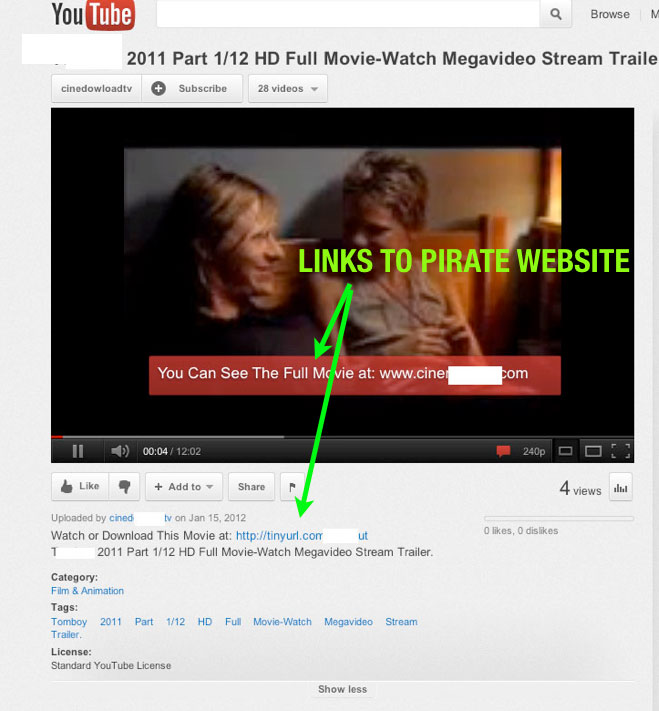
Note the search results showed dozens of pirate links uploaded within the last hour, something not uncommon for large Hollywood features. Most of these files are uploads made by pirates seeking to publicize (illegal) download links on other, non-YouTube sites. For pirates, uploading these bogus files is a free and easy way to advertise and direct users to their pirates websites. Unfortunately, while it appears that thousands of these are pirate clips are uploaded daily, The YouTube Content ID program can’t detect them, so you’ll have to use search to find. In the example below, you can see how using a keyword search can detect these infringing uploads.

Once you have a list like the one above, you can sort through it and see how you want to handle each file. I recommend making multiple searches using various keyword combinations. If you are searching for bogus pirate film files, including the word “full” or “full movie” are helpful. When you find illegal copies of your work, take note of what keywords the uploader used as it may provide insight into what search terms to use.
There’s also an option to send the entire list to “automated review.” That can be helpful if the clips include snippets of your film or music, but in the example above, most of the results point to dummy uploads (i.e. 10 minutes of black video with a single frame from pirated film). As I mentioned, YouTube Content ID cannot match these to any content, users are forced to look at each one by one and remove them. It’s tedious and time-consuming, but necessary.
Another option on your CMS dashboard is the option to view all “claims” that have been generated, either through manual search (shown above) or via YouTube Content ID. In terms of the latter, when a file is uploaded that matches your claimed content, it’s automatically added to your claims list. You can predetermine what happens to any matches (blocking or monetization) but if you choose to remove a file entirely, you must manually change the designation to “takedown.” Here’s an example from our CMS dashboard claims page that lists a number of recent pirate uploads linking to our film and some fan tributes/mashups.

In either case, whether discovering a questionable upload via search results or the claims list, if you find a file that contains your copyrighted content you can select it, and claim it based on your original reference version (note the bogus “Dreamworks” logo on this example used to make it look legit).

We tend to monetize the fan videos and remove (takedown) the pirate links. In the example below (pirate link to offsite version of our film) we chose “takedown.

Once you’ve taken down a video, viewers visiting the link will see this:

If a clip is discovered through video match, you can open the claim and change the default selection. This clip was monetized automatically, but had we wanted to, we could have blocked the clip or removed it. In this case, since it was a fan mashup, we chose to leave the default setting in place.

The dashboard also provides users with the ability to view income and drill down into analytics to determine the demographics and locations of your viewers. (Who knew lesbian rom-coms would be so popular in Saudi Arabia?)

You can also keep track of income, though, not surprisingly, this is the weakest and most opaque part of this system.

In order to actually be paid for any income accrued through monetization of your content, you must also have an active Google AdSense account. Fortunately, applying for an AdSense account is not all that difficult. Once approved, you must link your YouTube Content ID account with your AdSense account and receive payouts once your income exceeds $100. Depending on the type and amount of content you claim on YouTube, this can happen quickly or take months.
Is this system perfect? The short answer is NO. As mentioned previously, Content ID cannot catch the dozens or, in some cases, thousands of pirate uploads that contain dummy content but link to offsite downloads. You’ll have to ferret these out using search and remove them manually, but it’s still a thousand times more efficient than having to send DMCA notices.
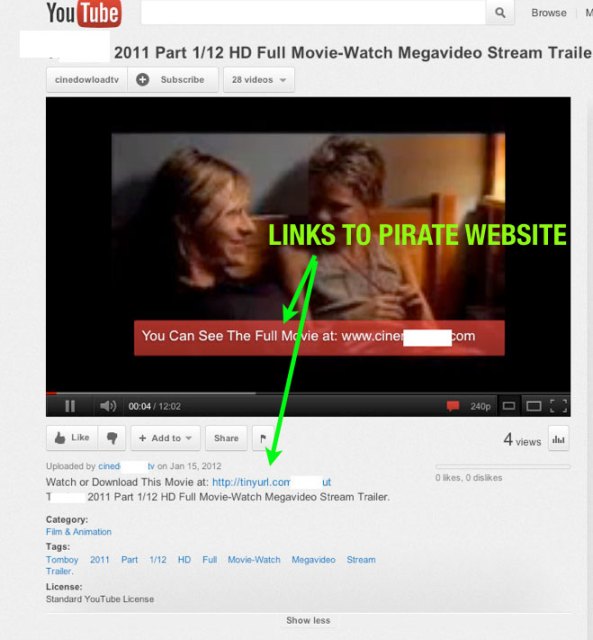
The Content ID system also seems to have a harder time finding clips that were previously uploaded to the site (before you claimed your content). When you create a new account, it’s advisable use search option on a regular basis to double-check for uploaded content, rather than depend entirely on Content ID’s automatic matching capabilities. If you do both, you can feel pretty good about having your bases covered when it comes to keeping pirated copies of your work off YouTube.
The other grey area with regard to the YouTube Content ID system and monetization is the utter lack of transparency. How much does Google actually make off the ads that appear next to your content? It’s not entirely clear and something Google should fix. One can only assume it’s to Google’s benefit, and not the artist’s, to keep this part of the system as opaque as possible.
When you start claiming and monetizing your content online you may also have uploaders who protest, citing the oft-used “fair use” excuse. If you have selected the option to monetize the content they uploaded, it’s usually as simple as writing them a short, polite message explaining that you own the rights to the material, but are not removing it, just monetizing it. However I’ve also had instances where someone uploads 10-minute sections of our film in multiple parts and claim “fair use” when I remove the clips. Again, I send a polite note explaining “fair use” does not allow one to upload 10 minutes excerpts of a feature film. It’s not a bad idea to include a link to Youtube’s copyright information/education pages as well. Once I send a note, I generally never hear back.
Whether or not you earn much income from your claimed content depends on the volume of material present, and the number of views generated. However, even if you won’t earn much in the way of income, it’s still worthwhile to take advantage of Content ID, if only to safeguard your work from piracy. The analytics can also offer some useful information as to the demographics and reach of your uploaded work and perhaps help guide you in developing effective new alternative approaches to online distribution.
Given today’s technology, there’s no reason websites around the globe can’t institute similar systems. Megaupload’s embattled Kim Dotcom likes to pontificate (to anyone who will listen) and claims he’s “…at the forefront of creating the cool stuff that will allow creative works to thrive in an Internet age. I have the solutions to your problems. I am not your enemy.”
Were that really true, why didn’t Mr. Dotcom use technology to transform Megaupload.com into legitimate UGC (user-generated content) by implementing a Content ID system like YouTube’s? Oh right, he would have had to share the profits. Despite his disingenuous rhetoric to the contrary, for him, theft for profit trumps technology any day of the week.
For sites that hope to create a legitimate business model to “share” creative work, providing content creators with technological tools to control online access to their work should be mandatory. If and when Congress revisits the antiquated DMCA (Digital Millenium Copyright Act) why not make such fingerprinting technology a requirement for meeting the “safe harbor” provisions of the law. Such a requirement wouldn’t “break” the internet, but could go a long way in mitigating piracy’s negative impact.
As online distribution options grow and improve, hopefully indie artists can say goodbye to the opaque revenue “sharing” model imposed by YouTube and take their content to sites/businesses where formulas for compensation are more transparent, and more generous to those who actually create the content.
For now, however, something is a whole lot better than nothing….
Update 12/13/13: See what’s happening with YouTube changes to Content ID on Multi Channel Networks and their affiliates on Plagiarism Today here: http://www.plagiarismtoday.com/2013/12/10/great-youtube-gaming-copyright-shakeup/


 According to an Associated Press story published on NBCnews.com, the U.S. embassy in Vietnam is utilizing a social media account on Zing, a website notorious for online piracy, in an effort to reach out to the country’s young people. This, despite the fact that Coke and Samsung recently pulled advertising from the site due to concerns about rampant piracy. Embassy officials defend their presence on Zing saying that options for outreach are limited in a country where the government controls most media.