by Ellen Seidler | Ad Sponsored Piracy, Copyright, Law, Piracy, Politics

Kim Dotcom, megalomaniac mastermind of Megaupload
Kim Dotcom sued by Hollywood studios
The legal woes for Megaupload’s founder Kim Dotcom continue with today’s news that six movie studios including Fox, Disney, Paramount, Columbia, Universal and Warner have filed a lawsuit in federal court charging Dotcom and his site with “massive” copyright infringement. From the complaint filed in federal district court in Virginia:
1. Until January 2012, when defendants were indicted on federal charges, defendants operated the notorious website and service located at www.Megaupload.com (“Megaupload” or �”Megaupload website”) as a commercial online hub for publicly providing popular copyrighted content, including thousands of plaintiffs’ copyrighted works, over the Internet to millions of Megaupload users without authorization ox license. On a daily basis, defendants intentionally infringed plaintiffs’ copyrighted motion picture and television programs on a massive scale and for a substantial profit. Defendants carried out this intentional, large-scale theft of plaintiffs’ intellectual property primarily through the operation of the Megaupload website, as well as associated websites like the video streanning service located at www.Megavideo.com (“Megavideo”).
2. Defendants intentionally and actively encouraged theix users to upload to the Megaupload computer servers infringing copies of the most popular entertainment content, including plaintiffs’ copyrighted television shows and movies. For example, through Megaupload’s “Uploader Rewards” program, defendants openly paid Megaupload users money to upload popular unauthorized and unlicensed content, including plaintiffs’ copyrighted television shows and movies, onto Megaupload’s computer servers. Pursuant to the Uploader Rewards program, the more often an uploaded file was downloaded by other users, the more money the uploader made.
3. Once a Megaupload user uploaded a file, defendants provided that user with a “link” to the infringing content and encouraged the user to disseminate the “link” as broadly as possible on the Internet so that as many people as possible would find the link and use it to download the infringing content from Megaupload’s servers.
4. Defendants profited handsomely from this copyright infringement in at least two ways: by selling users “premium” subscriptions, which enabled rapid, unrestricted downloading; and by selling online advertising space to advertisers.
The complaint goes to describe the site’s business model–one built on piracy whereby the more content uploaded, the more traffic for the site, and the more ad and subscription revenue earned–more than 25 million according to the complaint. It also pokes holes in the claims of Dotcom, and his apologists, that the site was a legitimate enterprise that merely provided storage for its users:
Contrary to some of defendants’ public assertions, Megaupload was not designed to be a private data storage provider. Users without premium subscriptions were restricted not only in their downloading capabilities, but also in their ability to store files on the site. Any content they uploaded would be deleted if it was not also downloaded within a certain period of time —after 21 days in the case of unregistered, anonymous users and after 90 days in the case of registered users who were not premium subscribers. Only premium subscribers (estimated to be 1% of users) could use Megaupload for long-term file storage. Thus, by design, Megaupload functioned not as a private online storage locker, but rather as a hub for uploading and downloading infringing copies of popular movies and television shows, including plaintiffs’ copyrighted works.
With this latest legal salvo fired against Megaupload and its founder perhaps it’s worth taking a moment to examine why YouTube, another site dependent on user-generated content (UGC) managed to survive and thrive, despite early accusations (and a major lawsuit) that labeled it a piracy cornucopia. Why did Megaupload end up on the dust bin of history while YouTube has become a web video (and music) juggernaut?
The early growth and popularity of both sites was dependent on the public’s general disregard for copyright law. Sure, some of the traffic to YouTube was generated by cute cat videos gone viral, but much of the site’s popular content included clips and often entire copies of tv shows and movies–content uploaders certainly had no right to disseminate. Like Megaupload, YouTube hid behind the shield of “safe harbor” and monetized the content with advertising but unlike Megaupload, the site did not offer cash or other incentives to uploaders, not directly anyway.*
In 2007 Viacom filed suit against YouTube and like today’s filing against Megaupload, the charge was “massive” and “brazen” copyright infringement. After seven years of legal back and forth, the parties finally announced they had settled the case in March, one week before they were scheduled to again face off in court. The companies issued a joint statement which characterized the resolution this way: “The settlement reflects the growing collaborative dialogue between our two companies on important opportunities, and we look forward to working more closely together.”
 Ultimately what separates YouTube/Google’s success versus Megaupload’s demise lies with the fact that the head honchos at Google determined that respecting copyright ultimately provided a better business model than ignoring it. On the heels of Viacom’s infringement suit, YouTube introduced its Content ID (digital fingerprinting) system in 2008 which gave rights holders a (relatively) efficient way to deal the massive copyright abuses that plagued the site. Rather than send hundreds, if not thousands of DMCA takedowns, musicians and filmmakers could claim content they own and be proactive in blocking, removing, or monetizing it. The key was that Content ID allowed the creators to determine if and how their content could be viewed on YouTube, not the other way around.
Megaupload paid lip service to honoring DMCA takedown requests, but in actuality was playing a shell game, removing infringing links but not removing the actual files. If you read the 70 page federal indictment against notorious pirate cyberlocker website Megaupload, you will find this charge on page 10, section 22:
When a file is being uploaded to Megaupload.com, the Conspiracy’s automated system calculates a unique identifier for the file (called a “MD5 hash”) that is generated using a mathematical algorithm. If, after the MD5 hash calculation, the system determines that the uploading file already exists on a server controlled by the Mega Conspiracy, Megaupload.com does not reproduce a second copy of the file on that server. Instead, the system provides a newand unique URL link to the new user that is pointed to the original file already present on the server. If there is more than one URL link to a file, then any attempt by the copyright holder to terminate access to the file using the Abuse Tool or other DMCA takedown request will fail because the additional access links will continue to be available.
During my dealings with Megaupload I’d long suspected as much. Time after time, I’d remove links using Megaupload’s content management tool only to see a duplicate file reappear (with a new link) minutes later. Of course, unlike federal authorities, I did not have access to the actual content residing on Megaupload’s servers, so I couldn’t really prove it.
In the fall of 2011 while I was researching a pirate blog that offered illegal downloads to LGBT films, I saw that the film “Kyss Mig” was being pirated. Since it’s a film distributed by the same company (Wolfe Video) that distributes our film I notified them of the infringing link. A DMCA notice was sent and, as expected, the link was disabled. However, when I went back to the website the following day I noticed that the disabled link had been replaced by a new one. That led me to again notify Wolfe and the exercise in futility was repeated. A few days later I noticed that the link was alive yet again, but the blog owner had changed things up (to protect her download) and the link now took me to an intermediate site “undeadlink.com.”
Essentially the site offered a convenient way to regenerate links to supposedly “dead” files on Megaupload (and apparently Fileserve). If Megaupload had actually removed the infringing file when it was originally reported, this wouldn’t have been an option. However, because Megaupload apparently did exactly what is spelled out in the indictment, it was very possible (and efficient). When I discovered what was going on last fall, and that it verified my suspicions, I decided to record the process. This video documents what I found.
[fve]http://vimeo.com/35648310[/fve]
Dotcom likes to pontificate (to anyone who will listen) and claims he’s “…at the forefront of creating the cool stuff that will allow creative works to thrive in an Internet age. I have the solutions to your problems. I am not your enemy.” Were that really true, why didn’t Mr. Dotcom use technology to transform Megaupload.com into legitimate UGC site by implementing a Content ID system like Youtube’s? Oh right, he would have had to share the profits. Despite disingenuous rhetoric to the contrary, unlike YouTube, Megaupload actually employed technology to ensure that copyright infringement continued rather than prevent it.
It’s an ethos that has allowed online piracy for profit (under the guise of innovation) to propagate across the globe. Why invest in a product when it’s just as easy to steal (and monetize) it? Of course Dotcom and Michael Robertson (founder of MP3tunes who was found liable and hit with a 41 million dollar verdict last month in a copyright infringement suit) have both discovered there are consequences to such theft, but this should be the norm, not the exception. Dotcom’s unbridled hubris and greed got the better of him. One can only imagine what he could have achieved had he crossed over from the dark side and followed YouTube’s lead.
Moving forward, preventing such businesses from taking root in the first place should be one goal in Congressional efforts to update the Digital Millennium Copyright Act for the 21st century. For all its faults, YouTube’s Content ID system lights the way for a possible path forward in redefining “safe harbor.” If a website’s business model to is predicated on “sharing” creative work, providing content creators with technological tools to safeguard their work should be a requirement for meeting the “safe harbor” provisions of the law. Such a requirement would not “break” the internet. It actually would could go a long way in fixing what’s currently broken.
Meanwhile, while YouTube has thrived where Megaupload has failed, businesses like YouTube can and should better reward the creators on whose work they depend. As online distribution options grow and improve, hopefully many will say goodbye to the opaque revenue “sharing” model imposed by YouTube (and others) and take their content to sites/businesses where formulas for compensation are more transparent, and more generous to those who actually create the content.

A download link to a pirated copy of our film on Megaupload.com
BTW, is there a way indie artists could jump on board the lawsuit filed by the studios? Why not make it a class action affair? There are plenty of indie musicians, filmmakers and authors around the world whose works (and livelihoods) were ripped off by Kim Dotcom’s enterprise. In their lawsuit the studios are asking for maximum statutory damages of $150,000 per infringement plus the profits the defendants generated. Just imagine how many new works might be in the offing if those thousands of creators whose works were pirated on Megaupload were awarded damages along with the studios?
*To this day there are still some YouTube users ‘s that earn ad revenue by uploading dubious content. Of course YouTube/Google earns income off these uploads too.

by Ellen Seidler | Copyright, Music, Piracy
 Yesterday Brad Buckles, Executive Vice President of the RIAA’s Anti-Piracy unit, wrote that “it’s time to rethink the notice and takedown provisions of the DMCA.” In a piece posted on the RIAA’s blog, he went on to outline the various ways that the DMCA (Digital Millennium Copyright Act) isn’t working. Up to this point we’ve heard a lot of discussion, mostly from copyright skeptics, about how the DMCA hurts innovation and thus tangentially, consumers. Little notice has been paid as to how the law (passed in 1998) has failed musicians, filmmakers, authors, journalists and others who create content–content now largely distributed via the digital realm.
Clearly the law is due for an overhaul, update, revision…. use whatever term you’d like. The bottom line is that the DMCA does little to help us (creators) safeguard our work, and by extension, our livelihoods.
Much is made (up) about supposed abuse of the DMCA takedown procedure by evil movie studios and record companies. It’s an issue that’s been overblown and is, frankly, one that pales in comparison to the daily barrage of pirated or plagiarized copies of their work that creators discover online each day. As I wrote in an earlier post on this blog:
Piracy apologists like to focus on erroneous takedowns and highlight stories whereby a 9 year-old in Finland had her computer confiscated, or a grandmother in Colorado had her ISP account wrongfully suspended. Certainly mistakes happen, and when they do it’s unfortunate, but they are few and far between when compared with the cumulative harm being done to those whose livelihoods are damaged by rampant online theft. For every search result removed in error there are thousands, if not hundreds of thousands, removed for valid reasons. Sensationalistic anecdotes make for splashy headlines and provide convenient red herrings for those who defend the piracy status quo–big bad Hollywood versus the grandmothers of the world–but meanwhile the genuine stories documenting piracy’s ruin are routinely minimized or ignored.
Also lost in this debate is the fact that if one takes the time to read the DMCA, it’s easy to see that the law actually favors the reported party, not the other way around. If a site has been removed in error, the owner can use the Google website to file a counter-claim with a click of a mouse. That immediately puts the onus on the party that filed the original DMCA request to go to court and prove the legitimacy of their claim. If that next step isn’t taken, the takedown becomes moot. Filing a court case is a costly endeavor so it’s unlikely that those whose file false DMCA claims, whether in error or purposely, would bother to spend money to enforce a bogus DMCA. Conversely, those content creators who don’t have deep pockets have little recourse when it comes to enforcing a valid DMCA takedown if the other party, representing an infringing (pirate) website, chooses to file a counter-claim.
In his post Buckles also points that the current system is largely impotent against a tide of online piracy for profit:
…the targets of our notices don’t even pretend to be innovators constructing new and better ways to legally enjoy music – they have simply created business models that allow them to profit from giving someone else’s property away for free. So while 20 million might sound impressive, the problem we face with illegal downloading on the Internet is immeasurably larger. And that is just for music.
We are using a bucket to deal with an ocean of illegal downloading. Under a controversial interpretation by search engines, takedown notices must be directed at specific links to specific sound recordings and do nothing to stop the same files from being reposted as fast as they are removed.
This warped system sustains an environment where (distribution) decisions that should up to the creator are instead made by profiteers too lazy (and cheap) to create their own content to monetize. Spin aside, the fact is that piracy does dilute the market for legitimately distributed content and does negatively impact the a creator’s bottom line. While the economic costs are obvious, a more insidious, but perhaps equally important reality is that this theft is gradually eroding the quality and diversity of creative work contributes to our collective culture. The sad truth is that we won’t realize how much we are missing if it’s never made.
Silicon Valley is thriving and millionaires made daily–but at whose expense? An industry that “innovates” on the back of another’s labor without due compensation is simply exploitative. Can’t we do better than that? Can’t we revise the DMCA so that it will shelter content creators from theft in a manner that is effective and affordable for independent artists and larger entities alike?
The real problem with the DMCA is not so much with the takedown process, but with the “safe harbor” provision the oft-abused language that provides shelter to digital thieves at the expense of rights holders. “Safe Harbor” has enabled the growth of a criminal cancer and it’s a cancer–that as of now–cannot be beaten, only kept (marginally) at bay. As I’ve suggested previously, any update to the law should include a requirement that in order to qualify for the limitations to liability that safe-harbor offers, user-generated content sites must implement reasonable technology to mitigate content theft.
Just as technology has evolved that facilitates the easy, worldwide dissemination of content– fingerprinting technology exists that could automate the takedown process. YouTube has already done so with its Content ID System. In order to qualify for “safe harbor” why can’t the future Kim Dotcom’s of the world do the same?
Digital technology can serve not as our nemesis, but our savior. Let’s craft legislation that leverages these technological capabilities to safeguard our creative work. Of course it will add somewhat to overhead costs, but so what? Why shouldn’t these businesses have to bear capital costs just as creators do when they produce a film, record a song, or write a novel?
Buckles writes “Creators of all types and sizes – and especially the individual creators who try to protect their content on their own, spending their own time and money sending takedown notices instead of making the movies and music to which they’ve devoted their lives — will tell you that the system isn’t working. The balance is off.”
Indeed, the balance is off, and as momentum builds in Washington to address issues of copyright and digital piracy, let’s hope creators voices are heard above the din of hyperbole and political posturing. As Buckle points out, “something isn’t working with this system which was intended to balance the rights of content creators with the rights of companies like Google.” Over these past 15 years the tech industry has thrived in large part because the DMCA is a flawed piece of legislation. Now let’s see if they–along with other interested parties–step up to help fix it keeping everyone’s best interests in mind.

by Ellen Seidler | Copyright

Content ID doesn’t help prevent pirate scams on YouTube
This week YouTube announced it was tweaking the algorithms used by its Content ID system in order to reduce the likelihood of erroneous takedowns. They also revised their dispute procedures to require rights holders to file a DMCA in order to enforce claims. Frankly, their system has always favored anyone who “disputed” a claim. As with the DMCA, YouTube’s previous procedure required that the rights holder to file a motion in court in order to enforce a disputed takedown. Most of us don’t have the money or time for that. Perhaps this new procedure will make the process more transparent and generate good buzz for YouTube, but as a practical matter, it doesn’t really change much.
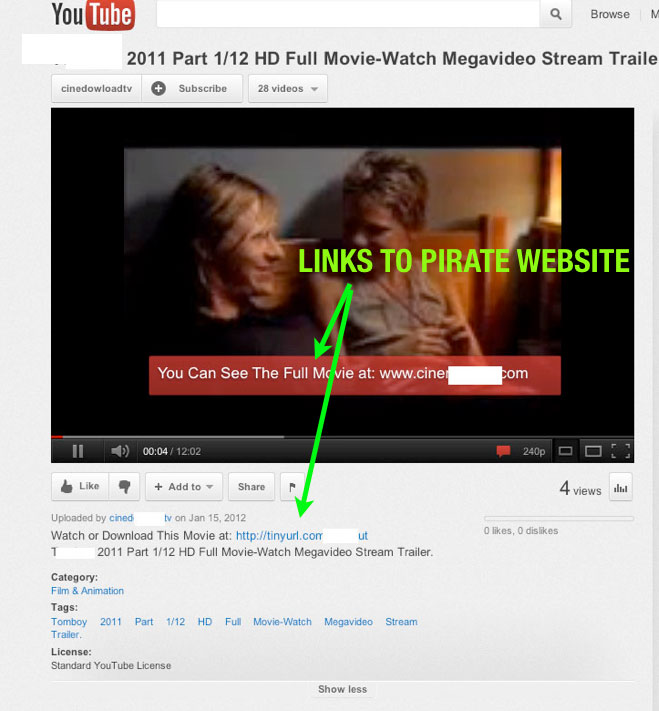
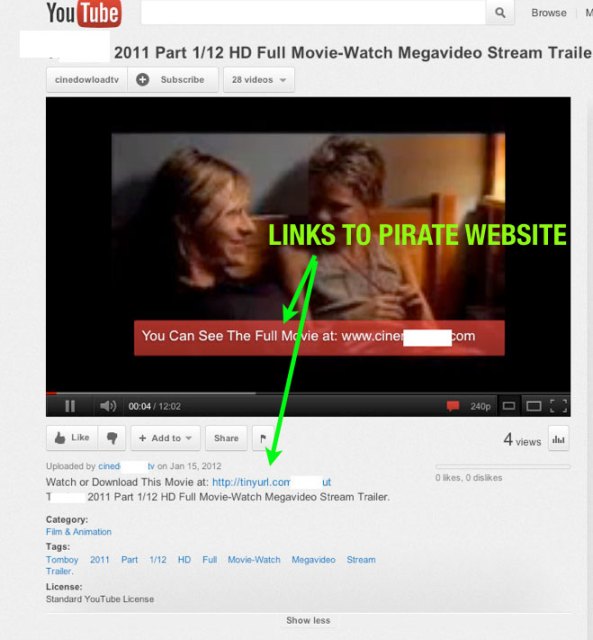
As I mentioned in an earlier blog post explaining how to use the Content ID, my real question is why didn’t YouTube address the other HUGE issue left unaddressed by the Content ID system? Why can’t YouTube Content ID algorithms be adjusted to catch the massive numbers of “fake” uploads that pirates literally use to advertise the availability of illegal downloads on other websites?
They claim to be improving their “matching quality:”
At the heart of Content ID is the matching technology that identifies partners’ content among all the videos on YouTube. Earlier this year we introduced a significant improvement to how the matching happens. We continue to work on ways to make the matching more precise through better algorithms and a more comprehensive reference library.
However, no mention is made of improving their technology to detect these dummy uploads. Pirates upload these files to YouTube and use specific search keywords to make them easy to find. Most are ten minutes in duration and contain a still from the pirated film with text overlays advertising the pirate link and a direct link in the description. While writing this post I used my own Content Management Account to search for the recent release “Arbitrage” using the search term “Arbitrage full movie.” You can see from the screen grab below that these dummy files weren’t hard to find.

Fake “Arbitrage” uploads on YouTube advertising links to pirate downloads.
When you go to the actual post you find a typical dummy upload. The pirate link is provided as a text overlay and in the description.
The keywords for this upload included: watch Arbitrage complete movie free,Arbitrage full movie + HD,watch Arbitrage complete movie online,Arbitrage part 1,Arbitrage Part 1 Full Movie + Free,watch: Arbitrage full online movie,Arbitrage :complete movie,Arbitrage free HD movie,watch: Arbitrage part 1 movie + free,watch Arbitrage online

Dummy upload for “Arbitrage” advertising link to pirate download.
When you click on the link you end up here:

Pirate site that uses YouTube to drive traffic.
If you look at one of these pirate’s YouTube page, you’ll find dozens of dummy uploads.

While it’s likely that thousands of these dummy files are uploaded daily on YouTube, in my experience they go undetected by the Content Management System. As I wrote in a post on www.popuppirates.com earlier this year:
Pirate thieves are entrepreneurs at heart. Money is what drives them. Since they can’t upload and/or monetize content they own via Youtube they resort to the next, best thing. They use Youtube as an advertising vehicle–a convenient gateway–to connect “customers” to their illegal websites.
I’m not sure why YouTube fingerprinting ID technology can’t automatically detect these files (most are videos comprised of a ten minute freeze frame). Why allow pirates to use YouTube for free advertising? To add insult to injury, notice too that when one navigates to one of these dummy uploads YouTube conveniently lists additional dummy uploads in the sidebar:

More dummy uploads offered by YouTube
As it stands, the only way a rights holder can detect them is to manually search and remove…a time-consuming process that few can afford. If folks at YouTube really want to “fix” their Content ID system, cutting off this lifeline to pirate websites would be a start.

by Ellen Seidler | Copyright
According to a story by Ryan Singel on Wired.com, the Official DNC Youtube live-stream of Michelle Obama’s Tuesday night speech was blocked for apparent copyright violations. As Singel explained it:
YouTube, the official streaming partner of the Democratic National Convention, put a copyright blocking message on the live-stream video of the event shortly after it ended, which was embedded prominently at BarackObama.com and DemConvention2012. Would-be internet viewers saw a message claiming the stream had been caught infringing on the copyright of one of many possible content companies:
This video contains content from WMG, SME, Associated Press (AP), UMG, Dow Jones, New York Times Digital, The Harry Fox Agency, Inc. (HFA), Warner Chappell, UMPG Publishing and EMI Music Publishing, one or more of whom have blocked it in your country on copyright grounds. Sorry about that.
 For their part, Youtube officials described the incident as a “technical error” and assured viewers the problem wouldn’t recur. However, that didn’t stop Tech Dirt’s Tim Cushing from using the incident to deride copyright and Youtube’s Content ID system saying “the inherent stupidity of the action,automated or not, does absolutely nothing to lock down stray, unmonetized content and absolutely everything to highlight the ridiculous nature of copyright protection in a digital age.”
Apparently it’s fine for content thieves to use technology to steal and monetize the work of others but when rights holders employ technology to protect their rights it suddenly becomes a problem? Clearly there was technical issue with the Youtube live-stream that needed to be addressed but this incident has absolutely nothing to do with the legitimacy of copyright. Of course, that doesn’t stop piracy apologists from drawing false equivalencies at every opportunity.
As I wrote in a previous blog post, Youtube’s Content ID system is not perfect, but it is an important tool that rights holders can use to protect their content online. After all, technology is ours to use too isn’t it? What’s so ridiculous about that?

by Ellen Seidler | Copyright, Film, Google, Music, Piracy, Tech
YouTube Content ID isn’t perfect, but it’s something.
When Google recently announced a change to its search rankings algorithm--lowering results for known pirate sites–critics asked why the company would not do the same for YouTube , despite the site’s popularity as a repository for pirated films and music.
Such criticism seems justified. After all, Google-owned YouTube, like the pirate sites being penalized, receives thousands of DMCA notices each day. If they’re serious about re-ranking pirate site search results, how can Google justify YouTube’s exclusion from this self-imposed pirate penalty?
As I see it, there’s really only one way that Google/YouTube can justify this apparent contradiction. Unlike the penalized pirate sites, YouTube distinguishes itself in one significant way—by offering rights holders access to a “Content ID” system. Imperfect though it may be, YouTube Content ID technology is a feature that all indie musicians and filmmakers should understand and utilize.
Here’s YouTube’s short video that explains how Content ID works:
As YouTube explains it:
Rights holders deliver YouTube reference files (audio-only or video) of content they own, metadata describing that content, and policies on what they want YouTube to do when we find a match. We compare videos uploaded to YouTube against those reference files.Our technology automatically identifies your content and applies your preferred policy: monetize, track, or block.
According to Youtube, here are reasons you should use Content ID:
- Make Money. Hundreds of media companies have signed up already, multiplying their inventory of monetizeable videos.
- Fan Interaction. Turn your fans into marketers and distributors of your content—while letting them interact with their favorite content.
- Reduce Infringement. Educate your fans about your copyright preferences and prevent your content from being distributed on YouTube without your permission.
- Fully Automated. Once you’re set up, Content ID will identify, claim, and apply policies to YouTube videos for you.
- Market Data. Access snapshots of your content profile on YouTube, anytime. See how your videos are performing, monetizing, being blocked—at a glance.
Sounds too good to be true right? Well, kinda….but, despite overblown claims and systemic weaknesses, it’s better than the alternative (rampant piracy). With a Content ID account, you’ll gain some control over your content that’s uploaded to YouTube and can determine its fate. Based on what rights you hold, you can remove it, monetize it (share ad revenue with YouTube) or block it (worldwide or by territory) via a fairly straightforward dashboard-a welcome alternative to wasting precious time sending YouTube multiple DMCA notices. As with DMCA takedowns, uploaders retain the right to dispute a file’s removal via a counter-notice, but if you have removed legitimately infringing content, this is usually moot.
You can apply for a Content ID account here. Once you’ve been approved, you all have access to a “Content Management” dashboard that looks like this:

The process is actually relatively straightforward. In order to “deliver” content to YouTube, technically all you really have to do is “claim it” when you upload it. Even if you don’t plan to post a public file on YouTube, you can upload a copy of your song or film just as a reference copy for the Content ID system to use as a “fingerprint.” Below is an example of what the claiming options look like when you upload a file (and have an approved Content ID account).

If the file is for reference purposes only, make sure to make it “private” so that it won’t be accessible to the public. Once you have a copy of your work (video or audio) uploaded and claimed, you can use the search option, and search for your work by title or other associated key words that uploaders might use. For demonstration purposes, I searched using the term “Hunger Games Full Movie” by date to demonstrate what results could look like.
Note the search results showed dozens of pirate links uploaded within the last hour, something not uncommon for large Hollywood features. Most of these files are uploads made by pirates seeking to publicize (illegal) download links on other, non-YouTube sites. For pirates, uploading these bogus files is a free and easy way to advertise and direct users to their pirates websites. Unfortunately, while it appears that thousands of these are pirate clips are uploaded daily, The YouTube Content ID program can’t detect them, so you’ll have to use search to find. In the example below, you can see how using a keyword search can detect these infringing uploads.

Once you have a list like the one above, you can sort through it and see how you want to handle each file. I recommend making multiple searches using various keyword combinations. If you are searching for bogus pirate film files, including the word “full” or “full movie” are helpful. When you find illegal copies of your work, take note of what keywords the uploader used as it may provide insight into what search terms to use.
There’s also an option to send the entire list to “automated review.” That can be helpful if the clips include snippets of your film or music, but in the example above, most of the results point to dummy uploads (i.e. 10 minutes of black video with a single frame from pirated film). As I mentioned, YouTube Content ID cannot match these to any content, users are forced to look at each one by one and remove them. It’s tedious and time-consuming, but necessary.
Another option on your CMS dashboard is the option to view all “claims” that have been generated, either through manual search (shown above) or via YouTube Content ID. In terms of the latter, when a file is uploaded that matches your claimed content, it’s automatically added to your claims list. You can predetermine what happens to any matches (blocking or monetization) but if you choose to remove a file entirely, you must manually change the designation to “takedown.” Here’s an example from our CMS dashboard claims page that lists a number of recent pirate uploads linking to our film and some fan tributes/mashups.

In either case, whether discovering a questionable upload via search results or the claims list, if you find a file that contains your copyrighted content you can select it, and claim it based on your original reference version (note the bogus “Dreamworks” logo on this example used to make it look legit).

We tend to monetize the fan videos and remove (takedown) the pirate links. In the example below (pirate link to offsite version of our film) we chose “takedown.

Once you’ve taken down a video, viewers visiting the link will see this:

If a clip is discovered through video match, you can open the claim and change the default selection. This clip was monetized automatically, but had we wanted to, we could have blocked the clip or removed it. In this case, since it was a fan mashup, we chose to leave the default setting in place.

The dashboard also provides users with the ability to view income and drill down into analytics to determine the demographics and locations of your viewers. (Who knew lesbian rom-coms would be so popular in Saudi Arabia?)

You can also keep track of income, though, not surprisingly, this is the weakest and most opaque part of this system.

In order to actually be paid for any income accrued through monetization of your content, you must also have an active Google AdSense account. Fortunately, applying for an AdSense account is not all that difficult. Once approved, you must link your YouTube Content ID account with your AdSense account and receive payouts once your income exceeds $100. Depending on the type and amount of content you claim on YouTube, this can happen quickly or take months.
Is this system perfect? The short answer is NO. As mentioned previously, Content ID cannot catch the dozens or, in some cases, thousands of pirate uploads that contain dummy content but link to offsite downloads. You’ll have to ferret these out using search and remove them manually, but it’s still a thousand times more efficient than having to send DMCA notices.
The Content ID system also seems to have a harder time finding clips that were previously uploaded to the site (before you claimed your content). When you create a new account, it’s advisable use search option on a regular basis to double-check for uploaded content, rather than depend entirely on Content ID’s automatic matching capabilities. If you do both, you can feel pretty good about having your bases covered when it comes to keeping pirated copies of your work off YouTube.
The other grey area with regard to the YouTube Content ID system and monetization is the utter lack of transparency. How much does Google actually make off the ads that appear next to your content? It’s not entirely clear and something Google should fix. One can only assume it’s to Google’s benefit, and not the artist’s, to keep this part of the system as opaque as possible.
When you start claiming and monetizing your content online you may also have uploaders who protest, citing the oft-used “fair use” excuse. If you have selected the option to monetize the content they uploaded, it’s usually as simple as writing them a short, polite message explaining that you own the rights to the material, but are not removing it, just monetizing it. However I’ve also had instances where someone uploads 10-minute sections of our film in multiple parts and claim “fair use” when I remove the clips. Again, I send a polite note explaining “fair use” does not allow one to upload 10 minutes excerpts of a feature film. It’s not a bad idea to include a link to Youtube’s copyright information/education pages as well. Once I send a note, I generally never hear back.
Whether or not you earn much income from your claimed content depends on the volume of material present, and the number of views generated. However, even if you won’t earn much in the way of income, it’s still worthwhile to take advantage of Content ID, if only to safeguard your work from piracy. The analytics can also offer some useful information as to the demographics and reach of your uploaded work and perhaps help guide you in developing effective new alternative approaches to online distribution.
Given today’s technology, there’s no reason websites around the globe can’t institute similar systems. Megaupload’s embattled Kim Dotcom likes to pontificate (to anyone who will listen) and claims he’s “…at the forefront of creating the cool stuff that will allow creative works to thrive in an Internet age. I have the solutions to your problems. I am not your enemy.”
Were that really true, why didn’t Mr. Dotcom use technology to transform Megaupload.com into legitimate UGC (user-generated content) by implementing a Content ID system like YouTube’s? Oh right, he would have had to share the profits. Despite his disingenuous rhetoric to the contrary, for him, theft for profit trumps technology any day of the week.
For sites that hope to create a legitimate business model to “share” creative work, providing content creators with technological tools to control online access to their work should be mandatory. If and when Congress revisits the antiquated DMCA (Digital Millenium Copyright Act) why not make such fingerprinting technology a requirement for meeting the “safe harbor” provisions of the law. Such a requirement wouldn’t “break” the internet, but could go a long way in mitigating piracy’s negative impact.
As online distribution options grow and improve, hopefully indie artists can say goodbye to the opaque revenue “sharing” model imposed by YouTube and take their content to sites/businesses where formulas for compensation are more transparent, and more generous to those who actually create the content.
For now, however, something is a whole lot better than nothing….
Update 12/13/13: See what’s happening with YouTube changes to Content ID on Multi Channel Networks and their affiliates on Plagiarism Today here: http://www.plagiarismtoday.com/2013/12/10/great-youtube-gaming-copyright-shakeup/


 Ultimately what separates YouTube/Google’s success versus Megaupload’s demise lies with the fact that the head honchos at Google determined that respecting copyright ultimately provided a better business model than ignoring it. On the heels of Viacom’s infringement suit, YouTube introduced its Content ID (digital fingerprinting) system in 2008 which gave rights holders a (relatively) efficient way to deal the massive copyright abuses that plagued the site. Rather than send hundreds, if not thousands of DMCA takedowns, musicians and filmmakers could claim content they own and be proactive in blocking, removing, or monetizing it. The key was that Content ID allowed the creators to determine if and how their content could be viewed on YouTube, not the other way around.