These days, if you happen to be a LGBTQ student at Harvard, good luck finding services. After Trump’s threats last spring, a once vibrant office BGLTQ+ office space that has served students since 2012 was shuttered.
Rainbow steps for Pride in 2024 (photo by author)
All that’s left is vague promise of, “Additional Resources Coming Soon‘ on the university’s website.
That’s why Press Secretary Karoline Leavitt’s rebooting of Trump’s war against Harvard last Saturday, where, during an appearance on on Fox News, she bemoaned its “LGBTQ graduate majors,” seemed particularly ironic.
Her renewal of the administration’s ongoing war against “woke” at Harvard, along with Secretary of Defense Pete Hegseth’s weekend announcement that war fighters wouldn’t be allowed either, came in the wake of a fresh Trump missive demanding Harvard pony up a BILLION dollars. This came via a typically unhinged hissy-fit posted on Truth Social after the New York Times apparently hurt his feelings earlier in the week.
This latest flurry of “anti-woke” Harvard rhetoric is just one more chapter in Trump’s ongoing rabid war against higher ed that began last spring with Columbia. Sensing blood in the water, Trump moved on to demand similar fealty from a number of other universities including Harvard, but those efforts were quickly rebuffed.
Today, we stand for the values that have made American higher education a beacon for the world. We stand for the truth that colleges and universities across the country can embrace and honor their legal obligations and best fulfill their essential role in society without improper government intrusion. That is how we achieve academic excellence, safeguard open inquiry and freedom of speech, and conduct pioneering research—and how we advance the boundless exploration that propels our nation and its people into a better future.
Backed by its 56 billion dollar endowment, Harvard immediately filed suit in federal court to block federal cuts and in September, a summary judgement in its favor was granted. In her decision Judge Allison D. Burroughs noted, among other things, that the Trump administration’s oft-used charge of antisemitism to justify its funding cuts was a red herring.
The idea that fighting antisemitism is Defendants’ true aim is belied by the fact that the majority of the demands they are making of Harvard to restore its research funding are directed, on their face, at Harvard’s governance, staffing and hiring practices, and admissions policies—all of which have little to do with antisemitism and everything to do with Defendants’ power and political views.
The First Amendment is important and the right to free speech must be zealously guarded. Free speech has always been a hallmark of our democracy.
…Now it is the job of the courts to similarly step up, to act to safeguard academic freedom and freedom of speech as required by the Constitution, and to ensure that important research is not improperly subjected to arbitrary and procedurally infirm grant terminations, even if doing so risks the wrath of a government committed to its agenda no matter the cost.
Why were Harvard’s LGBTQ+ students erased?
So, fast-forward to the present day. While Karoline Leavitt grouses about Harvard LGBTQ “majors” to fuel Trump’s anti-Crimson tantrum reboot she apparently didn’t take notice of the fact that the university had already quietly abandoned its LGBTQ students last summer.
In order to fully appreciate what’s transpired, it’s useful to re-examine how the language President Garber used in his initial response to Trump’s threats was deftly crafted to seemingly defy Trump demands while simultaneously, and subtly, setting the stage for some serious capitulation.
We need to ensure that the University lives up to its ideals by taking concrete steps to reaffirm a culture of free inquiry, viewpoint diversity, and academic exploration; making changes to our disciplinary systems so they will be more consistent and more effective in ensuring that our students, faculty, and staff take responsibility for their actions; implementing measures to ensure that all members of our community are safe and respected; and adopting important adjustments to the ways we build community—continuing to focus on individuals and their unique characteristics rather than their race. [emphasis added]
As part of this “working together,” process, Harvard administrators—unlike those at other targeted universities—determined that it would be acceptable to erase Harvard’s LGBTQ+ students from its website—and ultimately, its campus. How did this happen? Why did Harvard, in effect, bend the knee?
Last spring, while fighting funding cuts in court, Harvard also set to work to eliminate any obvious whiff of DEI on campus, replacing it with a potpourri of more benign offerings. The Office of Equity, Diversity, Inclusion, and Belonging was closed while a brand new Office for Community and Campus Lifeemerged from its ashes.The Harvard College Women’s Centerand the Office for BGLTQ Student Lifewere also shutteredwhile The Foundation for Intercultural and Race Relations morphed into something called The Harvard Foundation.
And, as a cherry on top, a new Office of Culture & Community was also established under auspices of the Dean of Students.
All this demolition, retooling and rebranding was a cop out. Rather than perform Kabuki theater, Harvard could have, should have—called the administration’s bluff and said no— DEI is actually a good, no, a great thing. Why not make the case that the concept of paying attention to diversity and inclusion is not about offering special treatment—but making sure talented people are NOT overlooked? The actual truth is that if you’re a person of color or female in our society, too often you have to be twice as talented to get half as far. That’s a fact.
Ironic, but in January of 2026 the Department of Education agreed to drop its demand that colleges and universities drop DEI programs after courts determined it violated the 1st amendment in August of 2025. Harvard could have resisted, but in weighing its options, it clearly chose the path of least resistance and folded quickly. As Randi Weingarten, president of the American Federation of Teachers said in a news release following the announcement:
When you fight you don’t always win, but you never win without a fight. We are proud that this case has once again halted the administration’s pattern of using executive fiat to undermine America’s laws that enshrine justice and opportunity for all.
I wonder how President Garber squares this circle, particularly in light of his impassioned defense of higher education offered in his first letter to the Harvard community last April.
Freedom of thought and inquiry, along with the government’s longstanding commitment to respect and protect it, has enabled universities to contribute in vital ways to a free society and to healthier, more prosperous lives for people everywhere. All of us share a stake in safeguarding that freedom. We proceed now, as always, with the conviction that the fearless and unfettered pursuit of truth liberates humanity—and with faith in the enduring promise that America’s colleges and universities hold for our country and our world..
Of course, rather than lead the resistance against the absurd, culture war “anti-woke”cri de coeur wielded as a well-worn cudgel in Trump’s Project 2025 directed attacks on higher ed, Harvard’s wisest believed that dropping various offices into a blender to create a product palatable to those forces would be a winning strategy. Why not throw Trump a bone? Harvard’s leadership ignored the one sure thing that happens when dealing with Trump’s mob extortion tactics—If you give an inch, he’ll take a mile. As David Kirp noted in his piece in The Guardian.
Those who bend the knee rationalize their actions as simply a prudent survival strategy. But that’s delusory, for the historical record shows that anticipatory compliance paves the road to autocracy. Bullies like Trump always demand more from their supplicants – more money, more abandoning principles, more loyalty-oath behavior. Anticipatory compliance feeds the beast, showing authoritarians how much they can get away with.
This brings me back full circle to present day. When the habitually dishonest Karoline Leavitt appeared on Fox this weekend to attack Harvard, chirping the tired canard of LGBTQ wokeness on campus—she apparently didn’t realize that her boss had already succeeded in eliminating that particular threat?
Karoline, Harvard already took care of that pesky LGBTQ issue.
Leavitt overlooked the fact that Harvard’s sterilization protocol to eliminate any woke germs left on campus also required making sure LGBTQ undergraduates were given no shelter, no support. LGBTQ student services weren’t simply folded into the benign Crimson stew of updated offerings—they disappeared.
Meanwhile, back at the shiny new Office of Culture and Community there’s this cheery note:
Exposure to and learning from different backgrounds, perspectives, and experiences leads to intellectual and personal growth, and the betterment of the University. We encourage the best to learn alongside one another, as they learn from one another. Everyone benefits when all are welcomed, supported, and included. [emphasis added]
It’s worth noting that the first groups featured on its website include Making Meaning (spiritual) and Military Affiliates. (Ironic that Pete Hegseth hadn’t noticed this dubious and transparent effort to cozy up to the military). Others highlighted include the First-Generation, Low-Income and the Harvard Foundation programs.
Not to discount the the 100 or so veterans and ROTC members on campus, nor those who are religious, but according to the Harvard Crimson’s Class of 2025 survey (the most recent I could find) the number of LGBTQ+ undegraduate students at Harvard is quite significant. Despite this—in the war against woke—LGBTQ+ undergrads aren’t worthy of mention—ignored both as a community and a culture.
Never mind that the college years are, for many, a hugely formative time in one’s life where support services can be especially crucial for vulnerable students. As someone who landed at Harvard as a freshman 50 years ago—feeling homesick, overwhelmed by classes and social expectations—while in the midst of a journey to embrace my identity as a lesbian—I cannot fathom how Harvard’s current administration thought it acceptable to dismantle such services, particularly at a time when identifying as a member of the LGBTQ community in America has become so fraught.
Looking around at various institutions around the nation, it’s not difficult any number of colleges and universities that offer support resources to their LGBTQ students. Unlike Harvard, rainbows on campus don’t seem to be a concern elsewhere.
Meanwhile, after much searching on Harvard’s website, the only vague hint of a LGBTQ presence on campus today—aside from archives—came via the sanitized replacement for Harvard’s Office for Gender Equity. (Somewhat off-topic and as an ironic aside I couldn’t resist posting— when I searched the term “lesbian” on Harvard’s website, this was the top result.🙄)
Ah, but I digress—back to my point. Since the term gender equity is also apparently now verboten at Harvard, the office that existed in January 2025 was replaced by one named CSNDR, the acronym for a generic and and non-threatening mouthful of a title, “Community Support, Non-Discrimination, Rights and Responsibilities.”
To appreciate the destruction (and dubious reconstruction) that’s taken place at Harvard, and how we got arrived here, it’s worth reviewing before and after snapshots from their website. The Wayback machine provides evidence of the before Trump vs the after.
CSNDR works with the Harvard community to foster an environment free from discrimination, interpersonal violence, and the impacts of such harm.
Before we move on to view the one, miniscule, and thereby dismissive mention of Havard LGBTQ+ undergraduate students that remains—for old time’s sake take, look back to January 20, 2025 on Harvard’s website when the Office of BGLTQ Student Life was alive and well.
As noted previously, now that safe space is no more—replaced by the aforementioned CSNDR and brief mention that’s barely a bookmark. For the record, a ghost version of the website still haunts the url: bgtlq.fas (dot) harvard.edu, but it’s inactive and unlisted. I first began monitoring this issue last October, and since then there have been no updates— as of today, February 9, 2026 all that’s remains of LGBTQ+ undergrad life on the Harvard campus is a “coming soon” notice.
So Karoline, your latest anti-woke missives directed at Harvard do seem a tad hyperbolic, no? And although Harvard is continuing its fight against funding cuts, the university clearly decided, as a token submission, to throw undergraduate LGBTQ students under the bus a few months ago. Perhaps next time, before lobbing dubious talking points on Fox News, White House staff should pay more attention to facts on the ground eh?
Meanwhile President Garber, what exactly did you mean when you wrote:
“Seeking truth is a journey without end. It requires us to be open to new information and different perspectives…”
What veritas is Harvard offering?
As for my perspectives on my alma mater, I’ll soon be publishing Part 2 of this piece recounting my aforementioned experiences as a young lesbian on campus at a time, 50 years ago, when LGBTQ life at Harvard was lived mostly on the down low, as an illustration as to why the changes that took place over subsequent decades really did matter. Hard to believe—but a half a century later—it seems those days may have returned. Stay tuned….
When people talk about effective ways to mitigate the impact of online piracy, YouTube’s Content ID is often used as an example of what works. Unfortunately, despite its role as poster boy for anti-piracy tech, in reality it falls flat as a gatekeeper against online piracy.
Aside from a labyrinth-like user interface that seems likely to have been designed–not to help– but to discourage rights holders from using Content ID, the actual fingerprinting technology behind it can be easily fooled.
YouTube introduced the Content ID system in 2007. At the time, the company was facing pressure from a Viacom lawsuit, among others. According to YouTube, it’s pretty straightforward:
Videos uploaded to YouTube are scanned against a database of files that have been submitted to us by content owners. Copyright owners get to decide what happens when content in a video on YouTube matches a work they own. When this happens, the video gets a Content ID claim.
Looking to make money off work they don’t own, clever YouTube users have discovered ways to fool the technology so their illegal uploads of copyrighted movies and music don’t get flagged, blocked or removed.
I began noticing this phenomenon more lately as I’ve begun to find full, infringing copies of films uploaded that matched content owned by a film distributor I work for. This seems to be happening more often and I was curious as to how these pirated copies had avoided detected by Content ID. When I looked closely I saw that subtle manipulations in brightness had taken place along with slight adjustments to frame size and sometimes the crop of the frame.
When I started poking around YouTube to find other examples of these uploads they were easy to find. It only took me a few minutes to find dozens of copies of a variety of full copyrighted movies, old and new. One title I came across was the movie, Everest. Below are screen captures from two different full uploads of the movie I found streaming on YouTube.
Two full copies of the movie Everest uploaded to YouTube.
In this case the uploader had used several techniques to avoid detection including reversing the frame (note the backwards title), darkening the lower part of the frame and cropping it. Of course, having recently viewed the film on HBO, watching a lousy copy like this on YouTube wouldn’t be my choice, but apparently others didn’t mind. Uploaded only a month ago, the movie had already racked up more than 16,000 views.
Pirate uploads make money for uploader and for YouTube
Why go to all this trouble to manipulate a movie for upload to YouTube? Well, it’s the age-old pirate motivator–money. This uploader, who goes by the name Kenneth Lamb, has claimed ownership of this content and monetized it with ads. He makes money. YouTube makes money. The movie’s actual production companies make nothing.
This YouTube user claims to own rights to Everest movie worldwide and makes money off ads
In an ironic twist, several of the ads that appeared when I was examining (and reloading) this pirated copy of the film were for films including DreamWork’s upcoming movie Trolls and Warner Brother’s Jason Bourne.It’s more than a tad ironic that Hollywood studios are (inadvertently) putting cash in YouTube’s hands via advertising on a pirated copy for one of its own productions.
Ultimate irony that ads for upcoming movie releases are featured on pirated copies of Hollywood films
I don’t deal with music or audio files on YouTube but there are similar manipulations happening there as well where uploaders resample, add noise, etc. to fool the Content ID system into ignoring the file.
What can YouTube do to fix this growing problem? Per usual, the list is long and varied, but begins with asking Google engineers to design better fingerprinting tech. There are other companies that offer digital fingerprinting technology seem to do a better job catching these circumventions. If I can easily uncover an upload is a copy of the movie Everest, why can’t Content ID? You can’t tell me that with all its financial (and technological) resources YouTube doesn’t means to upgrade its system?
Technological solutions exist. It’s just a matter of priorities. Stopping piracy isn’t a priority for YouTube.
Aside from updating its fingerprinting capabilities, YouTube could also improve the Content ID system through providing a better interface, more transparency, better compensation for artists, etc. Of course again that would mean lower profits for Google/YouTube so such straightforward fixes are unlikely. Meanwhile, YouTube makes great hay out of its concerns for poor, maligned users who may have received an erroneous DMCA notice. The company is willing to spend money to defend a few select uploaders but won’t spend resources to fix its broken Content ID system?
Operating only a marginal (not great) Content ID system is in YouTube’s best interests
Of course the powers that be at YouTube probably prefer to keep Content ID just the way it is–creaking along, occupying a neutral zone positioned between accolades and scorn. It’s a safe position, one that gives YouTube officials cover when they use disingenuous excuses about their anti-piracy practices to critics, while avoiding any real (legal or financial) consequences.
Content ID does the job just well enough….but that doesn’t mean it does a good job. It could serve as a true model for technological safeguards against piracy, but as now, it’s merely a slight bump in the road for those determined to steal and monetize the works of others. Meanwhile, YouTube continues to pocket advertising cash, make its stockholders happy while leaving filmmakers and musicians on the outside, looking in.
Why not make Content ID more accessible and transparent?
Much has been written about YouTube’s Content ID program, a fingerprinting technology that allows rights holders to find and claim their music or movies when uploaded to YouTube. The technology was introduced in 2008 in the wake of Viacom’s lawsuit against YouTube and since then has helped (some) creators mitigate the problem of piracy on the popular UGC (user-generated content) site.
Those who have access to the Content ID system can uploaded reference files and use a dashboard to choose how matches should be handled. They can be limited based on audio, video, and length. Matching content then can be blocked, removed, or monetized based on territorial rights.
I’ve written many pieces about what works and what doesn’t when it comes to Content ID so I won’t be redundant here, but this week I read some pieces which highlight some lingering issues that continue to limit the reach (and effectiveness) of this technology–most notably limited access and accountability.
Are audiobooks being ignored?
Author Ryan Holiday published a piece in The Observer asking, “When Will YouTube Deal With Its Audiobook and Podcast Piracy Problem?” He described how using search, he’d found the audio version of one of his books streaming, in full, on YouTube. The audio had been streamed 16,000 times. He observed, “It might not seem like a ton but the book had sold about 50,000 copies in audio—an additional 30% of that figure pirated it through a single video?”
Holiday goes on to repeat the oft-heard lament of filmmakers, musicians, et al who have found their pirated works streaming on YouTube. Like many of them, Holiday believes YouTube needs to make it easier for artists to protect their creations from this type of theft:
For its part, YouTube needs to get its act together and offer tools directly to publishers and authors. Audiobook piracy is real and clearly growing. The idea that songs and television and films all deserve protections from Content ID but authors don’t is absurd.
Now, to be fair, it’s not clear that Holiday himself has ever applied for Content ID access. It seems that the YouTube’s language dissuaded him.
I can continue to file these claims as the author but since I’m not a major publisher with a “substantial body of original material,” I can’t participate in YouTube’s Content ID personally.
If I were an author (or publisher) I would not hesitate to at least try to apply for a Content ID account. I had no difficulty being approved for a Content ID account in 2010 and only own the rights to two films, a feature and a documentary that I co-produced. The companies that distribute my film also have Content ID for their film catalogues.
…an evaluation of each applicant’s actual need for the tools. Applicants must be able to provide evidence of the copyrighted content for which they control exclusive rights…Content ID applicants may be rejected if other tools better suit their needs
The key here is the last sentence. There’s also Content Verification which seems to be another, higher tier of Content ID aimed at large companies. The other “tool” is simply sending a takedown via web form. That may be appropriate in very limited situations, but using it can be time-consuming and also requires a rights holder be proactive in searching for infringing content. Since Content ID does that work for you it’s the key reason it should be made available on a much wider scale. As Holiday noted, one copy of his book was accessed thousands of times….shouldn’t the onus be on YouTube to put a roadblock up to prevent infringement? Why should creators be required to be copyright cops too?
Lack of transparency has long been a flash point for musicians vs. YouTube
Frustration over YouTube’s Content ID and monetization scheme was also at the core of a blog post by 5-time Grammy winner, musician Maria Schneider published on Music Tech Policy. Schneider has become a strong advocate for artists rights and attacks Content ID on a number of levels including skewering YouTube over its lack of transparency (a common complaint among many musicians) and for its apparent refusal to grant access to artists–even those like her–who are Grammy recipients.
Content ID is reserved for big record companies with big catalogues, and probably selected independent artists whom YouTube believes will make YouTube a heap of money…In the press, YouTube has fought back against the recent flood of criticism, saying that all rights-holders can access Content ID – that they can get it through “third-party vendors.” These third party vendors often take between 20% to 50% of the revenue paid by YouTube—after YouTube takes its share.
I highly recommend reading Schneider’s post for her account of how Content ID has failed her and other musicians. As a filmmaker, in terms of using Content ID simply to combat piracy, my experiences have differed, but I do share many of her overall concerns. Unfortunately, the fact she (and others) are apparently being denied direct access to Content ID tools is an ongoing issue that inflames the lingering, legitimate mistrust creators have with Google.
Does it really need to be this way?
In spite of years of ongoing complaints like these, neither Google nor YouTube seem really to have made a genuine effort to work with artists–instead preferring to stonewall or sidestep debate. When YouTube officials do comment, they often find themselves tangled up in webs of their own making, as was the case when musician Zoe Keating took them to task in a very public exchange. Why not work with creators to solve some of these problems instead of demonizing them? There are ways to find common ground if only the powers that be at Google would care to (really) listen.
Content ID could make it easier for creators of all stripes to ask permission instead of simply taking content
Moving the Content ID machinery out of the shadows could pay dividends in other ways–perhaps by helping bridge the divide in disputes over copyright. Maarten Zeinstra, an “advisor on copyright and technology” recently penned a thoughtful blog post proposing that YouTube’s Content ID could become a useful tool for those who interested in utilizing content in legitimate ways. His piece, “YouTube should open up Content ID” was published this past May on the Dutch website, Kennisland. In it, Zeinstra noted:
YouTube should open up Content ID and make their register of rights holders publicly available...Let anyone be able to contact the rights owners of a certain clip or publicly contest that ownership. This creates an innovative new possibility in using content with permission or under copyright exceptions, and create legal certainty for copyright holders and remixers alike.
Now, I’m a tad skeptical as to what he means by “contest that ownership” but I’m open to the possibility that he’s merely describing a middle ground. If someone wants to make a mashup video using clips from my film or segments of archival footage from my documentary they could use Content ID to find that I am the rightful owner of the footage and can ask permission. Personally, I support the idea of fair use but also appreciate the fact that one should ask permission. I did so with footage used in my documentary and was always met with a positive response. Perhaps opening up Content ID in this way could foster a new respect for the work of creators and support the idea of asking, and not simply taking.
Improving Content ID would be in everyone’s best interests
Clearly, Google needs to do a much better job in providing access and accountability with its Content ID and monetization programs. Expand outreach to indie artists. Includethem in discussions about how to improve Content ID. Update the interface to make it more intuitive and user-friendly. Open the books so that creators can see exactly how much revenue is earned and where it goes. Be innovative and use Content ID to open new avenues to legitimate use of copyrighted content.
There’s little doubt that YouTube’s Content ID is a powerful tool that’s in dire need of an overhaul, both in terms of who uses it and how it’s used. This technology could provide so much more than it now does–but the ball is in Google’s court. I won’t hold my breath waiting for something to change–but there’s always hope isn’t there?
The threat of malware could turn people away from piracy
Last week the Digital Citizens Alliance (DCA)* released a study that found websites offering free, pirated content were rife with malware. According to the report, 33% of content theft sites exposed users to malware. Every month 12 million U.S. visitors to these sites open themselves up to the theft of personal data, or worse.
To assess the impact that this malware threat might have on American’s web surfing habits the DCA conducted two surveys on December 10-13.
The first examined behavior and opinions of 1,000 Americans, while the second focused on 500 Americans aged 18-29 (an age group more likely to partake in piracy). The main takeaway–once people realize malware is a threat–is that respondents would be much less likely to visit these sites.
Fifty-three percent of Americans aged 18-29 acknowledge having visited content theft sites, nearly three times as much as the overall population.
Seventy percent said that they knew these websites illegally offered content, while 13 percent said they knew it was “wrong” but weren’t sure if it was illegal or not.
Sixty-three percent said that if visiting these content theft websites exposed them to malware they would steer clear of them in the future.
Figures for all age groups show an even great aversion to the malware risk with 82% reporting they’d steer clear of such websites. This, coupled with the growing influence (and traffic) of legit streaming sites like Netflix give some cause for optimism in the ongoing battle against online pirate profiteers. Below are more results from the survey.
*Disclosure-I’m a member of the Digital Citizens Alliance Advisory Board
In its newest effort, the music industry has asked the federal government to change the Digital Millennium Copyright Act, saying that the law, which was passed in 1998 and protects sites like YouTube that host copyrighted material posted by users, is outdated and makes removing unauthorized content too difficult.
Cary Sherman, the chief executive of the Recording Industry Association of America, says that even when songs are taken down, they can easily be uploaded again.
“This is a new form of piracy,” he said. “You don’t have to go into dark corners and sell stuff out of your car. You can do it in plain sight and rely on the D.M.C.A. to justify that what you’re doing is perfectly legal.” –NY Times
Last month the U.S. Copyright Office held public roundtables in New York and San Francisco to hear testimony as part of its study to “evaluate the impact and effectiveness of the safe harbor provisions contained in section 512 of title 17, United States Code.”
As part of the study, the Copyright Office also solicited public comments. While I shared by thoughts with researchers at Mason Law’s Arts & Entertainment Advocacy Clinic for its submission, “Middle Class Artists Want a DMCA System that Works” I also drafted my own statement. Although my comments are part of the public record, I thought I’d share my them here as well. My hope is to generate further dialogue as to how we can advocate for a meaningful update to the DMCA so that moving forward, creators’ rights (and livelihoods) will be better protected.
Here’s my submission to the U.S. Copyright Office.
Updating the DMCA – Areas of Concern
Overwhelming volume
The DMCA is currently the only tool content creators have available to safeguard their work from online theft and profiteering. Unfortunately, these days, using the DMCA to fight piracy is about effective as standing under Niagara Falls holding an umbrella.
Within a few months of our independent film’s release in 2010 we’d found more than 56,000 illegal download links and streams for pirated copies. Those are only the ones we managed to uncover. There were likely thousands more.
Multiply that figure by hundreds, if not thousands, of downloads per link and one can begin to appreciate the scope of the problem. Of course not every illegal download equals a lost sale, but even looking at a fraction of the total, the income lost by diluting legit sales can represent the difference between paying off production debts and making another film, or not.
The time and effort spent in policing piracy on the web is time and effort most independent artists cannot afford. For larger entities that can engage takedown services to manage the work for them the process remains an expensive and daunting task.
Ultimately such efforts can only slow, not stop, the incredible tide of online piracy.
Overly complex takedown procedures
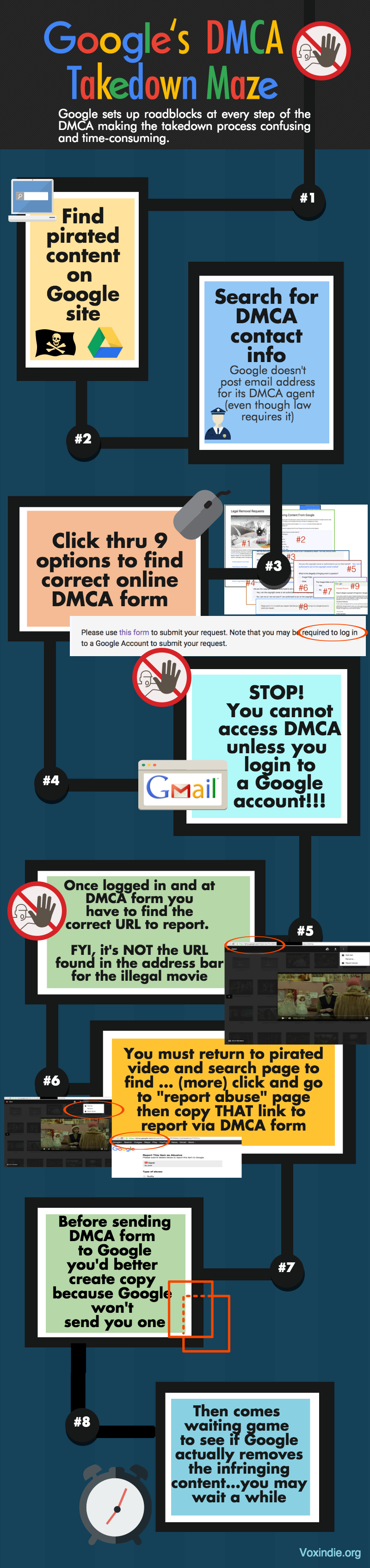
While that language required to craft a legal DMCA takedown notice is straightforward, the process for actually sending it to an OSP’s takedown agent is often not so clear. While some OSPs accept email notification (as required by law), other larger entities, like Google, prefer that requests be sent via a cumbersome and time-consuming online process.
Uploading infringing content to a Google site can be done with a mere click of a mouse, unfortunately removing it is not quite so simple. Because the email address for Google’s DMCA Agent is not posted on its websites, rights holders must jump through various hoops and navigate through a series of questions in order to arrive at the correct form. Once there it takes additional time to complete the 9-part form. Before one can actually send it one must be sure to create a Google account, then login and send.
Once the takedown request is sent, no copy of the actual takedown request is generated, only a brief acknowledgement of receipt. Then it’s a waiting game to see whether the infringing content gets removed.
Sending a simple DMCA takedown notice via email is simple, fast, and makes record keeping and follow up easy. Any update to the DMCA should continue to support email as an efficient way to send takedown requests and require that OSPs process emails with the same speed as those submitted via the web form.
Repeat infringement
Even if one sends a DMCA takedown notice to Google reporting a site for dozens of illegal links, Google allows the site to remain online. It takes multiple notices, sent 48 hours apart, to trigger any sort of account disabling.
Other sites employ varying degrees of punishment for repeat infringers and some do nothing. This is certainly an area of concern for rights holders as it adds to the overall ineffectiveness and inefficiencies of the DMCA notice and takedown process.
Any update to the DMCA should specify what constitutes a repeat infringement and require that OSPs publish this information on their website. The law should also require that the OSP be responsible for preventing any re-upload of content already reported as infringing. This can be achieved by employing technological solutions described in the following section.
Technological Solutions
Technology brought us to this point. It’s time technology be utilized to help safeguard copyrighted work. YouTube’s Content ID system, though not without problems, at least provides a way for rights holders to find and manage YouTube access for their music or films. Cloud storage provider Dropbox also employs technology to scan files for identifying hash data so that reported files cannot be uploaded repeatedly.
If an OSP’s (online service provider) business model is predicated on monetizing user-generated content (not vetted for copyright) then the OSP should be required, by law, to implement some form of digital fingerprinting to prevent infringing material from being uploaded in the first place. This type of technology would also help address enforce a takedown – stay down approach and prevent repeated uploads of pirated content to a site.
If an OSP does not have the resources to build its own proprietary tech like YouTube’s Content ID, there are a number of third-party vendors, like Vobile, that offer digital fingerprinting. While such 3rd-party services are not free, it seems only fair that cost of implementing a digital gatekeeper be considered a cost of doing business. Creators have long borne the “costs” of OSPs monetizing their content without permission. Having OSPs tap into profits to better protect copyright seems only fair.
Any update to the law should include a requirement that, in order to qualify for the limitations to liability that safe-harbor offers, certain user-generated content sites must implement reasonable technology to mitigate content theft.
Counter-notices and small claims process
Not only are creators burdened with having to play detective to find and remove their stolen content from various websites, but even the counter-notice system works against rights holders.
The counter-notice system allows recipients of an erroneous DMCA to prevent the removal of content and while such a system of checks and balances is important, problems occur when such counter-notices are themselves erroneous. Unless the sender of the DMCA notice files in federal court to enforce the takedown, following a 10-day waiting period, the reported content is reposted.
For most indie artists, the cost of filing in federal court to enforce a DMCA takedown is far too costly and so, in these cases, the infringing content remains online. I’ve experienced this situation multiple times and have seen full copies of a film reposted after a counter-notice (claiming fair use) was sent after a takedown on YouTube.
Perhaps, as part of any update to the DMCA, the time has finally come to create a small claims process to adjudicate copyright claims outside the federal court system. The U.S. Copyright Office has already studied the issue and has recommended creation of a voluntary system of adjudication to resolve copyright small claims. (http://copyright.gov/docs/smallclaims/usco-smallcopyrightclaims.pdf )
Content removed due to infringement should not be replaced by direct links to 3rd party site(s) that republish the same infringing links
Another issue not addressed by the DMCA is a problem that’s arisen thanks to a third-party database that records all the DMCA notices received by a number of OSPs including Google. The Lumen database https://lumendatabase.org/ (formerly Chilling Effects) offers a searchable database of these DMCA notices. While this might serve as a valuable archive, Lumen’s searchable database, in its current form, does not redact the infringing URLs from the DMCA notices and so–in effect–becomes an efficient search engine for pirated content. This afternoon I used Lumen’s search engine to look for illegal copies of the recent release “Carol.” With one click I found a link, then right-click and I ended up at an active, illegal copy online.
Lumen’s DMCA notices are also easily found thanks to Google’s direct links to them in what would seem to be blatant disregard for the DMCA’s intent–if not the law. The scenario works like this: When an infringing link is removed from Google search following a DMCA request, the search result remains, but the original infringing link is simply replaced with a fresh hyperlink to the DMCA notice stored in Lumen’s database. Essentially, removing the infringing link from Google search with a DMCA takedown requests only means a web user searching for pirated copies only has to click one additional link in order to find the pirated content he/she was looking for.
While the database itself may claim to operate under the mantel of “free speech” one has to ask how Google qualifies for “safe harbor” protection when infringing links removed from its search engine are replaced by a link to the DMCA notice on the Lumen database that contains the same, un-redacted infringing link. This type of re-linking should be explicitly banned in any update of the DMCA.
What’s at stake
Takedowns will continue to be a part of any DMCA fix, but collectively we must figure out a better way streamline the process, utilize technology, and mediate disputes in order to protect copyright and support a culture where creators can flourish– and the wealth of content they create can be enjoyed, and sustained, by consumers throughout the world.
If nothing is done to update the DMCA for the 21st century, content creators of all stripes will continue to struggle and the diversity, and variety of quality of creative content available to consumers will diminish. At first, we may not miss what isn’t made, but eventually our creative culture will be the lesser for it.
Hop aboard for another spin on Google’s DMCA Merry-Go-Round
It’s not news that Google-hosted Blogger websites are a favorite storefront for online pirates. It’s also not news that Google does its best to obstruct DMCA takedowns by setting up various roadblocks along the way. Today I discovered yet another example of just how difficult Google makes the DMCA process–this time with Blogger-hosted sites that use custom domain names.
When you create a blog using Blogger you’re given a domain that ends in blogspot.com. However users are free to use a custom domain name instead. That’s all well and good, unless the website distributes pirated content. In that case, if you’re a creator trying to get your pirated content removed (by Google), you’re likely to run into problems.
Usually, when one of these pirate entrepreneurs creates a site on blogspot.com a rightsholder can send a DMCA by using Google’s annoying web form (or annoy them by sending an email: [email protected]). However, if you use the same DMCA form to report a blogger-hosted site with a custom domain, Google won’t remove it. They’ll just send you back to the beginning.
I found out about this twist when I sent several DMCA notices this week on behalf of an indie film distributor. I requested the removal several pages of pirated movies I found on a Blogger-hosted website with a custom domain. The claim was rejected and the response on the Google Removals Dashboard read: Inappropriate for TCRP. Please submit through the standard web form.
TCRP stands for “Trusted Copyright Removal Program” but the problem is that I didn’t use any sort of TCRP…I wish I could, but I’m just a lowly commoner who doesn’t have access to this program. I USED THE STANDARD WEB FORM!!!!
Why–when there’s no doubt that this website is streaming a full copy of the film on a Google-hosted website–do they send me back to the same standard web form I used to send the original request? It’s an endless loop.Follow along below:
A DMCA request was sent using Google’s own web form (for Blogger) yet the claim is rejected and I’m told to send the takedown again using the very same form?
Apparently, even though Google hosts the pirate site, it refuses to remove infringing content the pirate is using a custom domain, not a blogspot.com domain. Welcome to the Google DMCA Merry-Go-Round. 🙁
When I researched the issue further I discovered I’m not the only one running into this problem. On Google’s own Blogger Help Forum there’s a recent thread about the issue. Last month a user DeeLite310 posted a question after receiving the same— Inappropriate for TCRP. Please submit through the standard web form–response to a DMCA s/he sent reportinga Blogger site pirated games.
Once again the not-so-helpful Google response was to send DeeLite310 (who’s not part of the TCRP) back the beginning of the Google Blogger DMCA merry-go-round. Here’s part of the exchange (but I suggest reading the entire thread to fully appreciate just how frustrating dealing with Google can be):
Welcome to the Google Merry-Go-Round…DeeLite310 is sent back the beginning…again and again…
Google loves to throw the word “transparency” around a lot in discussions around how it handles DMCA requests. Too bad it doesn’t provide more transparency when creators, victimized by pirates using Google products, make good faith (legal) efforts to request the removal of infringing content. As I’ve said before, the DMCA is broken…
*Update 5/16/16: During May’s Section 512 hearings in San Francisco I spoke with Fred von Lohmann, Google’s senior copyright counsel, about my blog post. He told me that I had indeed discovered a “bug” and that Google staff was working to fix the issue. I was happy to hear that Google was responding in a positive manner to this problem. I’ll test out whether it has been fixed by resending the original DMCA notice that prompted this post. Stay tuned…
Update 6/28/16: According to Mr. Von Lohmann, the bug has been fixed.
As an indie film and broadcast journalism veteran, I'll share my perspectives on issues of interest to the creative community and beyond--Ellen Seidler


 Why not make Content ID more accessible and transparent?