by Ellen Seidler | Ad Sponsored Piracy, Copyright, Film
 Excuse me if I don’t get too excited over Creative Future’s recent letter to ad industry representatives praising their for its efforts against online piracy.
We are writing to thank you for the progress you have made in addressing the exploitative practices used by some in the online advertising marketplace, including the diversion of advertising to websites
engaged in piracy.
Your pledge to act to reduce digital piracy is commendable. In your June 19 letter to the Co-Chairs of the International Creativity and Theft-Prevention Caucus, you highlighted the “Core Criteria for Effective
Digital Advertising Assurance” that you are developing, as well as the Interactive Advertising Bureau’s recently announced “Trustworthy Digital Supply Chain Initiative.” We believe these are the kinds of industry-led voluntary actions that can most effectively take the profit out of piracy.
Of course some action against ad-sponsored piracy is better than none, but news flash, ad-sponsored piracy is not news. Every few months it seems some new initiative is announced yet, in reality, in the land of the online pirates and their quest for profits, nothing much has changed. A year ago the White House released a statement on best practices to “Combat Online Piracy and Counterfeiting” which included this statement:
The Administration strongly supports voluntary efforts by the private sector to reduce infringement and we welcome the initiative brought forward by the companies to establish industry-wide standards to combat online piracy and counterfeiting by reducing financial incentives associated with infringement. We believe that this is a positive step and that such efforts can have a significant impact on reducing online piracy and counterfeiting.Y
Is there an echo in here? Why all this coddling of piracy’s enablers? Enough with the self-congratulatory preening. DO SOMETHING! Four years ago I wrote this on my blog about ad-sponsored piracy, popuppirates.com, when I launched the site in June of 2010:
In the process of scouring the web for the thousands of illegal download links and online streams of our film (more than 55,000 documented to date) I quickly discovered that various, theoretically legit companies, seemed to be (indirectly) generating income through the placement advertising on websites featuring streams and download links to pirated films. In addition, and most troubling, is that fact these ads generate income for operators of these pirate websites and add to generous profit totals for ad providers…
…The nature of the advertising varies, but I was dismayed to discover that the ads were not limited to cheesy online gaming sites, etc. Rather, they include a number of legit companies like Sony, Radio Shack, Pixar, Porsche, ATT, Chase, Network Solutions, Auto-Zone and even Netflix (particularly ironic since they carry our film). The list of advertisers goes on and on. It’s the same situation, if not worse for other films. Ads are ubiquitous on pirated content throughout the web
Now, exactly four years later what has changed? Not much…
Just this morning I checked out primewire.ag, a notorious pirate site and within moments was confronted by major brands advertising promoting their products while simultaneously filling the coffers of the pirate profiteers. As I reloaded the pages and clicked through listing of download links to movies like “The Transformers-Age of Extinction” and “Rio 2” I was greeted with ads from Lexus, Verizon, ATT, Domino’s Pizza, State Farm Insurance, Mucinex, Dick’s Sporting Goods and BP popping up directly beneath a ” Support the Site” plea. This is just one pirate site and it took me less than 10 seconds to find multiple major brands advertising there.
Time for talk is over. I’ll “thank” advertisers for their (overdue) response when–and if– I click on these pirate sites and don’t see this anymore:


by Ellen Seidler | Copyright, Film, Piracy, Tech
 Is this really what lawmakers had in mind when they wrote the DMCA?
Seriously, it’s not that I just love spending my time bashing Google, but the fact is that this company deserves to be taken to task (every second of every day) for the lousy job it does dealing with the rampant piracy on its Blogger platform. The slide show below is simply more documentation as to just how absurd, convoluted and outright busted the DMCA takedown process is with the barnacle that is Blogger (Blogspot.com). While mothership Google pretends not to notice, web pirates grow and thrive in the waters of its safe harbor.
Not only does Blogger provide a sanctuary for movie pirates around the globe, but Google’s cloud-based storage Google Drive, often a host for the Blogger pirated movies streams, looks a lot more like Megaupload than a legit business. Figures, for a company trying to bust indie-musicians and rip-off professional photographers, developing slick and slimy ways to avoid the law seems about par for the crooked course.
Google makes billions leveraging content created by others. The least they could do is respect our right to remove it, but that would mean less content for them to leverage, and thus less money for them. For Google, though it regards itself as the emperor of tech, ever evolving to offer society the next big thing; it’s really just like many other multinational behemoths seeking to protect and its increase profits. Who cares where those profits come from? Given greed’s at the company’s core, I once again welcome you to another example of Google’s takedown labyrinth.
[rev_slider Google_DMCA_circus]
When Congress crafted the Digital Millennium Copyright Act (DMCA) in 1998 they explicitly carved out “safe harbor” from liability for copyright infringement so long as the service provider, “upon obtaining such knowledge or awareness, acts expeditiously to remove, or disable access to, the material.”
Section 512(c) limits the liability of service providers for infringing material on websites (or other information repositories) hosted on their systems. It applies to storage at the direction of a user. In order to be eligible for the limitation, the following conditions must be met:
- The provider must not have the requisite level of knowledge of the infringing activity, as described below.
- If the provider has the right and ability to control the infringing activity, it must not receive a financial benefit directly attributable to the infringing activity.
- Upon receiving proper notification of claimed infringement, the provider must expeditiously take down or block access to the material.
The legislation also contains this language with regard to a service provider being eligible for limitations on liability, “: (1) it must adopt and reasonably implement a policy of terminating in appropriate circumstances the accounts of subscribers who are repeat infringers…
After you step through these slides and read my previous posts examining Google’s dysfunctional takedown procedures, can you really believe Google is “expeditiously” honoring the intent of the DMCA? If so, I’ve got a bridge to sell you…

by Ellen Seidler | Copyright, Film, Piracy, Tech
[vc_row][vc_column][vc_column_text]
 How much more of Googlenocchio can filmmakers take?
Google publicly brags about its “commitment to make copyright work better online” but the in reality it’s just a big, fat LIE.
I must say it was pretty ironic when, in the midst of working on this post, Ironically, I received this email from an indie film director asking my advice about dealing with Google:
Ellen, I have a quick question. I am having problems submitting DMCA notices to Google on some of the links, where I have submitted them before and Google hasn’t taken them down. [emphasis added]
When I try and re-submit–this can be weeks months later–it won’t allow me to submit the form, saying, the link has been submitted before. Do you have this problem, not sure if I am doing something wrong, or is there nothing I can do !
Sound familiar? I’m sure it does to the many indie filmmakers who, like myself and my colleague above, are routinely at the mercy of Google’s not-so-transparent, lame DMCA takedown procedure when we find stolen copies of our work online.
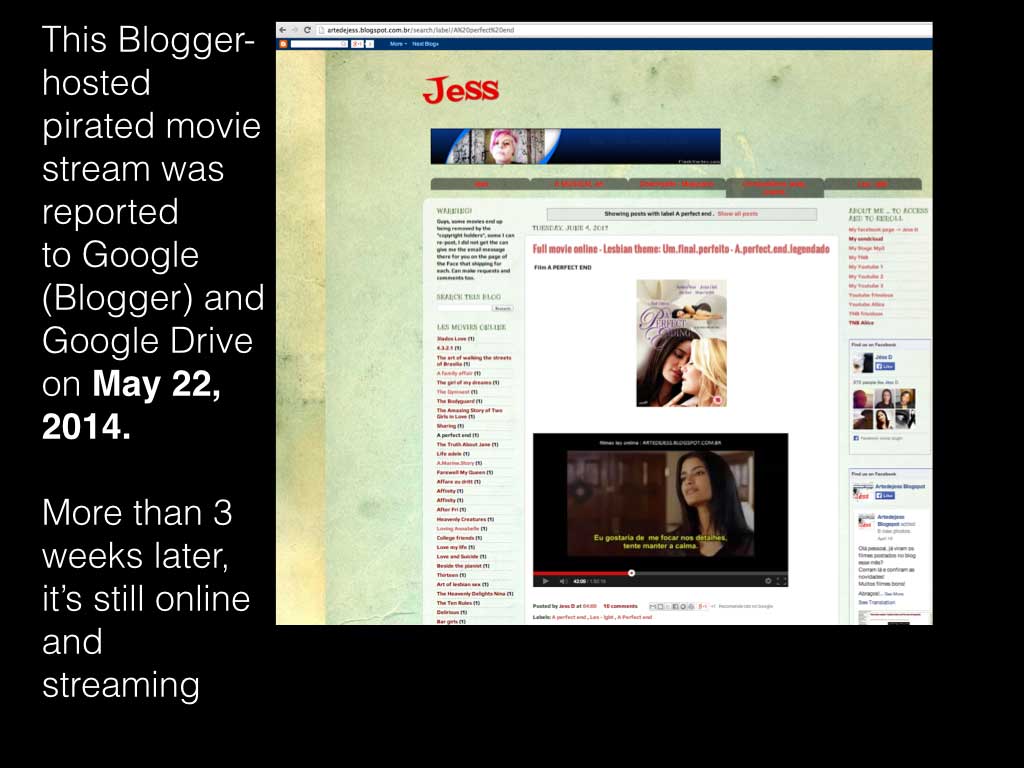
To dramatize just how flagrant Google’s DMCA foot dragging is I created a clock to track the company’s (lack of) action when it comes to efficient removal of pirated content from Blogger-hosted pirate sites. The clock below began started clicking on April 24th when 2 links were reported for copyright infringement. As of today, June 17th, nearly 2 months later, both pirated movies remain online as does the pirate Blogger-hosted website (see graphic below)
UPDATE: The site was removed July 10th, 2014, nearly 3 months after the first DMCA takedown notices was sent to Google.
[/vc_column_text][/vc_column][/vc_row][vc_row][vc_column width=”1/1″][/vc_column][/vc_row][vc_row][vc_column][vc_column_text]


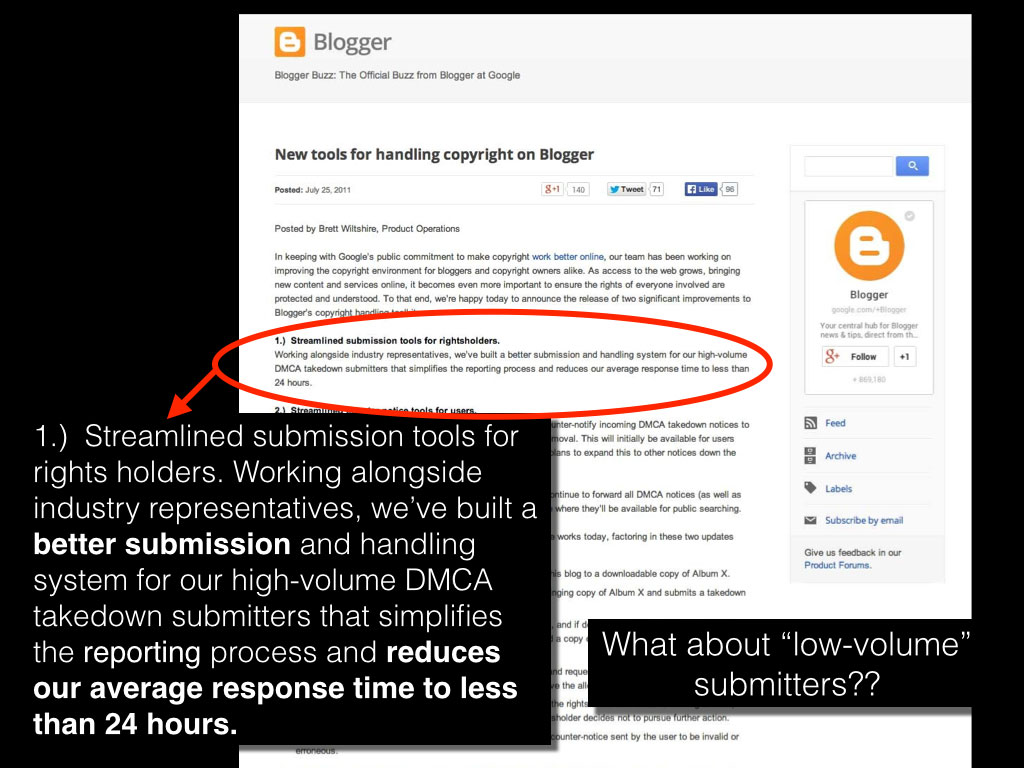
Remember, this is just ONE example of Google’s slow as molasses (or non-existent?) takedown work-flow. Remember this promise?
1.) Streamlined submission tools for rightsholders.
Working alongside industry representatives, we’ve built a better submission and handling system for our high-volume DMCA takedown submitters that simplifies the reporting process and reduces our average response time to less than 24 hours. [emphasis added]
When it comes to Google, broken promises are merely its modus operandi. When Google flacks claim the company cares about copyright infringement, it’s just a lie.
[/vc_column_text][/vc_column][/vc_row][vc_row][vc_column][vc_column_text][vc_column_text]
[/vc_column_text][/vc_column][/vc_row]

by Ellen Seidler | Copyright, Film, Piracy, Politics, Tech
 Google’s claim that it’s doing a great job streamlining its response to DMCA takedown notices on its Blogger-hosted websites doesn’t jibe with the truth. This year the U.S. Patent and Trade Office (USPTO) has been holding a series of hearings with the goal of “improving the operation of the DMCA notice and takedown policy.”
The first public meeting was held this past March in Alexandria, Virginia and second took place May 8th in Berkeley, California. I was able to attend the Berkeley hearing in person and heard representatives from content creation industries and service providers give their perspectives on the current state of “notice and takedown” for infringing content and what could/should be done to “fix” it.
Each speaker presented a PowerPoint, links to which can be found here and a video archive here. As with the initial hearing in March, Google was represented by its Legal Director for Copyright, Fred von Lohmann who walked the audience through Google’s “DMCA notice and takedown tools” and highlighted what he called the company’s “trusted submitter program.” In his PowerPoint, Mr. von Lohmann referenced Google blog post from 2011 “New tools for handling copyright on Blogger” that supposedly highlighted the great progress that’s been made in streamlining the process.
Listening to Mr. von Lohmann it seemed clear that his words were designed for an audience made up of government officials and industry representatives and not indie artists. He (carefully) described a two-tiered system in which “trusted” submitters have access to a wealth of takedown mechanisms to remove infringing content from Google affiliates. However, aside from YouTube, access to these “trusted” programs seems limited to the big film and music entities.
Specifically, with regard to Blogger, the criteria as to how one becomes a part of this so-called “trusted submitter” program remains murky and ill-defined. Immediately following the event I searched Google to find out more (and how to apply) I only came across a link to Mr. von Lohmann’s USPTO PowerPoint. There was nothing on any Google site to answer the question as to how indie rights holders could utilize this so-called “tool.” Since there was no more information to be found, shortly after the event I took to Twitter to ask @flohmann directly for a clarification on his presentation. The response thus far, only crickets…

In addition to this lack of clarity as to who exactly can take advantage of certain tools, Mr. von Lohmann’s careful characterization of his company efficient takedown system did not match my user experience, particularly with regard to Blogger. Over these past few years I’ve documented time and time again the many ways Blogger--and therefore Google–fails to live up to its promises to remove infringing content from its platforms.
 Yet, according to Google’s self-published, self-serving report, “How Google Fights Piracy,” (that I’ve criticized in a previous post) the company continues to insist that it’s proactive fighting piracy on its Blogger web-publishing platform:
We remain vigilant against the use of the Blogger platform by pirates looking to set up a free website…we will remove infringing blog posts when properly notified by a copyright owner, and will terminate the entire blog [emphasis added] where multiple complaints establish it as a repeat infringer.
Sorry, but the facts clearly don’t match up with this corporate hyperbolic PR spin. Truth be told, Blogger’s takedown system is, in reality, a hot mess. Add Google Drive to the mix and company claims of a “streamlined” takedown process seem even more absurd.
- Blogger content that is reported as infringing takes weeks, not days to remove.
- Blogger hosted blogs that are in the business of promoting pirated movies remain online despite multiple, repeated DMCA notices and despite clear evidence they exist to pirate films.
- The Google DMCA takedown procedure is not easy to navigate. Once users find it, they must repeatedly choose options in order to (eventually) get to the correct takedown form, even someone well versed in the procedure. Why not offer direct links to the correct forms for each platform?
- Blogger’s website templates offer no direct links to Google’s (streamlined) takedown form. Why can’t Blogger hosted sites automatically provide a button/link in their menu bar or footer, designed as part of any page template to enable easy and direct access to Google’s “streamlined” takedown form?
- Google Drive takedown procedures are convoluted and unclear. No easy way to determine file’s URL to report and no direct link to report.
- When a file is reported on Google drive it can take weeks, not days, to remove the infringing content.
Rather than fulfill its promise to expedite takedowns for copyright infringement, it seems that the “Google Team” does everything within its power to make the process convoluted, cumbersome and difficult–particularly for individual artists who don’t have the deep pockets to hire help and/or automate the takedown workflow. Please take some time to review the graphics that I’ve created that illustrate just how badly Google is doing when it comes to Blogger (and Google Drive) takedowns.


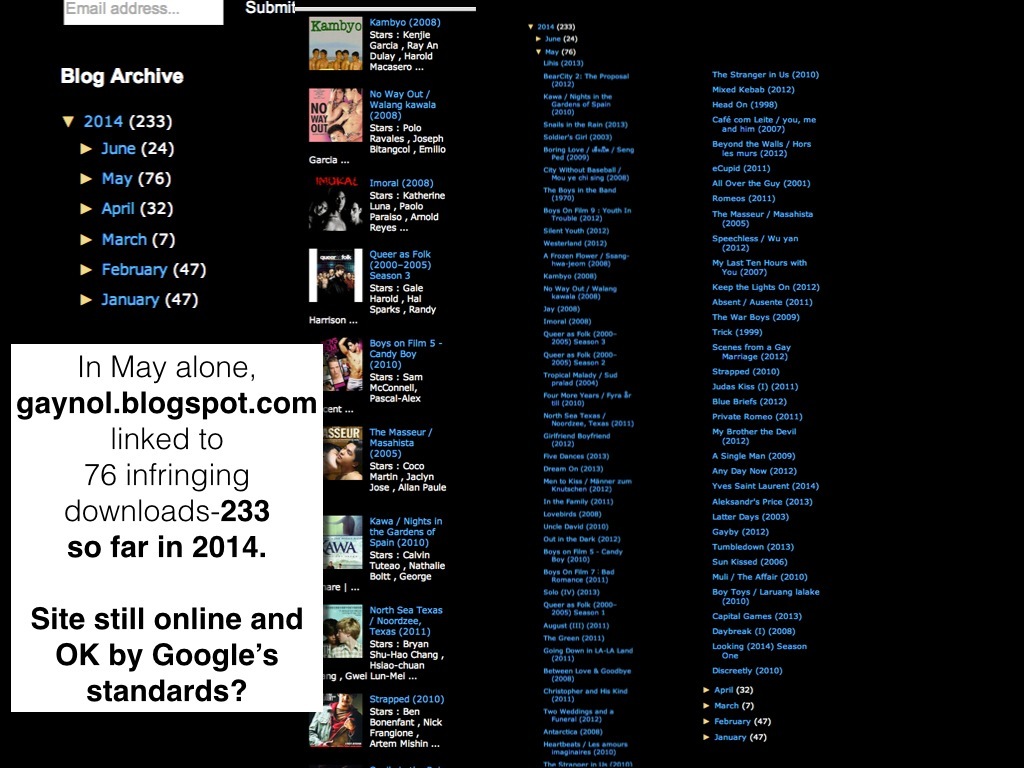


Given the complexity (and hilarity) of attempting to remove pirated stream of our film “And Then Came Lola” (seen in the example above) hosted on Google Drive I made the following video that will walk viewers through the process. Weirdly I was able to find the URL (that was not the case with some of the other examples I’ve provided) yet that didn’t help much since pirated copy is still, as of today, June 1st, available on line–more than two weeks after I sent a DMCA takedown notice to Google. As far as I’m concerned, when Google characterizes itself as doing a good job with this process I can only shake my head. No matter how many ways Google spins it, it’s not true.
https://vimeo.com/97077933
Coming soon, Part Two: How Google Could Fix its Broken DMCA Takedown System

by Ellen Seidler | Copyright, Film, Piracy, Politics
 The goals of protecting free speech and stopping online piracy are not mutually exclusive
The concept of protecting “free speech” is fundamental to sustaining healthy political discourse in any society. Yet in debates over copyright and content theft, those who oppose bringing any sort of regulation to the internet twist the concept of protecting “free speech” into a disingenuous cudgel to obfuscate the issue and generate opposition to anti-piracy efforts.
With this in mind, perhaps it’s worth looking at a recent example which demonstrates that the issue of squelching “free speech” is not inextricably linked to other forms of online expression, ie. piracy.
Russian social media site (and Facebook wannabe) Vkontakte (vk.com) provides a good example. Pavel Durov, the site’s founder, was recently pushed aside in favor of ownership interests tied to Russian President Vladimir Putin. Per news reports yesterday, he’s apparently left the Russia saying “Unfortunately, the country is incompatible with Internet business at the moment.” A piece published in January on TheVerge.com explained the power play in a piece, “How Putin’s cronies seized control of Russia’s Facebook,”
Durov, 29, sold his remaining stake in VK this week, officially ending his tenure at the helm of Russia’s most popular social network and turning the page on more than two years of turmoil and political strife.
Durov’s departure effectively transfers majority control of VK to business magnate Alisher Usmanov — Russia’s richest man, with an estimated worth of $20.2 billion, and a close ally of President Vladimir Putin. Durov sold his 12 percent stake to Ivan Tavrin, chief executive of telecom provider MegaFon, which Usmanov controls. (The exact sum of the sale was not disclosed, though it is believed to be between $300 and $400 million.) That means that Usmanov and his Kremlin-friendly allies now control 52 percent of the company, raising concerns over the future of VK and the freedom of its users.
It’s a stratagem that appears tied to disputes over political expression and Vladimir Putin’s crackdown on dissent that has become increasingly aggressive of late.
Even though much of the Russian media is known to be under state control, the Internet has remained relatively free, with blogs and social media sites providing an important and creative platform for political discussion. But on March 4, the Kremlin once again took the media battle it has been waging against pro-Western protests online. Russia’s Internet monitoring agency Roskomnadzor blocked 13 profiles associated with the Ukrainian protest movement on the popular Russian Facebook equivalent VKontakte because they “contained calls to commit terrorist acts and take part in unsanctioned mass action.”
Vk.com has been in the Kremlin’s sites since 2011 when Durov refused the government’s request to close down pages that promoted demonstrations against its policies after the results of parliamentary elections were disputed. According to a report in RIA Novosti:
“We received a request from the FSB to stop the activity of Vkontakte groups calling for riots and a revolution,” Vladislav Tsyplukhin, spokesman for social network VKontakte, wrote on his corporate web page.
“We explained in response that we have been following those groups and cannot block them as a whole just because some individual users have called for violence,” Tsyplukhin wrote.
The accounts of specific users who have explicitly called for public disorder however are being blocked by the company, he said, adding that there had not been any excessive “pressure, threats or rudeness” from the Federal Security Service (FSB) in its requests.
While expressions of political dissent are being squelched, online piracy remains alive and well on the site vk.com. Earlier this month it was announced that Sony, Universal and Warner were filing suit in Russian courts, charging the site with violating copyright. Since 2011 the site has also been on the Office of the United States Trade Representative’s list of Notorious Markets that “identifies markets around the world that harm American businesses and undermine our workers, through the infringement of intellectual property rights (IPRs).”
vKontakte.com (also operating as vK.com): The Russian site vKontakte.com, in the List since 2011, is styled primarily as a social networking site, and it is extremely popular in Russia and surrounding countries. While as a general matter, social networking sites can serve many salutary purposes, this site’s business model appears to include enabling the unauthorized reproduction and distribution, including streaming, of music and other content through the site and associated software applications.
In searching the site this week I easily found multiple users who utilized the site as a file host for thousands of websites offering streams of pirated movies.


According to a Russian blogger atkatyatrubilova.wordpress.com, Vk.com has an advantage over Facebook in attracting users due the fact piracy remains a perk not found on Facebook.
Nevertheless, Vkontakte offers a special feature which attracts more new members daily and makes them spend a lot of time online. Members are able to view thousands of pirated copies of domestic and foreign movies dubbed into Russian. In addition, it’s possible to upload and download video and audio files via the VK Tracker application.
Those who value free speech should be alarmed that Vk.com has fallen under the grip of Putin and his allies. The battle against piracy remains a separate issue here, and elsewhere. It’s time to disengage the two concepts. Fighting for one does not preclude fighting against the other.

by Ellen Seidler | Ad Sponsored Piracy, Copyright, Film, Google, Piracy
 Today’s Variety features an article by Todd Spangler with the headline, “House of Cards’ Searches on Google Turn Up Pirate Links as Top Results.” Color me not surprised in the least. Perhaps folks are noticing because House of Cards is a popular Netflix original series that just launched its second season but the fact that pirate top the list in Google search results is nothing new–just ask musicians and filmmakers. According to Spangler:
In a Google search for “Watch House of Cards” on Wednesday, the top two results were links to apparent pirate sites, couchtuner.eu and stream-tv.me; Netflix showed up third. WebProNews reported on the Google search results for “HoC” earlier, and found similar results for searches on other Netflix content including “Orange Is the New Black,” “Arrested Development,” “Lilyhammer” and “Derek.”
In December of 2012 I wrote a blog post “Google Search #FAIL Means More $$$ for Them” in which examined this same phenomenon with a search of a newly released indie film.
Not to beat a dead horse, but surprise, surprise….I did a Google search this morning to see how easy it would be to find download links for “Kyss Mig,” a recently released Swedish indie film. I used Google to search for “download kyss mig” from this past month, and….oops, so much for Google’s new search algorithm that’s supposed to penalize (reported) pirate sites. Why am I not surprised that The Pirate Bay result tops the list?
Here’s a screen shot of my results. It’s not surprising that the Netflix series is suffering the same fate that other content creators have long endured.

I went on to point out the interconnections between these illicit search results and the money trail. After all, as the Digital Citizens Alliance’s newly released report on piracy profit proves, it’s all about the money.
Not only did I find the full film streaming (for free) online (I checked and actually viewed the first ten minutes) but right beside was a Netflix advertisement. When I checked the source of the ad I found it led me back to “doubleclick.net” a Google-owned company. Perhaps this is how Google expects users to find legit copies of the film? After all, Kyss Mig does stream on Netflix….kind of a roundabout way to find the film when I can watch it right here, right now for free! Of course Google makes money from the ad either way (as does the pirate website) so what do they care? Hmmm, perhaps the Google ad placement has something to do with why this pirate site is comes up first in search results? Not to don my tin foil hat but….

- A full (free) stream of the indie film “Kyss Mig” was easy to find thanks to Google search results–result that generated ad revenue for Google and website operators. BTW, movie is now offline since I reported it to the distributor. I guess I’m going to have to be a good girl and use the search terms “buy Kiss Mig.” Only then am I given results that lead me to legit options.

BTW, I notified the distributor that the film was available via this pirate site so as of Monday, December 10th, this illegal stream is history. Too bad I can’t say the same for the website itself.
So, while today’s story about “House of Cards” search results leading to pirate websites may be a surprise to some, unfortunately for most of us, it’s old news. After all, if you’re looking for a sign post to find pirated content online, Google makes it easy.