by Ellen Seidler | Copyright, Film, Law, Piracy
If you can’t beat ’em, join ’em. Some cyberlocker websites that offer file storage, do (eventually) respond to DMCA takedown notices, but in an ironic final twist, a fair number of them have found a way to use copyright violation notifications to their advantage–monetizing requests via pop-up ads.
Examples are easy to find. Today I went to a notorious download site that offers download/streaming links to any number of popular (recent) films. I chose to find links for the Oscar-nominated “Silver Linings Playbook.” If you look at the column on the left, you’ll see more than 2 dozen links to view and/or download the film. I did not check them all, and imagine some have already been removed by studio anti-piracy efforts.
For purposes of this piece, I chose a link hosted on a site called “Faststream.in” When I clicked the link I arrived at a splash page that offered a stream of the film. I could click the button “proceed to video” be bombarded with ads before watching the film. However, what happens when the rights holder wants to send a DMCA notice to the site? On this site there’s no DMCA option provided, only a “contact” link. Click that and (cha-ching) a pop-up ad appears. To access the actual contact page, you have to close the ad.

I’ve come across many sites that utilize the same setup. I suppose that if a site is going to lose its carrot to attract ad clicks, operators may as well make some money in the process. Aside from earning cash from clicks, this cumbersome procedure also makes sending a legit DMCA notice a time-consuming, and thus expensive, proposition. I checked the U.S. Copyright Office list of designated agents to determine if this site had registered one. No listing was found, so using this contact page–for each and every takedown request– appears to be the only way to contact the site to send a takedown notice. No wonder the movie is still online.

I checked the WHOIS information to see if their was any contact information and found that the domain was registered by a Jeremiah Haselberg of PiratePoint.Ltd. in Canada. At least he’s honest about the nature of his entrepreneurial activities eh? Or maybe he’s just named his company after a favored vacation spot, Pirates Point Resort in the Caymen Islands….a “safe harbor” in more ways than one.

Aside from making money off DMCA takedown requests, this site is follows the traditional cyberlocker pirate business model, incentivizing infringing uploads with cash rewards.

It’s bad enough that rights holders have to police these sites to safeguard their work, but adding to their coffers in the process only adds insult to injury. Such is the nature of online piracy today.

by Ellen Seidler | Copyright, Film, Google, Piracy, Tech
It’s been a few months since Google announced a new initiative designed to lower search results for web-sites reported for piracy. According to Google, legitimate sites would move up and pirate sites would move down:
We aim to provide a great experience for our users and have developed over 200 signals to ensure our search algorithms deliver the best possible results. Starting next week, we will begin taking into account a new signal in our rankings: the number of valid copyright removal notices we receive for any given site. Sites with high numbers of removal notices may appear lower in our results. This ranking change should help users find legitimate, quality sources of content more easily—whether it’s a song previewed on NPR’s music website, a TV show on Hulu or new music streamed from Spotify.
Since we re-booted our copyright removals over two years ago, we’ve been given much more data by copyright owners about infringing content online. In fact, we’re now receiving and processing more copyright removal notices every day than we did in all of 2009—more than 4.3 million URLs in the last 30 days alone. We will now be using this data as a signal in our search rankings.
At the time, Google’s announcement seemed encouraging, despite their careful use of the more flexible phrase “may appear lower” as opposed to “will appear lower.” Now that some time has passed, I thought I’d do a random search to see how well Google’s new algorithm is working to thwart piracy. I decided to do a fairly generic search using the terms “watch free movies online.” I did not specify a time frame or put the search terms in quotes. This was the result.

Result for search “watch free movies online”
The first two results were “sponsored results” (shaded in pink) which direct users to legitimate sites Yideo and Netflix. However, the top two non-sponsored sites are sites offering pirate links. I clicked “LetMeWatchThis” the second non-sponsored result. That took me to this landing page which entices users with an array of movie poster thumbnails from current releases (many haven’t even been released on DVD). I chose to click on a thumbnail for film that is scheduled to be released next week on December 4th, 2012–The Odd Life of Timothy Green.

Below a short summary of the film, there’s a list of 30 links to watch/download it. I did not examine each and every link, but aside from several “sponsored” links, most point to sites known to host pirated films.

Ignoring the first one (it’s a sponsored link that leads to an illegal pay-to-watch site) I clicked on the link to “Sockshare” a popular cyber-locker site (one of many to flourish in the vacuum left by Megaupload’s shutdown). After clicking the link, and navigating past an ad (remember these pirate sites are in the business of making money off stolen content) I arrived at an embedded, full stream of the film.

Remember, according to Google’s explanation of its new policy, “we will begin taking into account a new signal in our rankings: the number of valid copyright removal notices we receive for any given site. Sites with high numbers of removal notices may appear lower in our results.” With this in mind, I decided to check Google’s “transparency report” to see how often this particular domain had been reported for copyright violations. According to these results, there had been more than 10,000 requests for the URL to be removed.

I also checked the value of this website using and found this:

If these Alexa statistics are accurate, it’s safe to say that operating this particular pirate site is a lucrative endeavor indeed. It’s long been notorious for its illegal links. The fact this site comes up second in a Google search for to “watch free movies online” is certainly a factor in their robust income. Despite Google’s pledge to begin “using this (copyright infringement reporting) data as a signal” to adjust search rankings, their new algorithms don’t seem to be penalizing this site in the least. To the contrary, it seems this site is being rewarded with a plum ranking resulting in plump profits.
The only conclusion I can draw from this is that, despite lip-service to the contrary, not much has changed when it comes to Google aiding and abetting websites that profit from piracy.

by Ellen Seidler | Copyright, Film, Google, Music, Piracy, Tech

YouTube Content ID isn’t perfect, but it’s something.
When Google recently announced a change to its search rankings algorithm--lowering results for known pirate sites–critics asked why the company would not do the same for YouTube , despite the site’s popularity as a repository for pirated films and music.
Such criticism seems justified. After all, Google-owned YouTube, like the pirate sites being penalized, receives thousands of DMCA notices each day. If they’re serious about re-ranking pirate site search results, how can Google justify YouTube’s exclusion from this self-imposed pirate penalty?
As I see it, there’s really only one way that Google/YouTube can justify this apparent contradiction. Unlike the penalized pirate sites, YouTube distinguishes itself in one significant way—by offering rights holders access to a “Content ID” system. Imperfect though it may be, YouTube Content ID technology is a feature that all indie musicians and filmmakers should understand and utilize.
Here’s YouTube’s short video that explains how Content ID works:
As YouTube explains it:
Rights holders deliver YouTube reference files (audio-only or video) of content they own, metadata describing that content, and policies on what they want YouTube to do when we find a match. We compare videos uploaded to YouTube against those reference files.Our technology automatically identifies your content and applies your preferred policy: monetize, track, or block.
According to Youtube, here are reasons you should use Content ID:
- Make Money. Hundreds of media companies have signed up already, multiplying their inventory of monetizeable videos.
- Fan Interaction. Turn your fans into marketers and distributors of your content—while letting them interact with their favorite content.
- Reduce Infringement. Educate your fans about your copyright preferences and prevent your content from being distributed on YouTube without your permission.
- Fully Automated. Once you’re set up, Content ID will identify, claim, and apply policies to YouTube videos for you.
- Market Data. Access snapshots of your content profile on YouTube, anytime. See how your videos are performing, monetizing, being blocked—at a glance.
Sounds too good to be true right? Well, kinda….but, despite overblown claims and systemic weaknesses, it’s better than the alternative (rampant piracy). With a Content ID account, you’ll gain some control over your content that’s uploaded to YouTube and can determine its fate. Based on what rights you hold, you can remove it, monetize it (share ad revenue with YouTube) or block it (worldwide or by territory) via a fairly straightforward dashboard-a welcome alternative to wasting precious time sending YouTube multiple DMCA notices. As with DMCA takedowns, uploaders retain the right to dispute a file’s removal via a counter-notice, but if you have removed legitimately infringing content, this is usually moot.
You can apply for a Content ID account here. Once you’ve been approved, you all have access to a “Content Management” dashboard that looks like this:

The process is actually relatively straightforward. In order to “deliver” content to YouTube, technically all you really have to do is “claim it” when you upload it. Even if you don’t plan to post a public file on YouTube, you can upload a copy of your song or film just as a reference copy for the Content ID system to use as a “fingerprint.” Below is an example of what the claiming options look like when you upload a file (and have an approved Content ID account).

If the file is for reference purposes only, make sure to make it “private” so that it won’t be accessible to the public. Once you have a copy of your work (video or audio) uploaded and claimed, you can use the search option, and search for your work by title or other associated key words that uploaders might use. For demonstration purposes, I searched using the term “Hunger Games Full Movie” by date to demonstrate what results could look like.
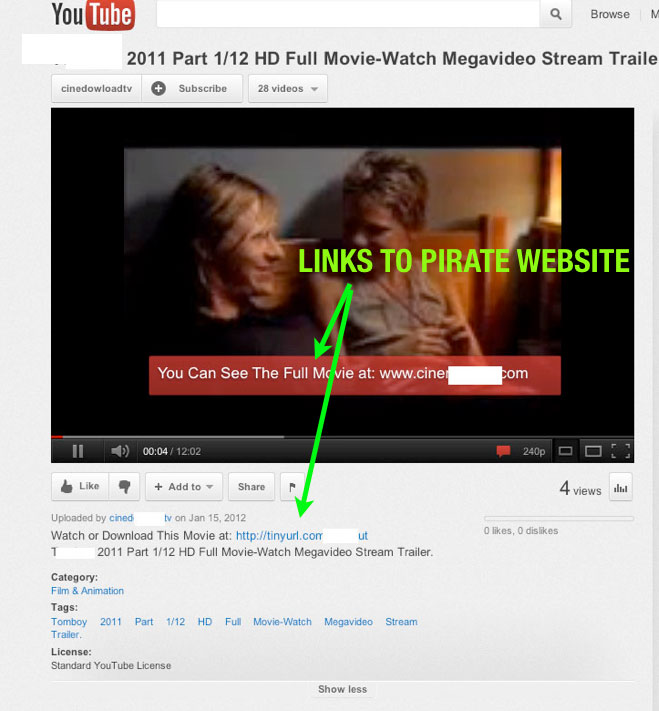
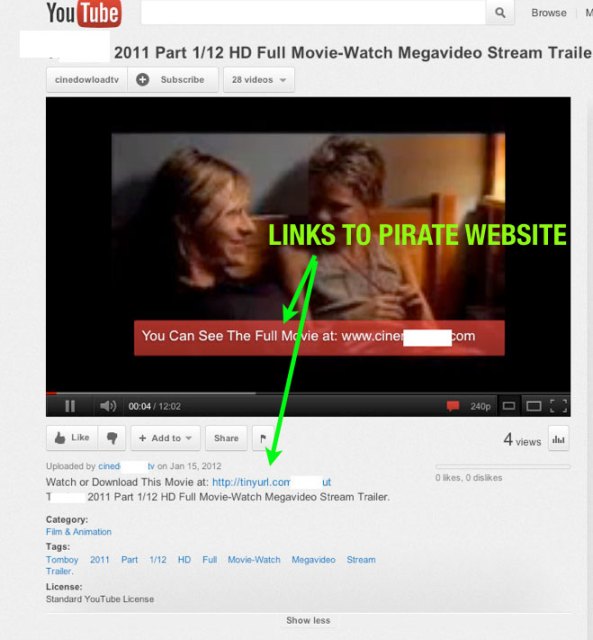
Note the search results showed dozens of pirate links uploaded within the last hour, something not uncommon for large Hollywood features. Most of these files are uploads made by pirates seeking to publicize (illegal) download links on other, non-YouTube sites. For pirates, uploading these bogus files is a free and easy way to advertise and direct users to their pirates websites. Unfortunately, while it appears that thousands of these are pirate clips are uploaded daily, The YouTube Content ID program can’t detect them, so you’ll have to use search to find. In the example below, you can see how using a keyword search can detect these infringing uploads.

Once you have a list like the one above, you can sort through it and see how you want to handle each file. I recommend making multiple searches using various keyword combinations. If you are searching for bogus pirate film files, including the word “full” or “full movie” are helpful. When you find illegal copies of your work, take note of what keywords the uploader used as it may provide insight into what search terms to use.
There’s also an option to send the entire list to “automated review.” That can be helpful if the clips include snippets of your film or music, but in the example above, most of the results point to dummy uploads (i.e. 10 minutes of black video with a single frame from pirated film). As I mentioned, YouTube Content ID cannot match these to any content, users are forced to look at each one by one and remove them. It’s tedious and time-consuming, but necessary.
Another option on your CMS dashboard is the option to view all “claims” that have been generated, either through manual search (shown above) or via YouTube Content ID. In terms of the latter, when a file is uploaded that matches your claimed content, it’s automatically added to your claims list. You can predetermine what happens to any matches (blocking or monetization) but if you choose to remove a file entirely, you must manually change the designation to “takedown.” Here’s an example from our CMS dashboard claims page that lists a number of recent pirate uploads linking to our film and some fan tributes/mashups.

In either case, whether discovering a questionable upload via search results or the claims list, if you find a file that contains your copyrighted content you can select it, and claim it based on your original reference version (note the bogus “Dreamworks” logo on this example used to make it look legit).

We tend to monetize the fan videos and remove (takedown) the pirate links. In the example below (pirate link to offsite version of our film) we chose “takedown.

Once you’ve taken down a video, viewers visiting the link will see this:

If a clip is discovered through video match, you can open the claim and change the default selection. This clip was monetized automatically, but had we wanted to, we could have blocked the clip or removed it. In this case, since it was a fan mashup, we chose to leave the default setting in place.

The dashboard also provides users with the ability to view income and drill down into analytics to determine the demographics and locations of your viewers. (Who knew lesbian rom-coms would be so popular in Saudi Arabia?)

You can also keep track of income, though, not surprisingly, this is the weakest and most opaque part of this system.

In order to actually be paid for any income accrued through monetization of your content, you must also have an active Google AdSense account. Fortunately, applying for an AdSense account is not all that difficult. Once approved, you must link your YouTube Content ID account with your AdSense account and receive payouts once your income exceeds $100. Depending on the type and amount of content you claim on YouTube, this can happen quickly or take months.
Is this system perfect? The short answer is NO. As mentioned previously, Content ID cannot catch the dozens or, in some cases, thousands of pirate uploads that contain dummy content but link to offsite downloads. You’ll have to ferret these out using search and remove them manually, but it’s still a thousand times more efficient than having to send DMCA notices.
The Content ID system also seems to have a harder time finding clips that were previously uploaded to the site (before you claimed your content). When you create a new account, it’s advisable use search option on a regular basis to double-check for uploaded content, rather than depend entirely on Content ID’s automatic matching capabilities. If you do both, you can feel pretty good about having your bases covered when it comes to keeping pirated copies of your work off YouTube.
The other grey area with regard to the YouTube Content ID system and monetization is the utter lack of transparency. How much does Google actually make off the ads that appear next to your content? It’s not entirely clear and something Google should fix. One can only assume it’s to Google’s benefit, and not the artist’s, to keep this part of the system as opaque as possible.
When you start claiming and monetizing your content online you may also have uploaders who protest, citing the oft-used “fair use” excuse. If you have selected the option to monetize the content they uploaded, it’s usually as simple as writing them a short, polite message explaining that you own the rights to the material, but are not removing it, just monetizing it. However I’ve also had instances where someone uploads 10-minute sections of our film in multiple parts and claim “fair use” when I remove the clips. Again, I send a polite note explaining “fair use” does not allow one to upload 10 minutes excerpts of a feature film. It’s not a bad idea to include a link to Youtube’s copyright information/education pages as well. Once I send a note, I generally never hear back.
Whether or not you earn much income from your claimed content depends on the volume of material present, and the number of views generated. However, even if you won’t earn much in the way of income, it’s still worthwhile to take advantage of Content ID, if only to safeguard your work from piracy. The analytics can also offer some useful information as to the demographics and reach of your uploaded work and perhaps help guide you in developing effective new alternative approaches to online distribution.
Given today’s technology, there’s no reason websites around the globe can’t institute similar systems. Megaupload’s embattled Kim Dotcom likes to pontificate (to anyone who will listen) and claims he’s “…at the forefront of creating the cool stuff that will allow creative works to thrive in an Internet age. I have the solutions to your problems. I am not your enemy.”
Were that really true, why didn’t Mr. Dotcom use technology to transform Megaupload.com into legitimate UGC (user-generated content) by implementing a Content ID system like YouTube’s? Oh right, he would have had to share the profits. Despite his disingenuous rhetoric to the contrary, for him, theft for profit trumps technology any day of the week.
For sites that hope to create a legitimate business model to “share” creative work, providing content creators with technological tools to control online access to their work should be mandatory. If and when Congress revisits the antiquated DMCA (Digital Millenium Copyright Act) why not make such fingerprinting technology a requirement for meeting the “safe harbor” provisions of the law. Such a requirement wouldn’t “break” the internet, but could go a long way in mitigating piracy’s negative impact.
As online distribution options grow and improve, hopefully indie artists can say goodbye to the opaque revenue “sharing” model imposed by YouTube and take their content to sites/businesses where formulas for compensation are more transparent, and more generous to those who actually create the content.
For now, however, something is a whole lot better than nothing….
Update 12/13/13: See what’s happening with YouTube changes to Content ID on Multi Channel Networks and their affiliates on Plagiarism Today here: http://www.plagiarismtoday.com/2013/12/10/great-youtube-gaming-copyright-shakeup/