Content ID doesn’t help prevent pirate scams on YouTube
This week YouTube announced it was tweaking the algorithms used by its Content ID system in order to reduce the likelihood of erroneous takedowns. They also revised their dispute procedures to require rights holders to file a DMCA in order to enforce claims. Frankly, their system has always favored anyone who “disputed” a claim. As with the DMCA, YouTube’s previous procedure required that the rights holder to file a motion in court in order to enforce a disputed takedown. Most of us don’t have the money or time for that. Perhaps this new procedure will make the process more transparent and generate good buzz for YouTube, but as a practical matter, it doesn’t really change much.
As I mentioned in an earlier blog post explaining how to use the Content ID, my real question is why didn’t YouTube address the other HUGE issue left unaddressed by the Content ID system? Why can’t YouTube Content ID algorithms be adjusted to catch the massive numbers of “fake” uploads that pirates literally use to advertise the availability of illegal downloads on other websites?
They claim to be improving their “matching quality:”
At the heart of Content ID is the matching technology that identifies partners’ content among all the videos on YouTube. Earlier this year we introduced a significant improvement to how the matching happens. We continue to work on ways to make the matching more precise through better algorithms and a more comprehensive reference library.
However, no mention is made of improving their technology to detect these dummy uploads. Pirates upload these files to YouTube and use specific search keywords to make them easy to find. Most are ten minutes in duration and contain a still from the pirated film with text overlays advertising the pirate link and a direct link in the description. While writing this post I used my own Content Management Account to search for the recent release “Arbitrage” using the search term “Arbitrage full movie.” You can see from the screen grab below that these dummy files weren’t hard to find.
Fake “Arbitrage” uploads on YouTube advertising links to pirate downloads.
When you go to the actual post you find a typical dummy upload. The pirate link is provided as a text overlay and in the description.
The keywords for this upload included: watch Arbitrage complete movie free,Arbitrage full movie + HD,watch Arbitrage complete movie online,Arbitrage part 1,Arbitrage Part 1 Full Movie + Free,watch: Arbitrage full online movie,Arbitrage :complete movie,Arbitrage free HD movie,watch: Arbitrage part 1 movie + free,watch Arbitrage online
Dummy upload for “Arbitrage” advertising link to pirate download.
When you click on the link you end up here:
Pirate site that uses YouTube to drive traffic.
If you look at one of these pirate’s YouTube page, you’ll find dozens of dummy uploads.
While it’s likely that thousands of these dummy files are uploaded daily on YouTube, in my experience they go undetected by the Content Management System. As I wrote in a post on www.popuppirates.com earlier this year:
Pirate thieves are entrepreneurs at heart. Money is what drives them. Since they can’t upload and/or monetize content they own via Youtube they resort to the next, best thing. They use Youtube as an advertising vehicle–a convenient gateway–to connect “customers” to their illegal websites.
I’m not sure why YouTube fingerprinting ID technology can’t automatically detect these files (most are videos comprised of a ten minute freeze frame). Why allow pirates to use YouTube for free advertising? To add insult to injury, notice too that when one navigates to one of these dummy uploads YouTube conveniently lists additional dummy uploads in the sidebar:
More dummy uploads offered by YouTube
As it stands, the only way a rights holder can detect them is to manually search and remove…a time-consuming process that few can afford. If folks at YouTube really want to “fix” their Content ID system, cutting off this lifeline to pirate websites would be a start.
YouTube is well-known for videos, but a recent Nielsen study revealed 64 percent of teens and young adults go to it to listen to and discover music. The free website, which is owned by Google, has set up advertising deals to help musicians get compensated. But it’s not clear how they’re getting paid — or how much.
First of all, I’d point out that Google didn’t “set up” advertising deals to “help” musicians get compensated. Advertising on YouTube was established to help Google make money. For them, compensating artists in some fashion is merely a part of doing business. Google’s motivations aside, as I mentioned in an earlier blog post on YouTube’s monetization program:
The other grey area with regard to the Content ID system and monetization is the utter lack of transparency. How much does Google actually make off the ads that appear next to your content? It’s not entirely clear and something Google should fix. One can only assume it’s to Google’s benefit, and not the artist’s, to keep this part of the system as opaque as possible.
Bottom line, musicians and filmmakers whose work is routinely uploaded to YouTube without permission can make some money from it. Time for Google to tell us exactly how much they are making. Anything less than full transparency is unacceptable.
Saucy Monky-(L to R) Cynthia Catania, Megan Jane, Annmarie Cullen and Steve Giles
The indie band Saucy Monky was founded in 2001 by Annmarie Cullen and Cynthia Catania after the two crossed met up amid the LA music scene. After partnering to host a weekly music night at a local Santa Monica pub, the two began writing music together.
“We’re like family,” says Annmarie. “We’ve been through it all in the past decade, but we’re still making music. We’d probably be each other’s first call in an earthquake, or if we got thrown in jail.”
Cynthia Catania and Annmarie Cullen of Saucy Monky (photo Trevor Gale)
As a duo they released their first album,Celebrity Trash in 2003 and Turbulence a year later. Their breakout came with the single “Disco Ball (Boulevard Remix)” which rose to the status of a bona fide Top 40 AAA hit.
Their music can be heard on television and film, including Nickelodeon’s iCarly to Blue Bloods and Alcatraz and Amexica. In 2008’s they released Between the Bars and now “Awkward”the first track from their new album, Trophy Girl has been released on iTunes.
“Awkward” is just one track from the EPs that comprise Trophy Girl. “We wanted to keep things interesting for audience,” Cynthia explained. “We’re releasing the pieces of this album, one at a time. Trophy Girl is actually a lyric from ‘Awkward’. So, the larger idea could be about dating a trophy girl or being one in some people’s eyes. It can be interpreted many ways.”
I had the opportunity to chat with Annmarie last week about what it takes to make an indie album these days and the brave new world of crowd-source funding via Pledge Music and social media marketing for indies. Here’s the interview: [jwplayer mediaid=”2622″]
Google and Amazon try to grab new top level domains and increase their control over the web
(this was originally posted on 9/12/12 but I’ve updated it to include new information on this power grab by Google and Amazon)
If you read the propaganda promoted by Google during last year’s SOPA debate, you would have come across pleas like this:
More than any time in history, more people in more places have the ability to make their voices heard. Just as we celebrate freedom, we need to celebrate the tools that support freedom. Add your voice in support of a free and open Internet.
According Google and other opponents in the tech industry, if the Stop Online Piracy Act were to pass, the internet would be “broken” and no longer “free.” A questionable concept, particularly when Google was against the legislation because it would impinge on their unfettered ability to make money (no matter the source).
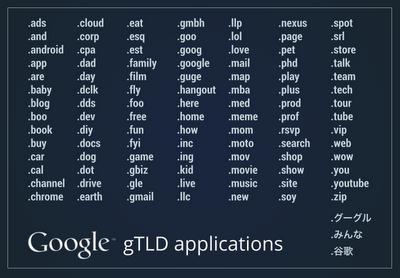
At the time, Google’s anti-SOPA activism was seen by many as more opportunistic than altruistic, and today that view seems to be further vindicated. According to a report from Consumer Watchdog on ICANN’s proposed addition of “top-level” domain names that noted, “Google has ponied up $18.7 million to buy 101 domain strings like .eat, .buy, .book, .free, .web, and .family.” They also want to own the domain string for “tech.”
A post on Google’s official blog explains their pursuit of these top-level names and characterizes the effort by employing their favorite, well-worn noun- “innovation.” In this case, however, it appears merely to be a euphemism for “control.” From their blog:
In 2008, ICANN announced a program to expand the number of generic TLDs (think .com, .org, .edu), developed through its bottom-up, multi-stakeholder process, in which we participate. Given this expansion process, we decided to submit applications for new TLDs, which generally fall into four categories:
Our trademarks, like .google
Domains related to our core business, like .docs
Domains that will improve user experience, such as .youtube, which can increase the ease with which YouTube channels and genres can be identified
Domains we think have interesting and creative potential, such as .lol
We want to make the introduction of new generic TLDs a good experience for web users and site owners. So we will:
Make security and abuse prevention a high priority
Work with all ICANN-accredited registrars
Work with brand owners to develop sensible rights protection mechanisms that build upon ICANN’s requirements
We’re just beginning to explore this potential source of innovation on the web, and we are curious to see how these proposed new TLDs will fare in the existing TLD environment. By opening up more choices for Internet domain names, we hope people will find options for more diverse—and perhaps shorter—signposts in cyberspace.
Ah, “signposts”….what a helpful sounding term. What Google really seeks to do looks more like a takeover– a move to control just about everything online, from search to domains. Consumer Watchdog expressed this concern in a letter sent to Senator Jay Rockefeller (D-WV), Chairman of the Senate’s Committee on Commerce, Science, and Transportation:
We believe the plans by Google and Amazon are extremely problematic and call on you to help
prevent their implementation. It is one thing to use a Top Level Domain name that is associated
with your brand name. In Google’s case that might be .Google or .YouTube or .Android.
Similarly it makes make sense for Amazon to acquire .Amazon or .Kindle. But, that is not what
is happening.
Google has ponied up $18.7 million to buy 101 domain strings like .eat, .buy, .book, .free, .web,
and .family. Amazon is close behind the Internet giant applying for 76 domain strings including
such names as .free, .like, .game, and .shop.
If these applications are granted, large parts of the Internet would be privatized. It is one thing to
own a domain associated with your brand, but it is a huge problem to take control of generic
strings. Both Google and Amazon are already dominant players on the Internet. Allowing them
further control by buying generic domain strings would threaten the free and open Internet that
consumers rely upon. Consumer Watchdog urges you to do all that you can to thwart these
outrageous efforts and ensure that the Internet continues its vibrant growth while serving the
interests of all of its users.
It would appear that the timing of the recent formation of a new tech Washington lobbying group “The Internet Association” is fortuitous. Member companies include : Amazon.com, AOL, eBay, Expedia, Facebook, Google, IAC, LinkedIn, Monster Worldwide, Rackspace, salesforce.com, TripAdvisor, Yahoo!, and Zynga with their stated mission:
The Internet Association, an umbrella public policy organization dedicated to strengthening and protecting a free and innovative Internet. The Internet Association will relentlessly represent this critical economic sector, in partnership with Main Street businesses and individual users, to ensure that the Internet will always have a voice in Washington and a seat at the table.
The most important question going forward would not seem to be will the internet have a voice, but whose internet will it be? Will it be the “free” one–or one owned by Google, Amazon and co?
Google has applied for these top-level domains
Update 8/21/14
It appears that creative artists are beginning to take notice and finally speak out against this land grab by Google and Amazon (and their ilk). From The Hill:
An independent music lobbying group is pushing to have the music community, not tech companies such as Google and Amazon, take control of the new Internet domain ending .music.
The American Association of Independent Music published a letter on Wednesday urging that ICANN not give the .music domain to companies like Google or Amazon, but instead hand it over to a non-profit entity:
We have followed the ICANN process and are very concerned of what might happen if ICANN does not select a music community supported organization, which understands the needs of our International music industry, to own and manage the .music gTLD. Our members’ livelihoods depend on the ability to license copyrights in a free market. This makes it essential to have regulatory partners that will help advance a worldwide enforceable regime for the protection of intellectual property online that enhances accountability at all levels of the online distribution chain and that deals effectively with unauthorized usages.
The benefits of the music community running the .music gTLD include maximizing the protection of intellectual property and incorporating appropriate enhanced safeguards to prevent copyright infringement, cybersquatting and any other type of malicious abuse. The community-based approach ensures that the string is managed under music-tailored registration policies. Such policies include registrant authentication, naming conditions which only allow registrants to register under their names or acronym and restricting content and usage to only legal music–related activities. This will ensure that any monies generated through .music will flow to the music creator community not pirates, unlicensed sites, or giant search engines.
We note two of the applicants are Amazon S.a.r.l (Amazon) and Charleston Road (Google). Both of these companies have exhibited a disregard for properly compensating music creators based upon music usage and for not protecting copyrights. Both have not valued Independent creator’s copyrights on the same equitable basis as larger copyright creators.
A worthwhile look at how today’s indie musicians have to navigate the good (and bad) of today’s online, internet-driven world via SantaFeNewMexican.com “Tech Bytes: Making music — and connections”
But while Bronson insists that the Internet has made it possible for him to have a working musical career in a lot of respects, he is also quick to point that there are certain downsides for creative artists in the Internet revolution. For while it has given artists the ability to control their presentation, it also has created an environment where content has become devalued as so much content is given away.
“One thing about the Internet that’s great is that we can search around for a lot of great content, and not just music, but movies and pictures and writing as well,” said Bronson. “Because people are now used to getting this information for free, to some degree content has been devalued and in a sense, creative people are devalued also.”
Richard Gere’s new movie “Arbitrage” was released this week to positive reviews and healthy box office returns. According to Variety, “Arbitrage …is banking on $750,000 Friday and roughly $2.3 million for the weekend at just 197 locations.” It’s not the robust opening weekend box office returns that makes this worth nothing. What’s significant is that the film’s theatrical release was only one part of a “day-and-date” release business model utilized by Lionsgate/Roadside. “Arbitrage” was released in theaters and VOD (video-on-demand) the same day.
Roadside Attractions used the same release model with their 2011 indie hit “Margin Call” , a film that grossed 5 million dollars in domestic box office. While some argued that the simultaneous VOD would undermine box office revenues, (VOD numbers aren’t made public), given the fact that Roadside is using the same approach with Arbitrage, one can only assume they liked what they saw.
Aside from bottom line figures, this release model is significant because it should dampen demand for illegal, pirated downloads. With “Arbitrage” immediately available via VOD, those who want to watch the movie right away, and avoid the theater, can do so via iTunes. Amazon Instant and similar on-demand sites.
But thwarting piracy isn’t the only benefit. For distributors, the option of using day-and-date release or the “ultra” release (releasing on VOD before a theatrical release) give studios a cost-efficient way to market a film.
Tom Quinn, President of the new Weinstein distribution company Radius was interviewed in a recent Entertainment Weekly article. Radius is distributing the Sundance hit “The Bachelorette” via the “ultra-release” model. Releasing the film on VOD a full-month before it’s September 7th theatrical release helped generate buzz and made it a #1 download on iTunes:
Once the movie hits VOD, the hope is that audiences will click to it, so to speak, and help spark the word-of-mouth campaign for the impending theatrical release — without the massive expense of marketing a major film. ”Not only is [VOD] a marketing tool,” says Quinn, “but more importantly, it’s a revenue generating marketing tool…
While it may seem somewhat counterintuitive — wouldn’t VOD ultimately take away some of the money the movie would otherwise be making at the box office? — when it’s working right, this “multi-platform” release pattern forms a mutually beneficial feedback loop, with the VOD release fueling the theatrical box office, and the theatrical release raising awareness for VOD. “You’re only creating more audience by showing your movie,” says Quinn. “If it has good word-of-mouth, then you should show it to as many people as you possibly can.” –Entertainment Weekly
Piracy apologists have long argued that online piracy was good for business. Problem is, the piracy “business” is predicated on theft, benefiting criminals like Kim Dotcom, not creators. Despite endless spin to the contrary, illegal downloads do not generally translate into profit for creators.
The key to these new models is the fact that distribution choices are controlled by rights holders, not pirates. Profits go to creators and not to thieves. A film’s distribution can be tailored to match audience demands and generate revenue–two goals that need not be incompatible.
Fact is–movies and music don’t have to be free for the internet to be free.
As an indie film and broadcast journalism veteran, I'll share my perspectives on issues of interest to the creative community and beyond--Ellen Seidler