First Look, Facebook’s New Rights Manager Tools

First Look, Facebook’s New Rights Manager Tools

Facebook rights manager applyFacebook finally joins YouTube in offering anti-piracy content detection tools

Facebook has been promising for some time to introduce tools that would allow rights holders to automatically detect and remove pirated content from its pages.

The company has endured a lot of bad publicity around the freebooting of viral YouTube videos on its pages, but Facebook’s also long been a place where pirated movies and music found a cozy habitat.  That is–until now. I’ve recently begun to utilize this tool to manage Facebook DMCA takedowns and wanted to share my first impressions, but first a bit of background.

First of all, I’m thrilled that Facebook, with all its resources, has finally begun to take copyright infringement seriously.  In introducing the new tool last month the Facebook development team explained why the company had finally stepped up:

Video has become an important part of the Facebook experience for people around the world, due in large part to the amazing creativity we’re seeing from all kinds of video publishers.

To provide the best experience for everyone who watches, creates and shares videos on Facebook, we work with our community to understand which tools they want us to build. Based on this feedback, on top of the measures we already have in place, we’ve been building new video matching technology to further help rights owners protect the content they own.

Signing up is easy and the interface straightforward and simple to use

I found signing up for the rights manager tool to be relatively straightforward.  You must have a page to link the rights manager to and I initially applied for, and was accepted into the program, by using our film’s Facebook page.  Once I received approval I was able to upload a reference copy of our film (and trailer) to the Facebook rights manager dashboard.  A trailer I’d uploaded to our page previously was also listed.  From there, Facebook’s automated digital matching tools went to work.

Facebook Rights Manager user dashboard

Facebook’s Rights Manager dashboard is pretty straightforward

According to Facebook the Rights Manager tools will allow publishers to:

  • Easily upload and maintain a reference library of the video content they want to monitor and protect. Publishers can upload content libraries and publish live video as references for Rights Manager to check against, including videos they are not sharing publicly on Facebook. Rights Manager then monitors for potential infringement of that content across Facebook.
  • Create rules about how individual videos may be used. Publishers can set specific match rules to either allow or report copies of their videos based on criteria of their choosing—for example, how much content has been reused, where the matching video is located or how many views the matching video has received.
  • Identify new matches against protected content. Rights Manager’s dashboard surfaces any new matches against a publisher’s uploaded reference files and live video. On the dashboard, publishers can filter matches by time, date or view count, and then either report potential copyright infringement or allow the matching content to remain published.
  • Whitelist specific Pages or profiles to allow them to use their copyrighted content. Publishers can specify Pages or profiles that have permission to publish their protected content without being monitored for potential infringement.
  • Protect their reference library at scale with the new Rights Manager API. We’re rolling out an API for Rights Manager to improve bulk uploading for publishers and to allow media management companies to support partners in managing, monitoring and protecting their content across Facebook. You can find out more about the Rights Manager API here.

Facebook’s tech support is responsive and proactive in working to improve the system

Facebook asks for feedback

Facebook asks for feedback in an effort to improve its rights manager tools

I do believe this type of fingerprinting technology will be an increasingly crucial tool as we move forward in the battle against online piracy on sites like Facebook, but as with any new offering, there are glitches.

The good news is that so far, Facebook’s technical support team is quite responsive and the company seems to be making a concerted effort to sort through issues and improve the tool’s operation.  Any time you remove an item from the dashboard a window pops up soliciting feedback.  I’ve also had a fair amount of helpful email correspondence with the support team and have found Facebook’s prompt and open response to my queries offers a welcome contrast the less-than-stellar support offered by a (popular) site that shall remain nameless.

As with any new tech, there are some glitches

I also set up a Rights Manager account for an independent film distributor I work for and in the process of uploading dozens of reference files have found the “matching” to be rather hit and miss.  At this point Rights Manager seems to do a great job detecting the company’s opening logo (and music) but little else.  What makes it even stranger is that the tool detects the distributors opening logo and music and then matches it to the wrong reference file.  Obviously ALL the titles I’ve been uploading share the same opening sequence from the distributor but when it comes time to actually issue the takedown to remove the infringing (matched) content, it auto-populates the form with the film’s title, which in these instances is the wrong one.

Facebook Rights Manager

Lots of early glitches with Facebook’s Rights Manager tools

I’ve also come across situations where a single film title is simultaneously listed has having matched multiple reference files to different titles, but NEVER the actual reference file for that particular film. Consequently, rather than send a DMCA notice with incorrect information, which would be illegal, I have chosen to wait for Facebook to sort out this particular glitch.  This is where their responsive tech support will, hopefully, come in handy.

I’ve also found that there’s a lot of uploaded content that doesn’t really match anything.  Perhaps a song is playing in the background that matches the film’s soundtrack, but it’s difficult to tell?  At this point the system’s matching capabilities clearly need to be dialed in order to better weed out innocent content.

As it stands, I have been manually removing this erroneous matches from the dashboard, but that takes precious time, and efficiency is one reason this system was developed in the first place.  For larger entities there are API tools, but for independent, smaller entities, it seems that utilizing the dashboard will be best route.

Facebook match rules

Users can create “match rules” to fine tune content matching

Some of the hiccups I’ve encountered thus far are likely simple bugs in the system, while others may well be user error.  Fortunately, Facebook has created tools that allow publishers/creators to fine tune the matches based on length of time, territory and content type.

I plan to spend some time working through the reference files I’ve uploaded to create appropriate match rules in the hope that it will result in fewer false positives.

Will creators be able to make money from their videos and music?

There’s also the question of monetization.  Will rights holders be able to earn money from copies of their work uploaded to Facebook?  It’s likely at some point in the future, but first Facebook will need to fine-tune Rights Manager.  They can’t afford to complicate a system that’s still for all practical purposes in beta mode.

Overall I’m pleased with Facebook’s effort.  Yes, it’s overdue and yes, it’s not (yet) perfect but it is a huge step in the right direction and hopefully can serve as a model for other social media and video sites across the web looking to do a better job thwarting piracy.

Facebook thumbs up!As I’ve written previously, I firmly believe UGC sites of a certain size (like Facebook, Vimeo, YouTube, et al) should be required to offer this type of tech in order to qualify for safe harbor.  Of course that assumes the creaky old DMCA will be revised and the odds of that actually happening any time soon….well, I’ll leave that discussion for another day.  In the meantime, I’m going to get busy on Facebook and upload some more reference files.  So far I’ll give the new system a thumbs up!

Google updates its anti-piracy report

Google updates its anti-piracy report


Googlgoogle-sign-post-piracye’s updated piracy report offers the some well-worn excuses

It’s that time of year.  The time of year where Google rolls out a shiny update on its “How Google Fights Piracy” report.  Google began the tradition in 2013.  At the time I noted that Google’s claim to be a “leader” in the fight against piracy was its first mistake. With today’s update, it appears the Silicon Valley giant hasn’t backed down from that dubious claim (or many others).

Katie Oyama, Senior Policy Counsel, Google asserts that, “We take protecting creativity online seriously, and we’re doing more to help battle copyright-infringing activity than ever before.”  Yet, in spite of Oyama’s rosy quote, in truth the reality (for creators) battling online piracy continues to be a bleak one.

Google search continues to list pirate links at the top of results

For the moment I’ll focus on Google search.  The report claims, “…Google does not want to include any links to infringing material in our search results, and we make significant efforts to prevent infringing webpages from appearing.”  It goes on to outline what Google’s doing to remedy the issue including this nugget:

Google believes that providing convenient, compelling, legitimate alternatives is one of the best means of fighting piracy. Accordingly, Google has launched a number of initiatives to present legitimate alternatives to users as part of search results, including providing advertisements on queries for movies and music to link users to legitimate means of purchasing content.

Google pretends to fight piracyThe reports also notes that it has focused on providing, “Clean results for media-related queries users actually type: Thanks to the efforts of Google’s engineers, the vast majority of media-related queries that users submit every day return results that include only legitimate sites.”

Oh Yeah, I’ve heard this line before, but unfortunately it isn’t true. This morning, after taking a gander at the report I went to Google search to search for the recent indie film Carol.  I typed in a pretty logical query–the kind “users submit every day” — choosing the phrase “watch Carol online.”  The VERY TOP RESULT took me–instantly–to a full, high-quality, pirated, illegal stream of the film.

Google search leads directly to pirated copy of film

Top result leads to full, pirated stream of the movie

Ok, so maybe the word “online” is too linked to piracy….so let’s drop the term and use only the terms, “watch Carol,” the first result was identical and led to the same pirated stream.  Yeah, there was was ad offering legit links at the top (which is a good thing) but unfortunately pirated versions remained front and center and at #1 in the actual search results.. Different search term, but same result

So much for their well-oiled talking point.  The fact is that Google search still provides a direct path to pirated content.

If some innocent person is simply looking for a way to (legally) watch Carol uses Google search instead of wheretowatch.com, why does the FIRST link in Google’s results offer a pirated version?  I didn’t say I wanted to “watch Carol free” I said merely that I wanted to “watch Carol.”  Is that a pretty standard approach to consuming movies???  Watching them???

Does Google really believe that watch isn’t a term people use every day to search for a movie online?

Google’s auto-complete suggests piracy-linked search terms

The only time I found somewhat clean results was by using the term “Carol movie.”   Now, forgive me, but it someone is looking to “watch” a film doesn’t it make sense they’d use that same term in a search query? Apparently Google’s engineers didn’t think so.  For them it seems that using the term “watch” is not a word worthy of inclusion amid their “vast quantity of media-related queries” when it comes to searching for a film title?

It’s also important to note that when I started typing in the terms “Carol mov…” Google’s own auto-complete provided the suggestion (carol movie online) which leads directly to the same pirated stream of Carol listed at #1 (see below).

Google auto-complete piracy term

Google auto-complete offers up a term that leads directly to pirated copy of the film

Didn’t Google’s engineering wizards notice this when they supposedly tweaked their algorithms to return results that include only legitimate sites?”

I’ll be examining Google’s report further and will follow up with another post, but I couldn’t let the announcement of this update slide by with nary a mention.  There’s much more to sift through, but I’d venture to guess it will be more of the same old, same old.  As I noted in my analysis of an earlier version of this Google report:

After reading it I think a more accurate title would be “Why Google Shouldn’t Have to Fight Piracy Because it Offers so Much Other Good Stuff.”

While the report does outline various positive steps Google’s taken (under duress) to mitigate its role in incentivizing and enabling piracy, most of the document reads more like an evangelical tome as to how their innovations have benefited content creators, blunting any collateral damage that may have occurred.  In other words, let’s overlook the bad in favor of the good…

I have a feeling not much will have changed…If there’s any truth in the claim that Google is “doing more” it’s because it’s allowing more pirated content than ever on its products.

New study shows bias against women in film continues

New study shows bias against women in film continues

Slated Study - Women In FilmYet again, women in Hollywood find themselves on the short end of the stick

A new infographic by Slated (an organization that filmmakers with talent, financing & distribution) first published in The Hollywood Reporter exposes a “a systemic lack of trust on the part of the film industry when it comes to collaborating with women in the workplace.” 

The infographic’s authors used statistical analysis to look at 1,591 feature films released (theatrically) between 2010 and 2015 and published findings via an infographic.

Bias was documented not only by the woefully low numbers of female directors, but even in categories like supporting actors where only 41% of the roles were filled by women.  While such inequality has been highlighted in previous studies like the Celluloid Ceiling Report published by researchers at San Diego State, Slated’s data analysis looks took another approach by asking, “how data science can best be harnessed to offset what is evidently a pattern of institutionalized bias at play in the marketplace.”

Slated’s CEO Stephan Paternot told the Hollywood Reporter’s Rebecca Sun that the issue goes beyond gender disparity in employment, pointing to an overall “trust gap” that handicaps female filmmakers:

Women are being given fewer films, and not only is that true, but they’re having to make their movies with less money, so they’re doing it with one arm tied behind their back. That effectively puts less production value up on the screen, meaning movies with a little narrower scope…  And once the product is all made, assuming it’s as good despite having less money, it’s then handicapped by being shown on two-thirds fewer screens. Those movies just don’t get seen. So then there’s this ongoing perception that women just aren’t really into the movie industry, and if they do make stuff, it’s not quite as good. – Hollywood Reporter

This “trust deficiency” exists despite the fact that while women-helmed features often have lower budgets, they “generate higher returns,” providing a higher return on investment (ROI).  This disparity is most evident among screenwriters where women achieve the highest ROI, yet account for less than 10% of theatrically released screenplays.

After reviewing the data, Slated researchers asked:, “When one looks at the ROIs, it’s clear that women are outperforming men all over the place — so what can we do as an industry to make sure that the production volumes are more comparable?”

Overall Slated’s analysis revealed:

  • Women Directors are the most under-represented major category in cinema, accounting for 8.8% of films made in this survey period. They are followed by Women Writers (13.2%), Women Producers (19.8%) and Women Acting Leads (29.4%) Even roles for Supporting Actors, which one might think would be close to fifty-fifty, are tilted towards men.

  • Regardless of role, women are afforded smaller budgets than their male counterparts. And yet, with the exception of Women Directors, those same women generate higher returns despite deploying those smaller production resources.

  • Women Writers seem particularly shortchanged: Their scripts achieve the highest ROI of any category and yet their work commands two-thirds of the average budgets given to Male Writers. This imbalance becomes particularly egregious for films budgeted at more than $25 million, a category in which Women Writers achieve an industry-high ROI of 3.72 and yet account for just 8.7% of theatrically released screenplays.

  • Even though male writers generate considerably more theatrical material than women writers, the market potential for their screenplays is essentially the same. The tiny difference in their Slated SCRIPT SCORES, an industry-weighted measure of a script’s quality that is derived from the year-adjusted performance analysis of 191 screenplays, does not come close to the imbalance in their script production volumes. For Male Writers that score is 78.0; for Female Writers it is 76.6.

  • In every cinematic genre, far fewer films are directed by women than by men. But if you adjust for that discrepancy, you will see that the volume of films made in each genre by men and women flexes up and down in surprising synchrony. So, too, does the ROI on those genres for both sexes.

Here’s the rest of Slated’s infographic:

2-Slated_infographic_women_filmstudy

Infographic: Slated.com

Infographic: Slated.com

Update to Digital Millennium Copyright Act Long Overdue

Update to Digital Millennium Copyright Act Long Overdue

DMCA is outdated and broken

Momentum is building for changes to the DMCA that will better protect creators

Content creators from all walks of life are coalescing around the need to update copyright law to protect their work against theft in digital age.  A piece in yesterday’s NY Times,  Music World Bands Together Against YouTube, Seeking Change to Lawis the latest to highlight growing calls by the creative community to update a woefully antiquated Digital Millennium Copyright Act of 1998.

In its newest effort, the music industry has asked the federal government to change the Digital Millennium Copyright Act, saying that the law, which was passed in 1998 and protects sites like YouTube that host copyrighted material posted by users, is outdated and makes removing unauthorized content too difficult.

Cary Sherman, the chief executive of the Recording Industry Association of America, says that even when songs are taken down, they can easily be uploaded again.

“This is a new form of piracy,” he said. “You don’t have to go into dark corners and sell stuff out of your car. You can do it in plain sight and rely on the D.M.C.A. to justify that what you’re doing is perfectly legal.” –NY Times

Last month the U.S. Copyright Office held public roundtables in New York and San Francisco to hear testimony as part of its study to “evaluate the impact and effectiveness of the safe harbor provisions contained in section 512 of title 17, United States Code.”

As part of the study, the Copyright Office also solicited public comments. While I shared by thoughts with researchers at Mason Law’s Arts & Entertainment Advocacy Clinic for its submission, “Middle Class Artists Want a DMCA System that Works”  I also drafted my own statement.  Although my comments are part of the public record, I thought I’d share my them here as well.   My hope is to generate further dialogue as to how we can advocate for a meaningful update to the DMCA so that moving forward, creators’ rights (and livelihoods) will be better protected.

Here’s my submission to the U.S. Copyright Office.

Updating the DMCA – Areas of Concern

Overwhelming volume

The DMCA is currently the only tool content creators have available to safeguard their work from online theft and profiteering. Unfortunately, these days, using the DMCA to fight piracy is about effective as standing under Niagara Falls holding an umbrella.

Within a few months of our independent film’s release in 2010 we’d found more than 56,000 illegal download links and streams for pirated copies. Those are only the ones we managed to uncover. There were likely thousands more.

Multiply that figure by hundreds, if not thousands, of downloads per link and one can begin to appreciate the scope of the problem. Of course not every illegal download equals a lost sale, but even looking at a fraction of the total, the income lost by diluting legit sales can represent the difference between paying off production debts and making another film, or not.

The time and effort spent in policing piracy on the web is time and effort most independent artists cannot afford. For larger entities that can engage takedown services to manage the work for them the process remains an expensive and daunting task.

Ultimately such efforts can only slow, not stop, the incredible tide of online piracy.

Overly complex takedown procedures

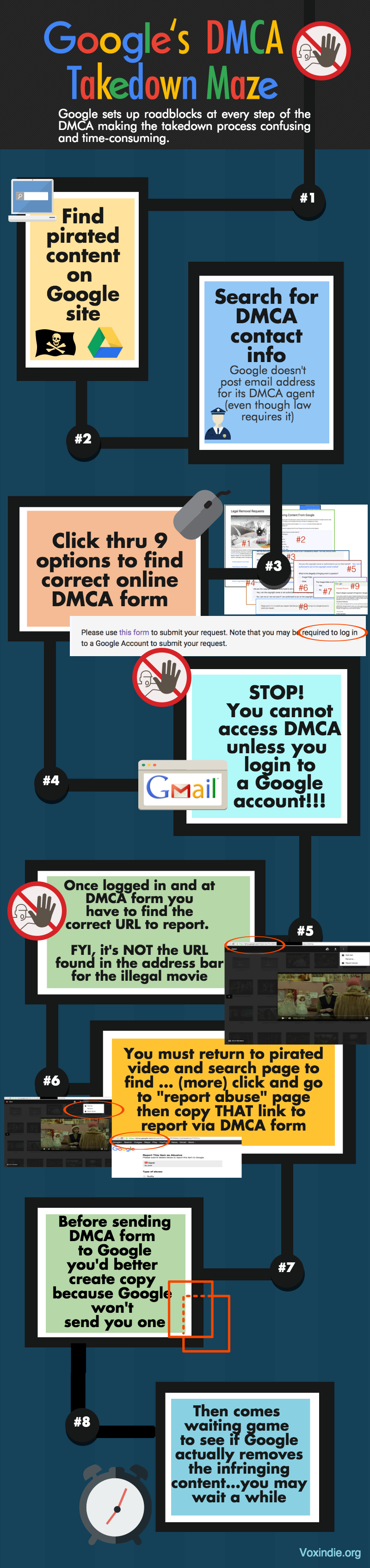
While that language required to craft a legal DMCA takedown notice is straightforward, the process for actually sending it to an OSP’s takedown agent is often not so clear. While some OSPs accept email notification (as required by law), other larger entities, like Google, prefer that requests be sent via a cumbersome and time-consuming online process.

Uploading infringing content to a Google site can be done with a mere click of a mouse, unfortunately removing it is not quite so simple. Because the email address for Google’s DMCA Agent is not posted on its websites, rights holders must jump through various hoops and navigate through a series of questions in order to arrive at the correct form. Once there it takes additional time to complete the 9-part form. Before one can actually send it one must be sure to create a Google account, then login and send.

Once the takedown request is sent, no copy of the actual takedown request is generated, only a brief acknowledgement of receipt. Then it’s a waiting game to see whether the infringing content gets removed.

Sending a simple DMCA takedown notice via email is simple, fast, and makes record keeping and follow up easy.   Any update to the DMCA should continue to support email as an efficient way to send takedown requests and require that OSPs process emails with the same speed as those submitted via the web form.

Repeat infringement

Even if one sends a DMCA takedown notice to Google reporting a site for dozens of illegal links, Google allows the site to remain online.   It takes multiple notices, sent 48 hours apart, to trigger any sort of account disabling.

Other sites employ varying degrees of punishment for repeat infringers and some do nothing. This is certainly an area of concern for rights holders as it adds to the overall ineffectiveness and inefficiencies of the DMCA notice and takedown process.

Any update to the DMCA should specify what constitutes a repeat infringement and require that OSPs publish this information on their website. The law should also require that the OSP be responsible for preventing any re-upload of content already reported as infringing. This can be achieved by employing technological solutions described in the following section.

Technological Solutions

Technology brought us to this point. It’s time technology be utilized to help safeguard copyrighted work. YouTube’s Content ID system, though not without problems, at least provides a way for rights holders to find and manage YouTube access for their music or films. Cloud storage provider Dropbox also employs technology to scan files for identifying hash data so that reported files cannot be uploaded repeatedly.

If an OSP’s (online service provider) business model is predicated on monetizing user-generated content (not vetted for copyright) then the OSP should be required, by law, to implement some form of digital fingerprinting to prevent infringing material from being uploaded in the first place. This type of technology would also help address enforce a takedown – stay down approach and prevent repeated uploads of pirated content to a site.

If an OSP does not have the resources to build its own proprietary tech like YouTube’s Content ID, there are a number of third-party vendors, like Vobile, that offer digital fingerprinting. While such 3rd-party services are not free, it seems only fair that cost of implementing a digital gatekeeper be considered a cost of doing business. Creators have long borne the “costs” of OSPs monetizing their content without permission. Having OSPs tap into profits to better protect copyright seems only fair.

Any update to the law should include a requirement that, in order to qualify for the limitations to liability that safe-harbor offers, certain user-generated content sites must implement reasonable technology to mitigate content theft.

Counter-notices and small claims process

Not only are creators burdened with having to play detective to find and remove their stolen content from various websites, but even the counter-notice system works against rights holders.

The counter-notice system allows recipients of an erroneous DMCA to prevent the removal of content and while such a system of checks and balances is important, problems occur when such counter-notices are themselves erroneous. Unless the sender of the DMCA notice files in federal court to enforce the takedown, following a 10-day waiting period, the reported content is reposted.

For most indie artists, the cost of filing in federal court to enforce a DMCA takedown is far too costly and so, in these cases, the infringing content remains online. I’ve experienced this situation multiple times and have seen full copies of a film reposted after a counter-notice (claiming fair use) was sent after a takedown on YouTube.

Perhaps, as part of any update to the DMCA, the time has finally come to create a small claims process to adjudicate copyright claims outside the federal court system. The U.S. Copyright Office has already studied the issue and has recommended creation of a voluntary system of adjudication to resolve copyright small claims. (http://copyright.gov/docs/smallclaims/usco-smallcopyrightclaims.pdf )

Content removed due to infringement should not be replaced by direct links to 3rd party site(s) that republish the same infringing links

Another issue not addressed by the DMCA is a problem that’s arisen thanks to a third-party database that records all the DMCA notices received by a number of OSPs including Google. The Lumen database https://lumendatabase.org/ (formerly Chilling Effects) offers a searchable database of these DMCA notices. While this might serve as a valuable archive, Lumen’s searchable database, in its current form, does not redact the infringing URLs from the DMCA notices and so–in effect–becomes an efficient search engine for pirated content. This afternoon I used Lumen’s search engine to look for illegal copies of the recent release “Carol.” With one click I found a link, then right-click and I ended up at an active, illegal copy online.

Lumen’s DMCA notices are also easily found thanks to Google’s direct links to them in what would seem to be blatant disregard for the DMCA’s intent–if not the law. The scenario works like this: When an infringing link is removed from Google search following a DMCA request, the search result remains, but the original infringing link is simply replaced with a fresh hyperlink to the DMCA notice stored in Lumen’s database. Essentially, removing the infringing link from Google search with a DMCA takedown requests only means a web user searching for pirated copies only has to click one additional link in order to find the pirated content he/she was looking for.

While the database itself may claim to operate under the mantel of “free speech” one has to ask how Google qualifies for “safe harbor” protection when infringing links removed from its search engine are replaced by a link to the DMCA notice on the Lumen database that contains the same, un-redacted infringing link.  This type of re-linking should be explicitly banned in any update of the DMCA.

What’s at stake

Takedowns will continue to be a part of any DMCA fix, but collectively we must figure out a better way streamline the process, utilize technology, and mediate disputes in order to protect copyright and support a culture where creators can flourish– and the wealth of content they create can be enjoyed, and sustained, by consumers throughout the world.

If nothing is done to update the DMCA for the 21st century, content creators of all stripes will continue to struggle and the diversity, and variety of quality of creative content available to consumers will diminish. At first, we may not miss what isn’t made, but eventually our creative culture will be the lesser for it.


More Google DMCA misdirection…refusing takedown requests for Blogger sites with custom domains

More Google DMCA misdirection…refusing takedown requests for Blogger sites with custom domains

Hop aboard the Google DMCA carouselHop aboard for another spin on Google’s DMCA Merry-Go-Round

It’s not news that Google-hosted Blogger websites are a favorite storefront for online pirates.  It’s also not news that Google does its best to obstruct DMCA takedowns by setting up various roadblocks along the way.  Today I discovered yet another example of just how difficult Google makes the DMCA process–this time with Blogger-hosted sites that use custom domain names.

When you create a blog using Blogger you’re given a domain that ends in blogspot.com. However users are free to use a custom domain name instead.  That’s all well and good, unless the website distributes pirated content.  In that case, if you’re a creator trying to get your pirated content removed (by Google), you’re likely to run into problems.

Usually, when one of these pirate entrepreneurs creates a site on blogspot.com a rightsholder can send a DMCA by using Google’s annoying web form (or annoy them by sending an email: [email protected]).  However, if you use the same DMCA form to report a blogger-hosted site with a custom domain, Google won’t remove it.  They’ll just send you back to the beginning.

I found out about this twist when I sent several DMCA notices this week on behalf of an indie film distributor.   I requested the removal several pages of pirated movies I found on a Blogger-hosted website with a custom domain.  The claim was rejected and the response on the Google Removals Dashboard read: Inappropriate for TCRP. Please submit through the standard web form.

TCRP stands for “Trusted Copyright Removal Program” but the problem is that I didn’t use any sort of TCRP…I wish I could, but I’m just a lowly commoner who doesn’t have access to this program.  I USED THE STANDARD WEB FORM!!!!

Why–when there’s no doubt that this website is streaming a full copy of the film on a Google-hosted website–do they send me back to the same standard web form I used to send the original request?  It’s an endless loop.  Follow along below:

Google hosted Blogger pirate site

Code shows site hosted by Google's Blogger

A DMCA request was sent using Google’s own web form (for Blogger) yet the claim is rejected and I’m told to send the takedown again using the very same form?

Apparently, even though Google hosts the pirate site, it refuses to remove infringing content the pirate is using a custom domain, not a blogspot.com domain.  Welcome to the Google DMCA Merry-Go-Round. 🙁

When I researched the issue further I discovered I’m not the only one running into this problem.  On Google’s own Blogger Help Forum there’s a recent thread about the issue.  Last month a user DeeLite310  posted a question after receiving the same— Inappropriate for TCRP. Please submit through the standard web form–response to a DMCA s/he sent reporting a Blogger site pirated games.

Once again the not-so-helpful Google response was to send DeeLite310 (who’s not part of the TCRP)  back the beginning of the Google Blogger DMCA merry-go-round.   Here’s part of the exchange (but I suggest reading the entire thread to fully appreciate just how frustrating dealing with Google can be):

Google DMCA roadblocks

Google doesn't make sending DMCA notice easy

Welcome to the Google Merry-Go-Round…DeeLite310 is sent back the beginning…again and again…

Google sends you back to where you started

Google loves to throw the word “transparency” around a lot in discussions around how it handles DMCA requests.  Too bad it doesn’t provide more transparency when creators, victimized by pirates using Google products, make good faith (legal) efforts to request the removal of infringing content.  As I’ve said before, the DMCA is broken…

*Update 5/16/16:  During May’s Section 512 hearings in San Francisco I spoke with Fred von Lohmann, Google’s senior copyright counsel, about my blog post.  He told me that I had indeed discovered a “bug” and that Google staff was working to fix the issue.  I was happy to hear that Google was responding in a positive manner to this problem.  I’ll test out whether it has been fixed by resending the original DMCA notice that prompted this post.  Stay tuned…

Update 6/28/16:  According to Mr. Von Lohmann, the bug has been fixed.