by Ellen Seidler | Copyright, Film, Google, Law, Piracy
 Doing the job, but not a very good job
When people talk about effective ways to mitigate the impact of online piracy, YouTube’s Content ID is often used as an example of what works. Unfortunately, despite its role as poster boy for anti-piracy tech, in reality it falls flat as a gatekeeper against online piracy.
Aside from a labyrinth-like user interface that seems likely to have been designed–not to help– but to discourage rights holders from using Content ID, the actual fingerprinting technology behind it can be easily fooled.
YouTube introduced the Content ID system in 2007. At the time, the company was facing pressure from a Viacom lawsuit, among others. According to YouTube, it’s pretty straightforward:
Videos uploaded to YouTube are scanned against a database of files that have been submitted to us by content owners. Copyright owners get to decide what happens when content in a video on YouTube matches a work they own. When this happens, the video gets a Content ID claim.
Looking to make money off work they don’t own, clever YouTube users have discovered ways to fool the technology so their illegal uploads of copyrighted movies and music don’t get flagged, blocked or removed.
I began noticing this phenomenon more lately as I’ve begun to find full, infringing copies of films uploaded that matched content owned by a film distributor I work for. This seems to be happening more often and I was curious as to how these pirated copies had avoided detected by Content ID. When I looked closely I saw that subtle manipulations in brightness had taken place along with slight adjustments to frame size and sometimes the crop of the frame.
When I started poking around YouTube to find other examples of these uploads they were easy to find. It only took me a few minutes to find dozens of copies of a variety of full copyrighted movies, old and new. One title I came across was the movie, Everest. Below are screen captures from two different full uploads of the movie I found streaming on YouTube.

Two full copies of the movie Everest uploaded to YouTube.
In this case the uploader had used several techniques to avoid detection including reversing the frame (note the backwards title), darkening the lower part of the frame and cropping it. Of course, having recently viewed the film on HBO, watching a lousy copy like this on YouTube wouldn’t be my choice, but apparently others didn’t mind. Uploaded only a month ago, the movie had already racked up more than 16,000 views.
Pirate uploads make money for uploader and for YouTube
Why go to all this trouble to manipulate a movie for upload to YouTube? Well, it’s the age-old pirate motivator–money. This uploader, who goes by the name Kenneth Lamb, has claimed ownership of this content and monetized it with ads. He makes money. YouTube makes money. The movie’s actual production companies make nothing.

This YouTube user claims to own rights to Everest movie worldwide and makes money off ads
In an ironic twist, several of the ads that appeared when I was examining (and reloading) this pirated copy of the film were for films including DreamWork’s upcoming movie Trolls and Warner Brother’s Jason Bourne. It’s more than a tad ironic that Hollywood studios are (inadvertently) putting cash in YouTube’s hands via advertising on a pirated copy for one of its own productions.

Ultimate irony that ads for upcoming movie releases are featured on pirated copies of Hollywood films
I don’t deal with music or audio files on YouTube but there are similar manipulations happening there as well where uploaders resample, add noise, etc. to fool the Content ID system into ignoring the file.
What can YouTube do to fix this growing problem? Per usual, the list is long and varied, but begins with asking Google engineers to design better fingerprinting tech. There are other companies that offer digital fingerprinting technology seem to do a better job catching these circumventions. If I can easily uncover an upload is a copy of the movie Everest, why can’t Content ID? You can’t tell me that with all its financial (and technological) resources YouTube doesn’t means to upgrade its system?
Technological solutions exist. It’s just a matter of priorities. Stopping piracy isn’t a priority for YouTube.
Aside from updating its fingerprinting capabilities, YouTube could also improve the Content ID system through providing a better interface, more transparency, better compensation for artists, etc. Of course again that would mean lower profits for Google/YouTube so such straightforward fixes are unlikely. Meanwhile, YouTube makes great hay out of its concerns for poor, maligned users who may have received an erroneous DMCA notice. The company is willing to spend money to defend a few select uploaders but won’t spend resources to fix its broken Content ID system?
Operating only a marginal (not great) Content ID system is in YouTube’s best interests
Of course the powers that be at YouTube probably prefer to keep Content ID just the way it is–creaking along, occupying a neutral zone positioned between accolades and scorn. It’s a safe position, one that gives YouTube officials cover when they use disingenuous excuses about their anti-piracy practices to critics, while avoiding any real (legal or financial) consequences.
Content ID does the job just well enough….but that doesn’t mean it does a good job. It could serve as a true model for technological safeguards against piracy, but as now, it’s merely a slight bump in the road for those determined to steal and monetize the works of others. Meanwhile, YouTube continues to pocket advertising cash, make its stockholders happy while leaving filmmakers and musicians on the outside, looking in.
by Ellen Seidler | Google, Music, Tech

Google’s anti-SOPA plea
Google and Amazon want to rule the top level domain web universe
(this piece originally posted on 9/12/12 but I’ve updated it to include new information on efforts by representatives of indie musicians to thwart this top level domain name power grab by Google and Amazon)
If you read the propaganda promoted by Google during last year’s SOPA debate, you would have come across pleas like this:
More than any time in history, more people in more places have the ability to make their voices heard. Just as we celebrate freedom, we need to celebrate the tools that support freedom. Add your voice in support of a free and open Internet.
According Google and other opponents in the tech industry, if the Stop Online Piracy Act were to pass, the internet would be “broken” and no longer “free.” A questionable concept, particularly when Google was against the legislation because it would impinge on their unfettered ability to make money (no matter the source).
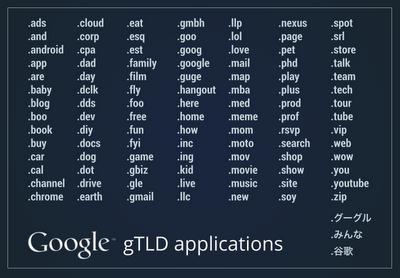
At the time, Google’s anti-SOPA activism was seen by many as more opportunistic than altruistic, and today that view seems to be further vindicated. According to a report from Consumer Watchdog on ICANN’s proposed addition of “top-level” domain names that noted, “Google has ponied up $18.7 million to buy 101 domain strings like .eat, .buy, .book, .free, .web, and .family.” They also want to own the domain string for “tech.”
A post on Google’s official blog explains their pursuit of these top-level names and characterizes the effort by employing their favorite, well-worn noun- “innovation.” In this case, however, it appears merely to be a euphemism for “control.” From their blog:
In 2008, ICANN announced a program to expand the number of generic TLDs (think .com, .org, .edu), developed through its bottom-up, multi-stakeholder process, in which we participate. Given this expansion process, we decided to submit applications for new TLDs, which generally fall into four categories:
- Our trademarks, like .google
- Domains related to our core business, like .docs
- Domains that will improve user experience, such as .youtube, which can increase the ease with which YouTube channels and genres can be identified
- Domains we think have interesting and creative potential, such as .lol
We want to make the introduction of new generic TLDs a good experience for web users and site owners. So we will:
- Make security and abuse prevention a high priority
- Work with all ICANN-accredited registrars
- Work with brand owners to develop sensible rights protection mechanisms that build upon ICANN’s requirements
We’re just beginning to explore this potential source of innovation on the web, and we are curious to see how these proposed new TLDs will fare in the existing TLD environment. By opening up more choices for Internet domain names, we hope people will find options for more diverse—and perhaps shorter—signposts in cyberspace.
Ah, “signposts”….what a helpful sounding term. What Google really seeks to do looks more like a takeover– a move to control just about everything online, from search to domains. Consumer Watchdog expressed this concern in a letter sent to Senator Jay Rockefeller (D-WV), Chairman of the Senate’s Committee on Commerce, Science, and Transportation:
We believe the plans by Google and Amazon are extremely problematic and call on you to help prevent their implementation. It is one thing to use a Top Level Domain name that is associated with your brand name. In Google’s case that might be .Google or .YouTube or .Android. Similarly it makes make sense for Amazon to acquire .Amazon or .Kindle. But, that is not what is happening.
Google has ponied up $18.7 million to buy 101 domain strings like .eat, .buy, .book, .free, .web, and .family. Amazon is close behind the Internet giant applying for 76 domain strings including such names as .free, .like, .game, and .shop.
If these applications are granted, large parts of the Internet would be privatized. It is one thing to own a domain associated with your brand, but it is a huge problem to take control of generic strings. Both Google and Amazon are already dominant players on the Internet. Allowing them further control by buying generic domain strings would threaten the free and open Internet that consumers rely upon. Consumer Watchdog urges you to do all that you can to thwart these outrageous efforts and ensure that the Internet continues its vibrant growth while serving the interests of all of its users.
It would appear that the timing of the recent formation of a new tech Washington lobbying group “The Internet Association” is fortuitous. Member companies include : Amazon.com, AOL, eBay, Expedia, Facebook, Google, IAC, LinkedIn, Monster Worldwide, Rackspace, salesforce.com, TripAdvisor, Yahoo!, and Zynga with their stated mission:
The Internet Association, an umbrella public policy organization dedicated to strengthening and protecting a free and innovative Internet. The Internet Association will relentlessly represent this critical economic sector, in partnership with Main Street businesses and individual users, to ensure that the Internet will always have a voice in Washington and a seat at the table.
The most important question going forward would not seem to be will the internet have a voice, but whose internet will it be? Will it be the “free” one–or one owned by Google, Amazon and co?
Update 8/21/14
While Amazon has been denied the right to its own moniker .amazon–since it appears that there’s major South American waterway that “owned” the name long before–the fate of many other top level domains, including .music, remains up in the air. Fortunately it seems that creative artists are beginning to take notice and speak out against this land grab by Google and Amazon (and their ilk). From The Hill:
An independent music lobbying group is pushing to have the music community, not tech companies such as Google and Amazon, take control of the new Internet domain ending .music.
The American Association of Independent Music published a letter on Wednesday urging that ICANN not give the .music domain to companies like Google or Amazon, but instead hand it over to a non-profit entity:
We have followed the ICANN process and are very concerned of what might happen if ICANN does not select a music community supported organization, which understands the needs of our International music industry, to own and manage the .music gTLD. Our members’ livelihoods depend on the ability to license copyrights in a free market. This makes it essential to have regulatory partners that will help advance a worldwide enforceable regime for the protection of intellectual property online that enhances accountability at all levels of the online distribution chain and that deals effectively with unauthorized usages.
The benefits of the music community running the .music gTLD include maximizing the protection of intellectual property and incorporating appropriate enhanced safeguards to prevent copyright infringement, cybersquatting and any other type of malicious abuse. The community-based approach ensures that the string is managed under music-tailored registration policies. Such policies include registrant authentication, naming conditions which only allow registrants to register under their names or acronym and restricting content and usage to only legal music–related activities. This will ensure that any monies generated through .music will flow to the music creator community not pirates, unlicensed sites, or giant search engines.
We note two of the applicants are Amazon S.a.r.l (Amazon) and Charleston Road (Google). Both of these companies have exhibited a disregard for properly compensating music creators based upon music usage and for not protecting copyrights. Both have not valued Independent creator’s copyrights on the same equitable basis as larger copyright creators.
That last sentence pretty much says it all. If ever there was a time the creative community to speak up, it’s now, but musicians aren’t the only ones raising concern.
FairSearch.org is also fighting tooth and nail against Google’s efforts to control top level domains, including .search. A report published on its website exactly one year ago (August 22, 2013) summarized its opposition:
FairSearch hopes ICANN rejects Google’s applications to control new gTLDs to prevent the far reaching competitive implications of giving Google even more power over consumer and competitor data to increase its dominance online. The New York Times summed up this risk more generally in an article this week:
“There’s a larger issue at stake, however. Advocates of Internet freedom contend that such an expanded address system effectively places online control over powerful commercial and cultural interests in the hands of individual companies, challenging the very idea of an open Internet…”
We couldn’t have said it any better.
The ball is now in Google’s court, as industry news site TheDomains.com put it, “So Now What Will Google Do With Its New gTLD Application For .Search?” Regardless, the competition concerns remain around giving Google more ability to control Internet usage by allowing it to control access to key gTLDs soon to be put into use by ICANN.
FairSearch continues to oppose Google’s applications to control these top-level domains.

by Ellen Seidler | Ad Sponsored Piracy, Copyright, Film, Piracy, Tech
 Google comes in a close second to word-of-mouth in path to piracy poll
A while back one of the world’s most popular pirate websites, LetMeWatchThis went through tumultuous times as its domain name was hijacked and cloned by other not-so-nice pirates. According to torrentfreak.com the hijacking, and general confusion led to the domain switching to an entirely new domain, primewire.ag:
One of the largest unauthorized streaming movie websites on the Internet is at the center of what is probably the most confusing mess ever to hit the sector. Various hackings, hijackings, domain changes and nefarious happenings have turned 1Channel, LetMeWatchThis, PrimeWire.ag and Vodly.to into a maze of smoke and mirrors through which no regular user has a hope of navigating.
While it’s not clear if the dust as settled, what is clear is that someone operating the domain name primewire.ag is running a website full of illegal links to thousands of stolen movies. The pirate site, as mentioned in my earlier post today, makes money via advertising (mostly major American brands) but as I was researching the site for my post, I noticed another feature worth highlighting. In its sidebar, the website has posted a poll asking this question: How did you find us through our new name?
According to the results users turned, in large numbers, to that tried and true source for pirated content worldwide, Google search. Nearly 200,000 (29.88 %) users chose Google as their path to the site, second only to word of mouth which took top honors at 43%. While the poll is not scientific, it does provide more anecdotal evidence to what most believe to be true, Google is a major sign post on the path to online piracy. Even when pirate sites run into trouble with other pirates hacking and stealing their domains (ironic isn’t it), leave it to Google to come to the rescue.


by Ellen Seidler | Copyright
 The RIAA is not pleased with results of Google’s efforts to downgrade pirate websites in search results. According to a story by Stuart Dredge published today on Musically.com, the RIAA says Google’s not doing all it can to demote infringing sites:
The RIAA says it’s been monitoring the results, and it’s not happy. “Six months later, we have found no evidence that Google’s policy has had a demonstrable impact on demoting sites with large amounts of piracy. These sites consistently appear at the top of Google’s search results for popular songs or artists,” it says in a statement.
Specifically, the RIAA claims that the “serial infringers” sites that it analysed “still managed to appear on page 1 of the search results over 98% of the time in the searches conducted – in fact, these sites consistently showed up in 3 to 5 of the top 10 search results.”
I’ve found the same scenario with searches I’ve done. Earlier this month (2-11-13) did a search for an indie film “A Perfect Ending” that was released on DVD in early February. I searched the “past 24 hours” and used the search term: “a perfect ending” download. The results were not surprising. At the top of the list, after a paid Netflix placement, was a link to a Pirate Bay torrent.

Today I did a search for the Academy Award nominated “Silver Linings Playbook.” This time a I used a more general search term: silver linings playbook download and didn’t limit it by date. In this instance the first non-commercial result was the site www.movie2k.to. When I checked the link, I found more than 30 links to illegal downloads/streams. The first link was an active/embedded stream of the movie.* I checked the second link on the list and found it to be an active download.

When I checked Google’s Transparency Report for reported takedown request Google received over the past month for links to www.movie2k.to I found 37,764 URLS had been reported.

Now the top domain reported was Filestube.com with more than 400,000 takedown requests, but 37,764 is not an insignificant amount. BTW, this site itself is impervious to takedown requests. If you are a rights holder who wants the infringing links removed, you have to click each link and click often through a myriad of pop-up ads to report the file. Even then, some of the sites don’t respond. Lip-service to the contrary, Google remains a top dog in facilitating piracy. From Musically.com:
“There is a staggering amount of copyright infringement taking place every day online and much of it is facilitated by Google, as their own data shows,” wrote the MPAA’s SVP Content Protection, Internet, Marc Miller.
Earlier this week I wrote about Google’s disingenuous move to pressure payment providers to cease doing business with pirate websites. Once again I have to ask, why doesn’t Google clean its own house before shifting the focus to others? Seems like they still have plenty of their own work to do.
*In my experience the streams offered via this site (stream2k) are impervious to DMCA takedown requests.

by Ellen Seidler | Copyright

Google’s anti-SOPA plea
Google and Amazon try to grab new top level domains and increase their control over the web
(this was originally posted on 9/12/12 but I’ve updated it to include new information on this power grab by Google and Amazon)
If you read the propaganda promoted by Google during last year’s SOPA debate, you would have come across pleas like this:
More than any time in history, more people in more places have the ability to make their voices heard. Just as we celebrate freedom, we need to celebrate the tools that support freedom. Add your voice in support of a free and open Internet.
According Google and other opponents in the tech industry, if the Stop Online Piracy Act were to pass, the internet would be “broken” and no longer “free.” A questionable concept, particularly when Google was against the legislation because it would impinge on their unfettered ability to make money (no matter the source).
At the time, Google’s anti-SOPA activism was seen by many as more opportunistic than altruistic, and today that view seems to be further vindicated. According to a report from Consumer Watchdog on ICANN’s proposed addition of “top-level” domain names that noted, “Google has ponied up $18.7 million to buy 101 domain strings like .eat, .buy, .book, .free, .web, and .family.” They also want to own the domain string for “tech.”
A post on Google’s official blog explains their pursuit of these top-level names and characterizes the effort by employing their favorite, well-worn noun- “innovation.” In this case, however, it appears merely to be a euphemism for “control.” From their blog:
In 2008, ICANN announced a program to expand the number of generic TLDs (think .com, .org, .edu), developed through its bottom-up, multi-stakeholder process, in which we participate. Given this expansion process, we decided to submit applications for new TLDs, which generally fall into four categories:
- Our trademarks, like .google
- Domains related to our core business, like .docs
- Domains that will improve user experience, such as .youtube, which can increase the ease with which YouTube channels and genres can be identified
- Domains we think have interesting and creative potential, such as .lol
We want to make the introduction of new generic TLDs a good experience for web users and site owners. So we will:
- Make security and abuse prevention a high priority
- Work with all ICANN-accredited registrars
- Work with brand owners to develop sensible rights protection mechanisms that build upon ICANN’s requirements
We’re just beginning to explore this potential source of innovation on the web, and we are curious to see how these proposed new TLDs will fare in the existing TLD environment. By opening up more choices for Internet domain names, we hope people will find options for more diverse—and perhaps shorter—signposts in cyberspace.
Ah, “signposts”….what a helpful sounding term. What Google really seeks to do looks more like a takeover– a move to control just about everything online, from search to domains. Consumer Watchdog expressed this concern in a letter sent to Senator Jay Rockefeller (D-WV), Chairman of the Senate’s Committee on Commerce, Science, and Transportation:
We believe the plans by Google and Amazon are extremely problematic and call on you to help
prevent their implementation. It is one thing to use a Top Level Domain name that is associated
with your brand name. In Google’s case that might be .Google or .YouTube or .Android.
Similarly it makes make sense for Amazon to acquire .Amazon or .Kindle. But, that is not what
is happening.
Google has ponied up $18.7 million to buy 101 domain strings like .eat, .buy, .book, .free, .web,
and .family. Amazon is close behind the Internet giant applying for 76 domain strings including
such names as .free, .like, .game, and .shop.
If these applications are granted, large parts of the Internet would be privatized. It is one thing to
own a domain associated with your brand, but it is a huge problem to take control of generic
strings. Both Google and Amazon are already dominant players on the Internet. Allowing them
further control by buying generic domain strings would threaten the free and open Internet that
consumers rely upon. Consumer Watchdog urges you to do all that you can to thwart these
outrageous efforts and ensure that the Internet continues its vibrant growth while serving the
interests of all of its users.
It would appear that the timing of the recent formation of a new tech Washington lobbying group “The Internet Association” is fortuitous. Member companies include : Amazon.com, AOL, eBay, Expedia, Facebook, Google, IAC, LinkedIn, Monster Worldwide, Rackspace, salesforce.com, TripAdvisor, Yahoo!, and Zynga with their stated mission:
The Internet Association, an umbrella public policy organization dedicated to strengthening and protecting a free and innovative Internet. The Internet Association will relentlessly represent this critical economic sector, in partnership with Main Street businesses and individual users, to ensure that the Internet will always have a voice in Washington and a seat at the table.
The most important question going forward would not seem to be will the internet have a voice, but whose internet will it be? Will it be the “free” one–or one owned by Google, Amazon and co?

Google has applied for these top-level domains
Update 8/21/14
It appears that creative artists are beginning to take notice and finally speak out against this land grab by Google and Amazon (and their ilk). From The Hill:
An independent music lobbying group is pushing to have the music community, not tech companies such as Google and Amazon, take control of the new Internet domain ending .music.
The American Association of Independent Music published a letter on Wednesday urging that ICANN not give the .music domain to companies like Google or Amazon, but instead hand it over to a non-profit entity:
We have followed the ICANN process and are very concerned of what might happen if ICANN does not select a music community supported organization, which understands the needs of our International music industry, to own and manage the .music gTLD. Our members’ livelihoods depend on the ability to license copyrights in a free market. This makes it essential to have regulatory partners that will help advance a worldwide enforceable regime for the protection of intellectual property online that enhances accountability at all levels of the online distribution chain and that deals effectively with unauthorized usages.
The benefits of the music community running the .music gTLD include maximizing the protection of intellectual property and incorporating appropriate enhanced safeguards to prevent copyright infringement, cybersquatting and any other type of malicious abuse. The community-based approach ensures that the string is managed under music-tailored registration policies. Such policies include registrant authentication, naming conditions which only allow registrants to register under their names or acronym and restricting content and usage to only legal music–related activities. This will ensure that any monies generated through .music will flow to the music creator community not pirates, unlicensed sites, or giant search engines.
We note two of the applicants are Amazon S.a.r.l (Amazon) and Charleston Road (Google). Both of these companies have exhibited a disregard for properly compensating music creators based upon music usage and for not protecting copyrights. Both have not valued Independent creator’s copyrights on the same equitable basis as larger copyright creators.