by Ellen Seidler | Copyright, Film, Law, Piracy, Tech
 PayPal has finally ceased doing business with Kim Dotcom’s Mega site and he’s pouting about it. The man who has made millions be monetizing content stolen from others continues to assert that Mega is a legit cloud-based service and that its operations are legal. A statement posted on the site announcing that, “PayPal has ceased processing MEGA customer payments effective immediately…” also makes the claim that the cyberlocker site is being unfairly targeted:
MEGA has demonstrated that it is as compliant with its legal obligations as USA cloud storage services operated by Google, Microsoft, Apple, Dropbox, Box, Spideroak etc, but PayPal has advised that MEGA’s “unique encryption model” presents an insurmountable difficulty. The encryption models claimed by various USA and other entities apparently do not represent any problem to PayPal or the parties behind PayPal.
Nice try but even if you dress a wolf in sheep’s clothing he’s still just a wolf. It’s important to note that Mega rose from the ashes of Megaupload, the granddaddy of cyberlockers where the piracy for profit model was perfected and later copied by dozens of other online entrepreneurial thieves.  After the feds shut the site down in January of 2012, Dotcom got busy working a better way to circumvent copyright law and a year later launched a more nefarious piracy for profit site named Mega. The site uses encryption technology to protect its users (and site operators) from prying eyes. Dotcom claims Mega is full of folks’ baby pictures and the like, but in reality its business model continues to provide pirates with a profitable, and protected, haven for their transactions.
Until PayPal’s recent departure, officials at Mega even pointed to the relationship with the payment processor as a sign that Mega was “legit.” In response to charges in a study published last September by NetNames and the Digital Citizens Alliance, Mega CEO Graham Gaylard told TorrentFreak:
“We consider the report grossly untrue and highly defamatory of Mega…Mega has been accepted by PayPal because we were able to show that we are a legitimate cloud storage site. Mega has a productive and respected relationship with PayPal, demonstrating the validity of Mega’s business…”
For the past few years payment processors like Visa, Mastercard and PayPal have come under increasing scrutiny for their role in facilitating (and profiting from) pirate-linked transactions. Following publication of the NetNames study, Senator Patrick Leahy, Chairman of the Senate Judiciary Committee at the time, sent letters to the head of both Mastercard and Visa urging that the companies sever ties with piracy operations.
I’ve been reporting on this issue since 2010, and while some progress has been made as processors have severed ties with many of the worst offenders, much work remains. According to the study, PayPal was singled out for its business dealings with Dotcom:
PayPal was offered as payment option on only one site (Mega). This represents a major change in the cyberlocker universe compared to just three years ago. The fact that the vast majority of cyberlocker sites do not attempt to take PayPal through hidden or disguised means demonstrates that the payment method is not even considered as an option for accepting subscription payments.

Dropvideo still depends on PayPal
Apparently PayPal officials finally decided that doing business with Mega was no longer an option. Unfortunately, aside from Mega, PayPal’s involvement with pirate sites persists and extends beyond offering subscribers a way to pay for services.
PayPal remains an important cog in the the flow of money that’s central to the business model Dotcom perfected on Megaupload. It was essentially a pyramid scheme as I explained in this blog post from 2011. Basically, cyberlocker affiliates provide the fuel that drive the piracy machine. Individuals sign who up to be cyberlocker affiliates earn money for uploading (stolen) content based on the number of times a file was downloaded. They can also earn commissions for attracting other to enroll in various cyberlocker account offerings. Affiliate payments continue to be the lifeblood that sustain the cyberlocker eco-system and PayPal continues a popular means for affiliates to receive payment for their role in bringing traffic to sites. According to the NetNames report:
…PayPal is still used by some sites for affiliate or reward scheme payments. Of the thirteen sites that offered an affiliate scheme, eight (61.5 percent) offered PayPal as a way for affiliates to receive their payments (other online payment systems such as WebMoney and Payza were also used but PayPal was the most popular).
This morning I took a quick look at Dropvideo.com, a cyberlocker I’d recently sent DMCA notices to. Sure enough, they use PayPal for their affiliate payments. So while PayPal has distanced itself from Mega, the company still has a long way to go to clean up its dirty piracy profits.

by Ellen Seidler | Copyright
Most know by now that advertising dollars are the fuel that feeds the fire of today’s online piracy. Today (February 16th) I discovered that some of Uncle Sam’s money makes up part of that fuel. I came across this ad, apparently sponsored, at least in part it seems, by the U.S. Forest Service. The ad popped up on an (illegal) download for a recently released indie film “A Perfect Ending” on the movreel.com cyberlocker.

I imagine the U.S. Forest Service has no idea that their advertising for the Smokey the Bear website emblazons an illegal download, but its presence does indicate the depth of the problem with online advertising’s lack of accountability when it comes to financing web-based piracy. As the recently released USC Annenberg Lab Ad Transparency Report documents, brand supported piracy is pervasive across the globe and involves a number of major corporations such as American Express, BMW, ATT, Walmart, etc. Well, now it appears you can add the U.S. government to that list.
What can be done? Perhaps we should add online piracy to the list of fires that Smokey the Bear puts out, or, at the very least, have him talk with colleagues in Washington D.C. about ways to “prevent” the problem.

by Ellen Seidler | Copyright
 Kim Dotcom’s much ballyhooed new venture, Mega, has gone live. and is, according to a tweet from the mastermind himself, already wildly popular, “250,000 user registrations. Server capacity on maximum load. Should get better when initial frenzy is over. Wow!!!” It’s no great surprise that there’s a lot of early interest in site, but the real question going forward is whether anti-piracy activists should be running scared? For now, it seems too early to tell. The key to whether this new cloud-based file-sharing site will become the new nexus for online piracy depends on what business model is used, and at this point, it’s difficult to decipher exactly how this will all play out.
 There are already various cloud-based file-sharing sites, similar to the “new” Mega–sites DropBox and YouSendIt that already allow users to easily share large files across the web. However, unlike Kim Dotcom’s now-defunct Megaupload site, these services do not incentivize uploads. In other words, in contrast to cyberlocker favored by pirates, these legit sites don’t offer cash rewards based on the number of times a file is downloaded. As a result, most people who use these cloud-based file-sharing services do so because they have actual business to conduct, or seek to share files with family or friends.
Certainly some file-sharing that’s technically “illegal” takes place, but without cash carrots offered to uploaders, it’s relatively inconsequential in terms of the big picture. The success of DropBox and YouSendIt is not predicated on the need to draw traffic and generate ad clicks. Theirs is a business model that does not incentivize piracy on a viral scale.
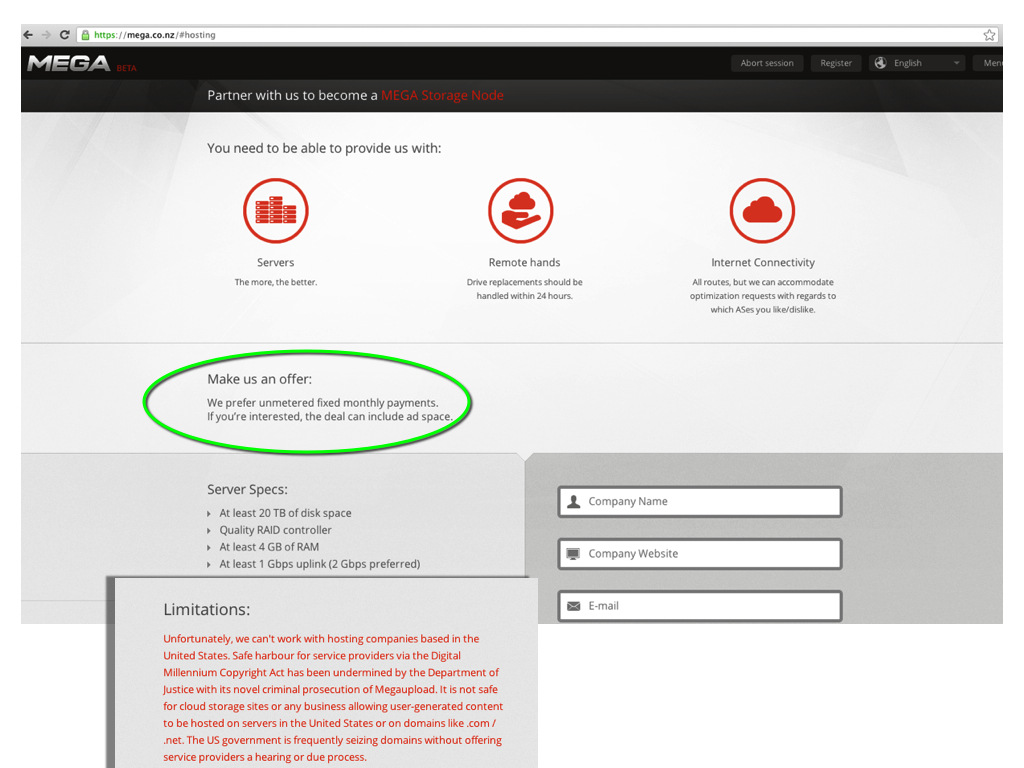
Perusing the new Mega website, I found some references to its planned business model, but no mention (yet) of any individual “partner” rewards programs like those found in its previous incarnation. Below is a solicitation for “Mega Storage Node” partners (located outside the United States). This program seems focused on attracting additional host companies that wish to integrate Mega’s infrastructure into their own businesses.

The new “Mega” is seeking partners to become a “storage node.”
Like Megaupload, Mega also offers tiered “Pro-memberships” which offer users greater storage and speed options. Prices range from $9.99 per month to $29.99 per month.

Although the new site has established its operations (and servers) outside of the United States, Mega’s “Terms of Service” does feature boilerplate language regarding intellectual property and copyright.

Note that Mega’s terms also includes language that includes references to protecting its own IP.
Our IP
13. The license that we give you to use the website and our services does not give you the right, and you can’t reproduce or use any of our copyright, intellectual property or other rights other than for the purposes of using the services and the website or as allowed under any open source licences under which we use intellectual property provided by others. The open source code that we use, where we obtained it, and licences for that code are all referenced in our FAQ.
14. You are not allowed to, and you can’t let anyone else, copy, alter, distribute, display, licence, modify or reproduce, reverse assemble, reverse compile (whether digitally, electronically, by linking, or in hard copy or by any means whatsoever) or use any of our copyright, intellectual property or other rights without getting our permission first in writing, unless in order to use our services and the website or as allowed under any open source licences under which we use intellectual property provided by others. The open source code that we use, where we obtained it, and licences for that code are all referenced in our FAQ.
At the moment the new site, not surprisingly, is running as slow as molasses due to heavy traffic. It remains to be seen if, and how, its presence will impact the online piracy landscape going forward. Right now this new site doesn’t seem all that revolutionary. For the end-user, it’s just another cloud storage solution.
No matter what transpires, Dotcom is clearly relishing his moment back in the spotlight. He’s already busy tweaking Hollywood posting this Tweet and image a couple of days ago. Despite his self-important cockiness, in the grand scheme of things, I don’t think he’ll be getting the last laugh.

Though Dotcom would likely disagree, when U.S. law enforcement took his popular Megaupload offline a year ago, it marked a significant turning point in the battle against online piracy. Since then real progress has been made. Copy-cat sites that modeled the success of Dotcom’s business model closed their doors. At the same time, more options for timely and legitimate online distribution of movies and music emerged–options both profitable for creators and affordable for consumers. Advertisers and payment processors have also stopped partnering with some remaining pirate cyberlocker sites, diminishing their profits and popularity. Other companies, such as Google, have also had to address their role in aiding, abetting and profiting from piracy. Overall, the lure of online piracy as a cottage industry has been greatly diminished.
Maybe Dotcom’s new Mega will be legit, maybe not. The world will be watching, but I’m not too worried. At least not yet.

by Ellen Seidler | Copyright
 As promised, Megaupload’s Kim Dotcom continues to work on a new cloud-based storage service called “Mega.” He’s even released some screen shots to gin up expectations. Of course the files featured on the example reflect a benign use of the site as a place to store medical records and family photos. According to Examiner.com’s Michael Santo, key to the new site is an encryption methodology controlled entirely by the user, not the site itself.
By using 2048-bit RSA encryption for files uploaded to the service, Mega will keep itself safely ensconced within the DMCA Safe Harbor provisions, which places any legal issues for content on the end user, not the site.
The question that remains unanswered is what business model will Mega use? How exactly does Kim Dotcom plan to make money? After all, given his track record, I imagine he’s developing this new business with profits in mind. The reason Megaupload was so insidious was not because it offered a convenient way to upload, store and “share” big files (like pirated movies). Rather, it was because its business model incentivized users to do so with cash rewards and other perks. There are plenty of cloud-based services out there that already do what Dotcom is proposing to do with his new site. And, while there are surely pirated copies shared via those channels, the problem is minimal because those sites aren’t designed to profit from piracy.
At any rate, I suppose we will have to wait a bit longer to see what pirate king Kim Dotcom has in mind for this new “Mega” venture. Somehow I expect that the profiting from piracy will remain a fundamental part of his business model. At least that’s my bet.

 PayPal has finally ceased doing business with Kim Dotcom’s Mega site and he’s pouting about it. The man who has made millions be monetizing content stolen from others continues to assert that Mega is a legit cloud-based service and that its operations are legal. A statement posted on the site announcing that, “PayPal has ceased processing MEGA customer payments effective immediately…” also makes the claim that the cyberlocker site is being unfairly targeted:
 After the feds shut the site down in January of 2012, Dotcom got busy working a better way to circumvent copyright law and a year later launched a more nefarious piracy for profit site named Mega. The site uses encryption technology to protect its users (and site operators) from prying eyes. Dotcom claims Mega is full of folks’ baby pictures and the like, but in reality its business model continues to provide pirates with a profitable, and protected, haven for their transactions.