by Ellen Seidler | Copyright, Film, Piracy, Politics, Tech
 Google’s claim that it’s doing a great job streamlining its response to DMCA takedown notices on its Blogger-hosted websites doesn’t jibe with the truth. This year the U.S. Patent and Trade Office (USPTO) has been holding a series of hearings with the goal of “improving the operation of the DMCA notice and takedown policy.”
The first public meeting was held this past March in Alexandria, Virginia and second took place May 8th in Berkeley, California. I was able to attend the Berkeley hearing in person and heard representatives from content creation industries and service providers give their perspectives on the current state of “notice and takedown” for infringing content and what could/should be done to “fix” it.
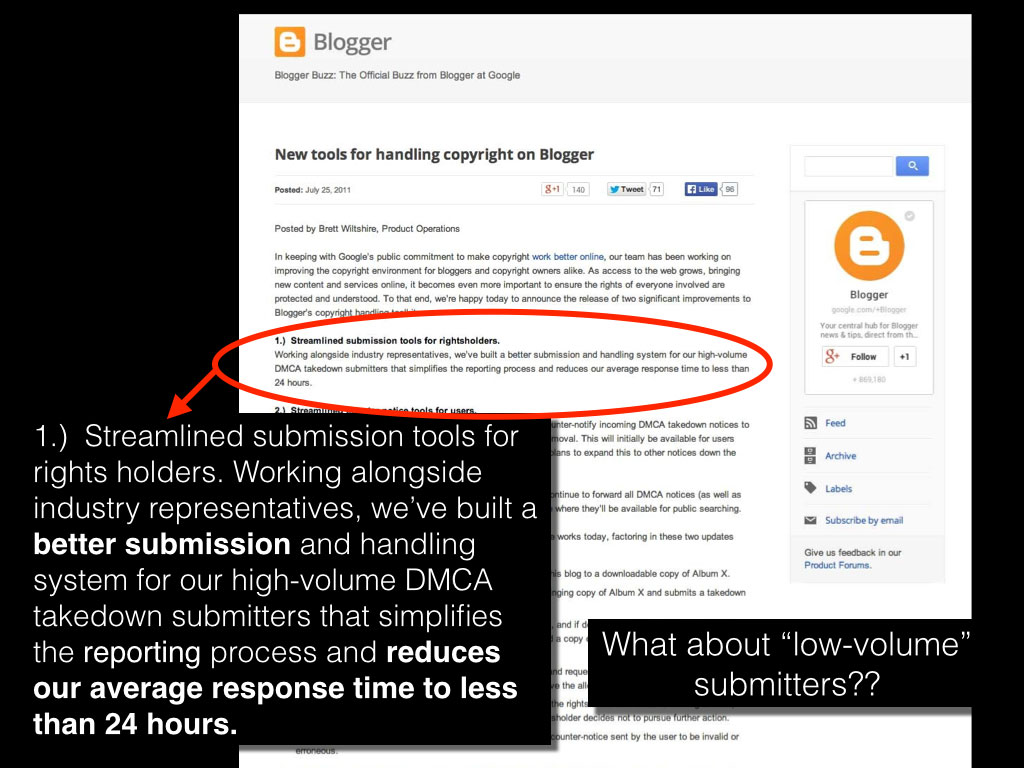
Each speaker presented a PowerPoint, links to which can be found here and a video archive here. As with the initial hearing in March, Google was represented by its Legal Director for Copyright, Fred von Lohmann who walked the audience through Google’s “DMCA notice and takedown tools” and highlighted what he called the company’s “trusted submitter program.” In his PowerPoint, Mr. von Lohmann referenced Google blog post from 2011 “New tools for handling copyright on Blogger” that supposedly highlighted the great progress that’s been made in streamlining the process.
Listening to Mr. von Lohmann it seemed clear that his words were designed for an audience made up of government officials and industry representatives and not indie artists. He (carefully) described a two-tiered system in which “trusted” submitters have access to a wealth of takedown mechanisms to remove infringing content from Google affiliates. However, aside from YouTube, access to these “trusted” programs seems limited to the big film and music entities.
Specifically, with regard to Blogger, the criteria as to how one becomes a part of this so-called “trusted submitter” program remains murky and ill-defined. Immediately following the event I searched Google to find out more (and how to apply) I only came across a link to Mr. von Lohmann’s USPTO PowerPoint. There was nothing on any Google site to answer the question as to how indie rights holders could utilize this so-called “tool.” Since there was no more information to be found, shortly after the event I took to Twitter to ask @flohmann directly for a clarification on his presentation. The response thus far, only crickets…

In addition to this lack of clarity as to who exactly can take advantage of certain tools, Mr. von Lohmann’s careful characterization of his company efficient takedown system did not match my user experience, particularly with regard to Blogger. Over these past few years I’ve documented time and time again the many ways Blogger--and therefore Google–fails to live up to its promises to remove infringing content from its platforms.
 Yet, according to Google’s self-published, self-serving report, “How Google Fights Piracy,” (that I’ve criticized in a previous post) the company continues to insist that it’s proactive fighting piracy on its Blogger web-publishing platform:
We remain vigilant against the use of the Blogger platform by pirates looking to set up a free website…we will remove infringing blog posts when properly notified by a copyright owner, and will terminate the entire blog [emphasis added] where multiple complaints establish it as a repeat infringer.
Sorry, but the facts clearly don’t match up with this corporate hyperbolic PR spin. Truth be told, Blogger’s takedown system is, in reality, a hot mess. Add Google Drive to the mix and company claims of a “streamlined” takedown process seem even more absurd.
- Blogger content that is reported as infringing takes weeks, not days to remove.
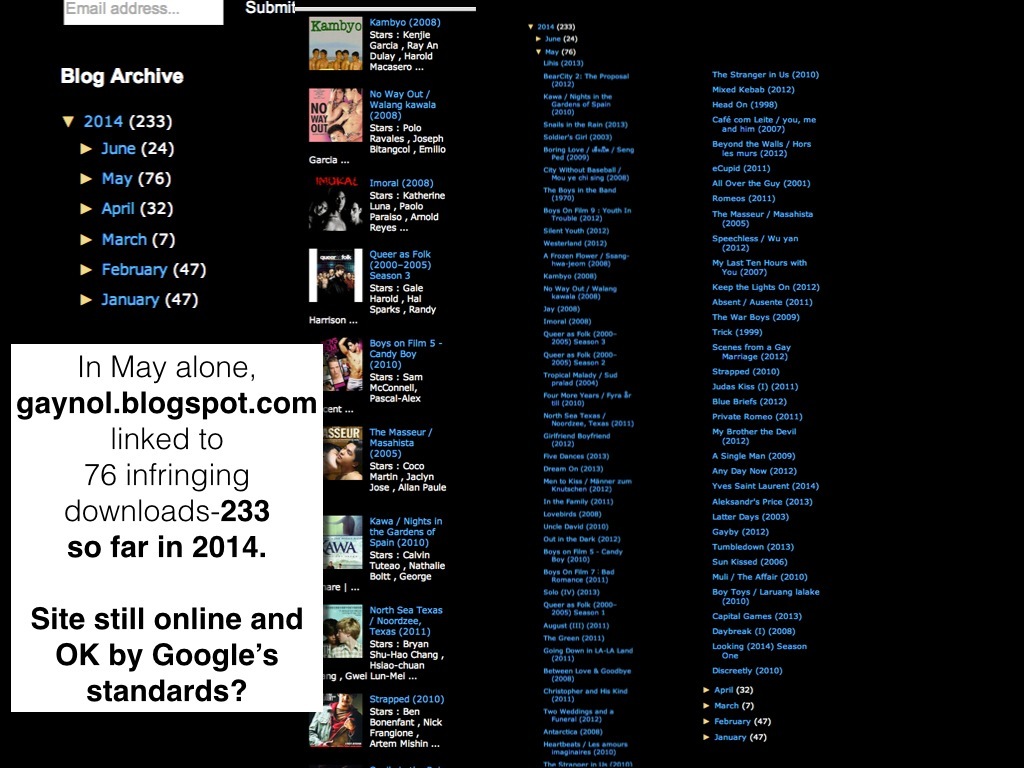
- Blogger hosted blogs that are in the business of promoting pirated movies remain online despite multiple, repeated DMCA notices and despite clear evidence they exist to pirate films.
- The Google DMCA takedown procedure is not easy to navigate. Once users find it, they must repeatedly choose options in order to (eventually) get to the correct takedown form, even someone well versed in the procedure. Why not offer direct links to the correct forms for each platform?
- Blogger’s website templates offer no direct links to Google’s (streamlined) takedown form. Why can’t Blogger hosted sites automatically provide a button/link in their menu bar or footer, designed as part of any page template to enable easy and direct access to Google’s “streamlined” takedown form?
- Google Drive takedown procedures are convoluted and unclear. No easy way to determine file’s URL to report and no direct link to report.
- When a file is reported on Google drive it can take weeks, not days, to remove the infringing content.
Rather than fulfill its promise to expedite takedowns for copyright infringement, it seems that the “Google Team” does everything within its power to make the process convoluted, cumbersome and difficult–particularly for individual artists who don’t have the deep pockets to hire help and/or automate the takedown workflow. Please take some time to review the graphics that I’ve created that illustrate just how badly Google is doing when it comes to Blogger (and Google Drive) takedowns.




Given the complexity (and hilarity) of attempting to remove pirated stream of our film “And Then Came Lola” (seen in the example above) hosted on Google Drive I made the following video that will walk viewers through the process. Weirdly I was able to find the URL (that was not the case with some of the other examples I’ve provided) yet that didn’t help much since pirated copy is still, as of today, June 1st, available on line–more than two weeks after I sent a DMCA takedown notice to Google. As far as I’m concerned, when Google characterizes itself as doing a good job with this process I can only shake my head. No matter how many ways Google spins it, it’s not true.
https://vimeo.com/97077933
Coming soon, Part Two: How Google Could Fix its Broken DMCA Takedown System

by Ellen Seidler | Copyright
“Oh what a tangled web we weave, when first we practice to deceive.”
— Sir Walter Scott
 Surprise, surprise–Google announced today that its profits “surged” this quarter thanks to an increase in online advertising revenue. A company press release heralded the report:
We ended 2012 with a strong quarter,” said Larry Page, CEO of Google. “Revenues were up 36% year-on-year, and 8% quarter-on-quarter. And we hit $50 billion in revenues for the first time last year – not a bad achievement in just a decade and a half. In today’s multi-screen world we face tremendous opportunities as a technology company focused on user benefit. It’s an incredibly exciting time to be at Google.”
The company’s stock price jumped nearly 5% on the news. So, while Google executives and its shareholders are happy, one has to ask–how much of that “revenue” continues to come from not-so-ethical sources? I hate to sound like a broken record, but until Google gets its act together, I will continue to point out its duplicity with regard to online piracy and its ad revenue.
In the wake of this bullish news from Google I thought I’d point out a recent case study that demonstrates the myriad of ways Google supports (and profits from) piracy. This particular pirate movie website (shown below) is hosted on Google’s free “Blogger” platform. As with most other posts on the site, this one (published 1-18-13) features an embedded movie (a complete version of the indie film David’s Birthday) hosted via Google’s YouTube. The advertising above, and to the right of the embedded film, is served up by Google’s AdSense. Oh, and I found this site using Google’s search engine.

This Google-hosted blog features pirated films hosted on YouTube as well as AdSense advertising.
What makes this situation particularly troubling is that this blog had already been reported to Google (via their DMCA system) in December of 2012.

After receiving a takedown notice from Google the site’s owner posted a response, saying that he was considering closing it.

Blogger site owner received this notice from Google. Despite the warning and repeated violations of Blogger “Terms of Use” the site remains online.
He apparently had a change of heart, and within a few days, resumed posting (infringing) content on his site –including (ironically) the aforementioned “David’s Birthday” despite its having been cited in the December DMCA notice. This time, instead of posting infringing download links, he’s chosen to embed movies streamed via YouTube, each coupled with AdSense ads.

So, despite having been reported for multiple infringing links, the site remains up and running. In the meantime, Google appears to be in no hurry to take it offline. Don’t they have an obligation to remove the site? The language in Blogger’s Terms of Service outlining their “content policy” is conveniently vague. When a site violates its policy Google promises to take action “based on the severity of the violation” but it’s not really clear what criteria is used to measure the “severity” of a reported violation.

Blogger’s terms of service
As for the AdSense, its “Terms of Service” seem pretty straightforward. Well, sort of…
Prohibited Uses. You shall not, and shall not authorize or encourage any third party to…
(v) display any Ad(s), Link(s), or Referral Button(s) on any Web page or any Web site that contains any pornographic, hate-related, violent, or illegal content;
6. Termination; Cancellation…Google may investigate any activity that may violate this Agreement. Google may at any time, in its sole discretion, terminate all or part of the Program, terminate this Agreement, or suspend or terminate the participation of any Property in all or part of the Program for any reason.
Since Google seems to have “investigated” this website in response to multiple DMCA notices, why is this AdSense account allowed to remain active? Does the aggrieved party have to file a DMCA with Blogger and with AdSense over and over again? It’s hard to imagine that Google’s copyright “team” isn’t aware these violations. Does Google not have the money to hire staff to follow-up on reported sites to enforce compliance? Is Google complying with U.S. law? What is meant by the caveat “its [Google’s] sole discretion?”
Does looking at the actual law clarify matters? According to Title 17 of U.S. Copyright Law, “conditions for eligibility” for “limitations on liability” include:
(i) Conditions for Eligibility.—
(1) Accommodation of technology. — The limitations on liability established by this section shall apply to a service provider only if the service provider —
(A) has adopted and reasonably implemented, and informs subscribers and account holders of the service provider’s system or network of, a policy that provides for the termination in appropriate circumstances of subscribers and account holders of the service provider’s system or network who are repeat infringers; (emphasis added)
How exactly does Google define a “repeat infringer?” They apparently don’t.
In a post published in September of 2011 on its own Public Policy Blog entitled “Making Copyright Work Better Online-A Progress Report,” Google gave itself a pat on the back, asserting that the company had made great strides in discouraging ad-sponsored piracy.
Improving our AdSense anti-piracy review. We have always prohibited the use of our AdSense program on web pages that provide infringing materials, and we routinely terminate publishers who violate our policies. In recent months, we have worked hard to improve our internal enforcement procedures. In April, we were among the first companies to certify compliance in the Interactive Advertising Bureau’s (IAB’s) Quality Assurance Certification program, through which participating advertising companies will take steps to enhance buyer control over the placement and context of advertising and build brand safety. In addition, we have invited rightsholder associations to identify their top priority sites for immediate review, and have acted on those tips when we have received them.
Sounds good right? On paper perhaps, but given the continued and pervasive presence of Google-sponsored advertising on pirate sites throughout the web, the reality is that Google’s public pledge appears to be carefully crafted lip-service designed to obfuscate the facts, rather than a representation of any meaningful progress.
Over the past two and a half years I’ve written extensively about Google’s ongoing link to ad piracy profits. Earlier this month USC’s Annenberg Innovation Lab released a report documenting the fact that search giant is at the head of the pack when it comes to monetizing (and subsidizing) online piracy via its ad networks. The relationship between Google and online piracy seems clear as day.
Yet, in the meantime–Google apparently plays fast and loose with the DMCA’s “safe harbor” provision. Given the fact they have teams of lawyers, one has to assume the company is careful to follow the letter of the law, but certainly not the spirit of it. Did the legislators who crafted the DMCA really intend for the law to enable entities like Google to hide behind the shield of safe harbor, under the guise of “innovation and free expression”–while simultaneously make (lots of) money monetizing stolen content? I doubt it.
Even the advertising industry recognizes that this is a area of concern. In May of last year The Association of National Advertisers (ANA) and the America Association of Advertising Agencies (4A’s) issued a statement entitled, “Best Practices to Address Online Piracy and Counterfeiting.” The statement included the following:
(i) All such intermediaries shall use commercially reasonable measures to prevent ads from being placed on such sites;
(ii) All such intermediaries shall have and implement commercially reasonable processes for removing or excluding such sites from their services, and for expeditiously terminating non-compliant ad placements, in response to reasonable and sufficiently detailed complaints or notices from rights holders and advertisers;
(iii) All such intermediaries shall refund or credit the advertiser for the fees, costs and/or value associated with non-compliant ad placements, or provide alternative remediation.
So, back to Google. Would a “reasonable measure” include removing AdSense ads from a site reported for piracy? What about reimbursing the advertiser who paid Google for these “non-compliant” ads and how does the fact Blogger is a Google-hosted site factor in? Should ad services do business with hosts that routinely serve pirated ads? In other words, should Google (AdSense) do business with itself (Blogger) if they are to honor these “best practices?”
My head is spinning. I guess that’s just the way the powers that be at Google like it.

by Ellen Seidler | Copyright
Much attention has been paid to Google’s role in supporting and profiting via online piracy through online advertising, but there’s another Google enterprise that bears further scrutiny–its “Blogger” hosted websites.
Google’s Blogger platform, like WordPress, offers users around the world a convenient, easy-to-use and free hosting platform to create a website/blog. Most sites are anchored by the Blogger domain blogspot.com although users can also use a custom domain name.
These Blogger-hosted sites are ubiquitous throughout the web and feature blogs offering a wealth of original content, from recipe ideas to personal journals. However, amid the multitude of legitimate users, with a quick (Google) web search, one can easily find a more nefarious use of Blogger websites–virtual emporiums for pirated content.
Of course it’s unreasonable to expect Google to police what could be millions of blogspot sites around the globe. But what happens when a copyright holder discovers a site that is offering illegal links and/or streams to their pirated work? According to Google, it’s a violation of their Blogger “Content Policy”:
Copyright: It is our policy to respond to clear notices of alleged copyright infringement. More information about our copyright procedures can be found here. Also, please don’t provide links to sites where your readers can obtain unauthorized downloads of other people’s content.
If a rights holder finds a Blogger site that violates this policy, Google offers this this online DMCA form to report the site.

It’s a relatively efficient and reasonable process. But what happens to these pirate sites once they are reported? Google explains the consequences for violating the policy as follows:
Our team reviews these flags for policy violations. If the blog does not violate our policies, we will not take any action against the blog or blog owner. If we find that a blog does violate our content policies, we take one or more of the following actions based on the severity of the violation:
- Put the blog behind a ‘mature content’ interstitial
- Put the blog behind an interstitial where only the blog author can access the content
- Delete the blog
- Disable the author’s access to his/her Blogger account
- Disable the author’s access to his/her Google account
- Report the user to law enforcement
What’s not clear is what criteria Google uses to measure the “severity of the violation.” At the bottom of the
online Blogger DMCA form Google explains account disabling:
Many Google Services do not have account holders or subscribers. For Services that do, Google will, in appropriate circumstances, disable the accounts of repeat infringers. If you believe that an account holder or subscriber is a repeat infringer, please follow the instructions above to contact Google’s DMCA agent and provide information sufficient for us to verify that the account holder or subscriber is a repeat infringer.
Is it up to the entity who files the DMCA to prove that the Blogger user is a “repeat infringer?” Doesn’t Google have a way to measure how many times a Blogger site has been reported? Exactly how many violations does it take before an account is disabled? What is Google’s definition of “appropriate circumstances?”
In my experience, upon receiving a DMCA, Blogger does remove pages that include the (reported) illegal links, but generally the blog itself (with dozens, if not hundreds of other illegal download links to other films) remains online, even after receiving multiple DMCAs. Note that these sites aren’t offering any original editorial content. They are sites dedicated solely to disseminating illegal links and streams to popular films, willfully disregarding Google’s stated policies. Yet even after receiving complaints, the “Google Team” allows these sites to remain in operation.
As with most pirate sites, it’s not an altruistic endeavor, but one driven by the profit-motive. These sites feature ads, often requiring users to click-thru an advertisement before reaching the “free” download most often hosted on a cyber-locker site.

Yet, as is often the case with Google products and services, transparency is an anathema. Why not be specific about the criteria used to “disable” these pirate blogs. How many violations does it take? Why not institute a 3-strike policy? The site operator would receive a warning on the first strike, advertising would be disabled on a second strike (this is an option in the Blogger dashboard) and a third strike would result in the site being removed. As with any DMCA complaint, the site operator should be able to counter any notice sent in error. Simple as that.
Google’s Blogger platform makes website creation easy. Why not do more to make operating a pirate site hard?

 Google’s claim that it’s doing a great job streamlining its response to DMCA takedown notices on its Blogger-hosted websites doesn’t jibe with the truth. This year the U.S. Patent and Trade Office (USPTO) has been holding a series of hearings with the goal of “improving the operation of the DMCA notice and takedown policy.”