by Ellen Seidler | Copyright, Google, Law, Piracy
 Hop aboard for another spin on Google’s DMCA Merry-Go-Round
It’s not news that Google-hosted Blogger websites are a favorite storefront for online pirates. It’s also not news that Google does its best to obstruct DMCA takedowns by setting up various roadblocks along the way. Today I discovered yet another example of just how difficult Google makes the DMCA process–this time with Blogger-hosted sites that use custom domain names.
When you create a blog using Blogger you’re given a domain that ends in blogspot.com. However users are free to use a custom domain name instead. That’s all well and good, unless the website distributes pirated content. In that case, if you’re a creator trying to get your pirated content removed (by Google), you’re likely to run into problems.
Usually, when one of these pirate entrepreneurs creates a site on blogspot.com a rightsholder can send a DMCA by using Google’s annoying web form (or annoy them by sending an email: [email protected]). However, if you use the same DMCA form to report a blogger-hosted site with a custom domain, Google won’t remove it. They’ll just send you back to the beginning.
I found out about this twist when I sent several DMCA notices this week on behalf of an indie film distributor. I requested the removal several pages of pirated movies I found on a Blogger-hosted website with a custom domain. The claim was rejected and the response on the Google Removals Dashboard read: Inappropriate for TCRP. Please submit through the standard web form.
TCRP stands for “Trusted Copyright Removal Program” but the problem is that I didn’t use any sort of TCRP…I wish I could, but I’m just a lowly commoner who doesn’t have access to this program. I USED THE STANDARD WEB FORM!!!!
Why–when there’s no doubt that this website is streaming a full copy of the film on a Google-hosted website–do they send me back to the same standard web form I used to send the original request? It’s an endless loop. Follow along below:


A DMCA request was sent using Google’s own web form (for Blogger) yet the claim is rejected and I’m told to send the takedown again using the very same form?
Apparently, even though Google hosts the pirate site, it refuses to remove infringing content the pirate is using a custom domain, not a blogspot.com domain. Welcome to the Google DMCA Merry-Go-Round. 🙁
When I researched the issue further I discovered I’m not the only one running into this problem. On Google’s own Blogger Help Forum there’s a recent thread about the issue. Last month a user DeeLite310 posted a question after receiving the same— Inappropriate for TCRP. Please submit through the standard web form–response to a DMCA s/he sent reporting a Blogger site pirated games.
Once again the not-so-helpful Google response was to send DeeLite310 (who’s not part of the TCRP) back the beginning of the Google Blogger DMCA merry-go-round. Here’s part of the exchange (but I suggest reading the entire thread to fully appreciate just how frustrating dealing with Google can be):


Welcome to the Google Merry-Go-Round…DeeLite310 is sent back the beginning…again and again…

Google loves to throw the word “transparency” around a lot in discussions around how it handles DMCA requests. Too bad it doesn’t provide more transparency when creators, victimized by pirates using Google products, make good faith (legal) efforts to request the removal of infringing content. As I’ve said before, the DMCA is broken…
*Update 5/16/16: During May’s Section 512 hearings in San Francisco I spoke with Fred von Lohmann, Google’s senior copyright counsel, about my blog post. He told me that I had indeed discovered a “bug” and that Google staff was working to fix the issue. I was happy to hear that Google was responding in a positive manner to this problem. I’ll test out whether it has been fixed by resending the original DMCA notice that prompted this post. Stay tuned…
Update 6/28/16: According to Mr. Von Lohmann, the bug has been fixed.

by Ellen Seidler | Copyright, Google, Law, Piracy, Tech
 Google could learn a thing or two from VIMEO about how to run an efficient DMCA takedown system
Love it or hate it, for now the DMCA (Digital Millennium Copyright Act) is the law of the land when it comes to safeguarding creative content online. The law, passed nearly 20 years ago, is woefully outdated, but for now, it’s the only tool creators have to protect their work from online thieves. Unfortunately, not every company in the business of “user generated content” approaches DMCA compliance the same way.
Google, a company that makes billions each year in ad revenues generated via trafficking in dubious content, has set up a takedown system that ensures the sending of a DMCA takedown notice is an onerous and inefficient task. After all, the harder Google makes it, the more discouraged creators will become, and the more money continues to flow into its coffers…
Anyone who’s made music or a movie probably has had experience with sending a DMCA takedown request to Google in some form. Whether it’s removing pirated music on YouTube, or requesting the takedown of pirated movies off Blogger sites, creators must tackle a haphazard and convoluted patchwork of online forms in order to get their work removed from Google’s online products.
Not that Google will listen to me, but I’m going to offer some suggestions for simple ways the company could improve the takedown system. Part I will focus on Blogger, Google’s online website platform that’s become the favorite of many pirate entrepreneurs due to its ease of use.
 As a creator, when you discover a pirate website hosted by Google’s Blogger (on blogspot.com) is offering pirated copies of your music or movie, to get it removed you usually have to send a DMCA notice to Google.
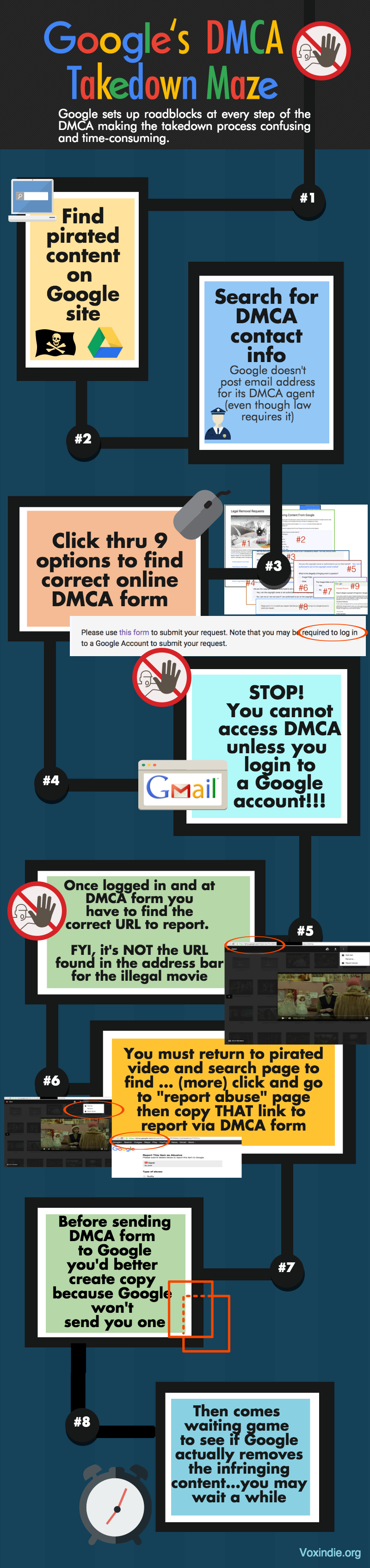
Here’s where Google turns what could be a relatively easy task into a huge time suck. First, in order to find the correct online form for Blogger you’re forced to click through a myriad of radio-buttons on Google’s Removing Content From Google page. When you finally do manage to click your way through to the proper form (it takes 7 clicks) you’ll waste more time carefully filling in each and every section. Note, your browser’s auto-fill function won’t work particularly well here. Finally, after you complete the form and click send, you can only wait (and hope) that the content will be removed. It can literally take weeks and sometimes it never gets removed.
 Here’s where it gets particularly annoying. Many companies, take the video-hosting site Vimeo, for example, give rights holders several ways to send a takedown notice: email, a web form or snail mail. When sending a DMCA to Vimeo (and many other sites) I use a template I created (with an attorney’s help) that makes it easy to copy and paste infringing links into a DMCA takedown email. It’s not only quick, but I have a record of the notice in my sent email box. For indie content creators fighting online piracy, email is by far the most efficient way to send and record DMCA notices. As far as I’m concerned, Vimeo earns a gold start for DMCA takedown efficiency.
Vimeo provides a shining example of good DMCA takedown practices:
- Vimeo accepts email submissions. It’s quick and efficient–a godsend if you have to send notices routinely (as many musicians and filmmakers do).
- You have a copy of the DMCA notice you sent and proof of when it was sent.
- You receive an email confirmation from Vimeo that the material has been removed and their message includes a copy of your original DMCA notice.
- Vimeo provides a reference # so that if there are any issues with your notice, you can easily follow-up with the real person that signs the email receipt.
Meanwhile, over at Google, things aren’t so straightforward. Each time I send a DMCA takedown to Google via its web form, if I want to keep a copy, I’m forced to create a PDF copy of web form. Even then some of the entries don’t show up. For the rights holder it’s an imperfect and time-wasting process. Google has intentionally created a takedown process that impedes creators at every step.
Google’s Blogger takedown procedure is a joke:
- Google requires users navigate through a series of buttons (7 clicks) to get to the DMCA web takedown form.
- Google requires you fill in the entire form each time you need to sent a takedown notice.
- Google does not give you a copy of the form you sent, only a brief acknowledgement that you sent something signed by the mysterious “Google Team.”
- Sender never receives notification infringing material has been disabled.
Because of their business practices, Google does have to deal with tons of takedown notices every day. It’s a mess of its own making and they certainly have the financial resources to deal with it responsibly. Google reps insist a web form is the only way to make sure they receive the information required in a DMCA notice. However, their refusal to accept emails (that could be read by a bot) forces indie artists who routinely send takedown requests to its web maze.
Since users are forced to use a DMCA web form, there’s certainly NO justifiable reason Google can’t respond with an email confirmation that includes the original takedown notice. After all, that’s an automated process and would require ZERO resources on their part. Google chooses not to do so because they want to make the process as opaque and complicated as possible. While it complies with the letter of the law, Google has refined a system whereby creators are discouraged from exercising their legal rights at every turn.
Google’s DMCA practices are designed to impede rights holders every step of the way

Vimeo quickly sends an email confirming removal

Along with the email, Vimeo includes the original DMCA notice

Google makes users jump through hoops to send a DMCA notice, doesn’t provide a copy, and offers no confirmation that any action has been taken
Google includes a case number in the subject heading of the email, but don’t bother trying to contact Google using it. The “Google Team” won’t respond. So what’s the case number good for? Not much.
As for turnaround time-when I send VIMEO a notice within hours the content has been removed (and I receive an email confirmation along with a copy of my notice). With Google it can literally take weeks…and sometimes nothing happens…ever.
In order to improve the DMCA system on Blogger I would ask for the following:
- Offer a direct link to the Blogger DMCA takedown form
- Allow the form to be auto-filled and if one has a Google account information the form would be pre-filled with the appropriate information
- Send an email receipt that includes a copy of the DMCA notice
- Send confirmation when the infringing content has been disabled
- Remove content in a timely manner. This means days, NOT weeks.
For a company like Google that can take us to the top of Mt. Everest with the click of a mouse it’s beyond comprehension as to why they can’t offer content creators a better way to utilize the DMCA process. Google periodically publishes puff PR pieces extolling the myriad of ways it supposedly tackles piracy, but in reality helps maintain the status quo where the rights of online thieves are held in higher regard than those of creators. Of course for Google impeding the legal rights of creators is good for business. Profits ahead of people is the key to Google’s success.
Next week-Part II-YouTube’s DMCA CMS takedown, another inefficient mess for rights holders.
by Ellen Seidler | Copyright, Film, Piracy, Tech
 Is this really what lawmakers had in mind when they wrote the DMCA?
Seriously, it’s not that I just love spending my time bashing Google, but the fact is that this company deserves to be taken to task (every second of every day) for the lousy job it does dealing with the rampant piracy on its Blogger platform. The slide show below is simply more documentation as to just how absurd, convoluted and outright busted the DMCA takedown process is with the barnacle that is Blogger (Blogspot.com). While mothership Google pretends not to notice, web pirates grow and thrive in the waters of its safe harbor.
Not only does Blogger provide a sanctuary for movie pirates around the globe, but Google’s cloud-based storage Google Drive, often a host for the Blogger pirated movies streams, looks a lot more like Megaupload than a legit business. Figures, for a company trying to bust indie-musicians and rip-off professional photographers, developing slick and slimy ways to avoid the law seems about par for the crooked course.
Google makes billions leveraging content created by others. The least they could do is respect our right to remove it, but that would mean less content for them to leverage, and thus less money for them. For Google, though it regards itself as the emperor of tech, ever evolving to offer society the next big thing; it’s really just like many other multinational behemoths seeking to protect and its increase profits. Who cares where those profits come from? Given greed’s at the company’s core, I once again welcome you to another example of Google’s takedown labyrinth.
[rev_slider Google_DMCA_circus]
When Congress crafted the Digital Millennium Copyright Act (DMCA) in 1998 they explicitly carved out “safe harbor” from liability for copyright infringement so long as the service provider, “upon obtaining such knowledge or awareness, acts expeditiously to remove, or disable access to, the material.”
Section 512(c) limits the liability of service providers for infringing material on websites (or other information repositories) hosted on their systems. It applies to storage at the direction of a user. In order to be eligible for the limitation, the following conditions must be met:
- The provider must not have the requisite level of knowledge of the infringing activity, as described below.
- If the provider has the right and ability to control the infringing activity, it must not receive a financial benefit directly attributable to the infringing activity.
- Upon receiving proper notification of claimed infringement, the provider must expeditiously take down or block access to the material.
The legislation also contains this language with regard to a service provider being eligible for limitations on liability, “: (1) it must adopt and reasonably implement a policy of terminating in appropriate circumstances the accounts of subscribers who are repeat infringers…
After you step through these slides and read my previous posts examining Google’s dysfunctional takedown procedures, can you really believe Google is “expeditiously” honoring the intent of the DMCA? If so, I’ve got a bridge to sell you…

by Ellen Seidler | Copyright, Film, Piracy, Tech
[vc_row][vc_column][vc_column_text]
 How much more of Googlenocchio can filmmakers take?
Google publicly brags about its “commitment to make copyright work better online” but the in reality it’s just a big, fat LIE.
I must say it was pretty ironic when, in the midst of working on this post, Ironically, I received this email from an indie film director asking my advice about dealing with Google:
Ellen, I have a quick question. I am having problems submitting DMCA notices to Google on some of the links, where I have submitted them before and Google hasn’t taken them down. [emphasis added]
When I try and re-submit–this can be weeks months later–it won’t allow me to submit the form, saying, the link has been submitted before. Do you have this problem, not sure if I am doing something wrong, or is there nothing I can do !
Sound familiar? I’m sure it does to the many indie filmmakers who, like myself and my colleague above, are routinely at the mercy of Google’s not-so-transparent, lame DMCA takedown procedure when we find stolen copies of our work online.
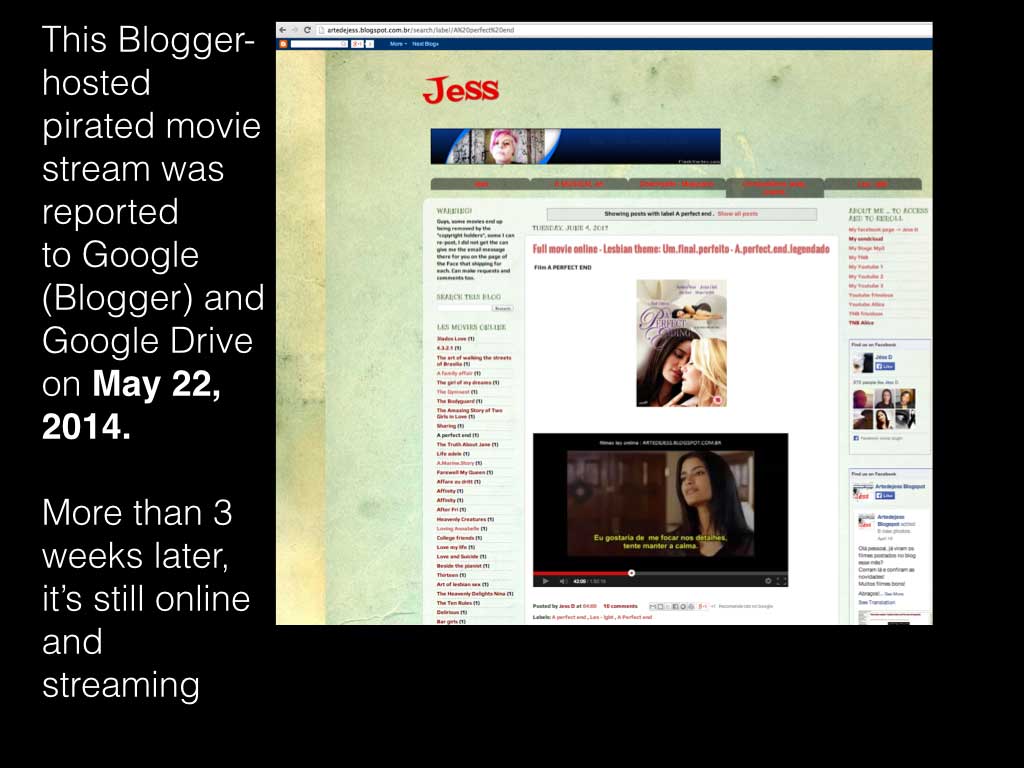
To dramatize just how flagrant Google’s DMCA foot dragging is I created a clock to track the company’s (lack of) action when it comes to efficient removal of pirated content from Blogger-hosted pirate sites. The clock below began started clicking on April 24th when 2 links were reported for copyright infringement. As of today, June 17th, nearly 2 months later, both pirated movies remain online as does the pirate Blogger-hosted website (see graphic below)
UPDATE: The site was removed July 10th, 2014, nearly 3 months after the first DMCA takedown notices was sent to Google.
[/vc_column_text][/vc_column][/vc_row][vc_row][vc_column width=”1/1″][/vc_column][/vc_row][vc_row][vc_column][vc_column_text]


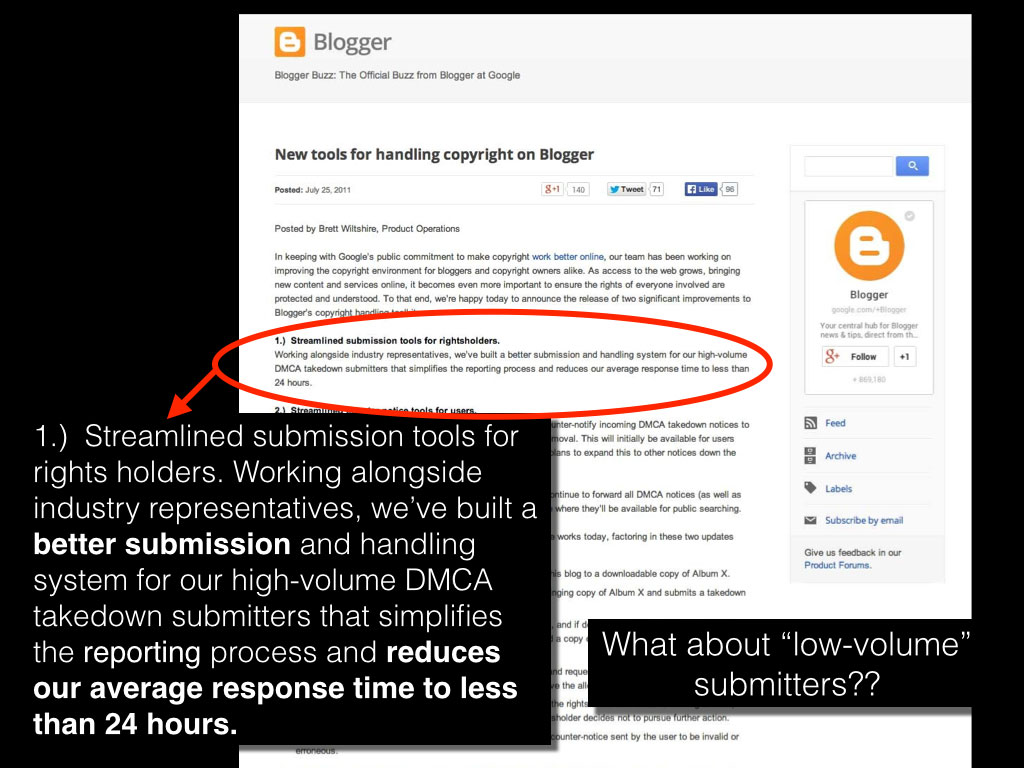
Remember, this is just ONE example of Google’s slow as molasses (or non-existent?) takedown work-flow. Remember this promise?
1.) Streamlined submission tools for rightsholders.
Working alongside industry representatives, we’ve built a better submission and handling system for our high-volume DMCA takedown submitters that simplifies the reporting process and reduces our average response time to less than 24 hours. [emphasis added]
When it comes to Google, broken promises are merely its modus operandi. When Google flacks claim the company cares about copyright infringement, it’s just a lie.
[/vc_column_text][/vc_column][/vc_row][vc_row][vc_column][vc_column_text][vc_column_text]
[/vc_column_text][/vc_column][/vc_row]

by Ellen Seidler | Copyright, Film, Piracy, Politics, Tech
 Google’s claim that it’s doing a great job streamlining its response to DMCA takedown notices on its Blogger-hosted websites doesn’t jibe with the truth. This year the U.S. Patent and Trade Office (USPTO) has been holding a series of hearings with the goal of “improving the operation of the DMCA notice and takedown policy.”
The first public meeting was held this past March in Alexandria, Virginia and second took place May 8th in Berkeley, California. I was able to attend the Berkeley hearing in person and heard representatives from content creation industries and service providers give their perspectives on the current state of “notice and takedown” for infringing content and what could/should be done to “fix” it.
Each speaker presented a PowerPoint, links to which can be found here and a video archive here. As with the initial hearing in March, Google was represented by its Legal Director for Copyright, Fred von Lohmann who walked the audience through Google’s “DMCA notice and takedown tools” and highlighted what he called the company’s “trusted submitter program.” In his PowerPoint, Mr. von Lohmann referenced Google blog post from 2011 “New tools for handling copyright on Blogger” that supposedly highlighted the great progress that’s been made in streamlining the process.
Listening to Mr. von Lohmann it seemed clear that his words were designed for an audience made up of government officials and industry representatives and not indie artists. He (carefully) described a two-tiered system in which “trusted” submitters have access to a wealth of takedown mechanisms to remove infringing content from Google affiliates. However, aside from YouTube, access to these “trusted” programs seems limited to the big film and music entities.
Specifically, with regard to Blogger, the criteria as to how one becomes a part of this so-called “trusted submitter” program remains murky and ill-defined. Immediately following the event I searched Google to find out more (and how to apply) I only came across a link to Mr. von Lohmann’s USPTO PowerPoint. There was nothing on any Google site to answer the question as to how indie rights holders could utilize this so-called “tool.” Since there was no more information to be found, shortly after the event I took to Twitter to ask @flohmann directly for a clarification on his presentation. The response thus far, only crickets…

In addition to this lack of clarity as to who exactly can take advantage of certain tools, Mr. von Lohmann’s careful characterization of his company efficient takedown system did not match my user experience, particularly with regard to Blogger. Over these past few years I’ve documented time and time again the many ways Blogger--and therefore Google–fails to live up to its promises to remove infringing content from its platforms.
 Yet, according to Google’s self-published, self-serving report, “How Google Fights Piracy,” (that I’ve criticized in a previous post) the company continues to insist that it’s proactive fighting piracy on its Blogger web-publishing platform:
We remain vigilant against the use of the Blogger platform by pirates looking to set up a free website…we will remove infringing blog posts when properly notified by a copyright owner, and will terminate the entire blog [emphasis added] where multiple complaints establish it as a repeat infringer.
Sorry, but the facts clearly don’t match up with this corporate hyperbolic PR spin. Truth be told, Blogger’s takedown system is, in reality, a hot mess. Add Google Drive to the mix and company claims of a “streamlined” takedown process seem even more absurd.
- Blogger content that is reported as infringing takes weeks, not days to remove.
- Blogger hosted blogs that are in the business of promoting pirated movies remain online despite multiple, repeated DMCA notices and despite clear evidence they exist to pirate films.
- The Google DMCA takedown procedure is not easy to navigate. Once users find it, they must repeatedly choose options in order to (eventually) get to the correct takedown form, even someone well versed in the procedure. Why not offer direct links to the correct forms for each platform?
- Blogger’s website templates offer no direct links to Google’s (streamlined) takedown form. Why can’t Blogger hosted sites automatically provide a button/link in their menu bar or footer, designed as part of any page template to enable easy and direct access to Google’s “streamlined” takedown form?
- Google Drive takedown procedures are convoluted and unclear. No easy way to determine file’s URL to report and no direct link to report.
- When a file is reported on Google drive it can take weeks, not days, to remove the infringing content.
Rather than fulfill its promise to expedite takedowns for copyright infringement, it seems that the “Google Team” does everything within its power to make the process convoluted, cumbersome and difficult–particularly for individual artists who don’t have the deep pockets to hire help and/or automate the takedown workflow. Please take some time to review the graphics that I’ve created that illustrate just how badly Google is doing when it comes to Blogger (and Google Drive) takedowns.


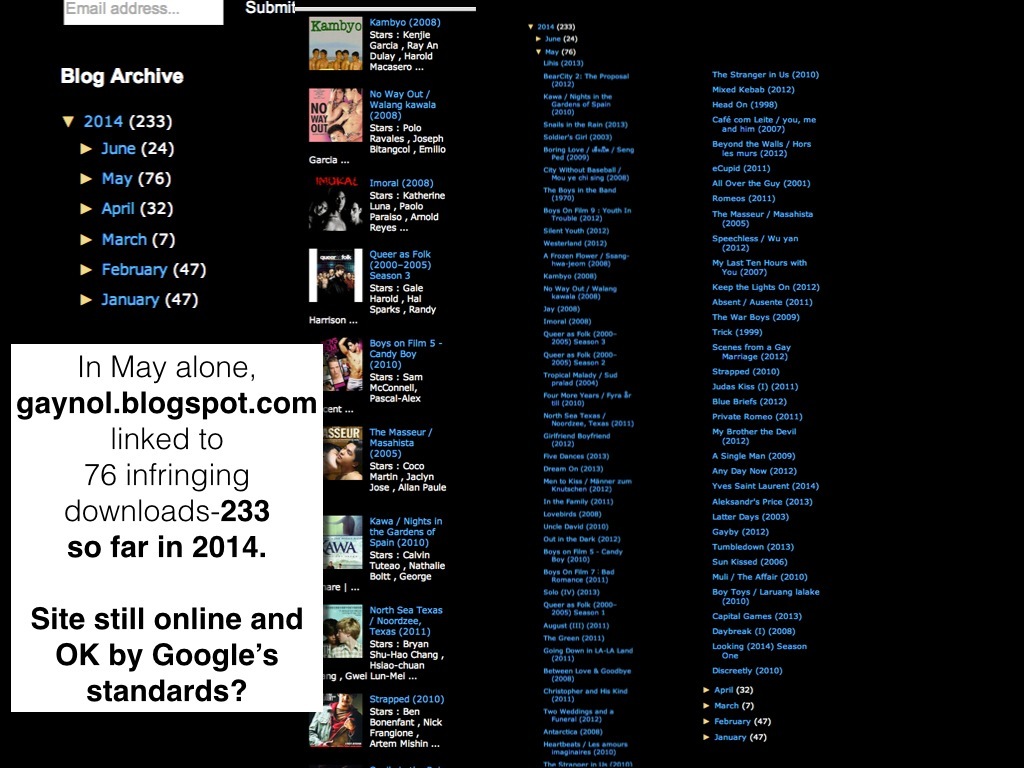


Given the complexity (and hilarity) of attempting to remove pirated stream of our film “And Then Came Lola” (seen in the example above) hosted on Google Drive I made the following video that will walk viewers through the process. Weirdly I was able to find the URL (that was not the case with some of the other examples I’ve provided) yet that didn’t help much since pirated copy is still, as of today, June 1st, available on line–more than two weeks after I sent a DMCA takedown notice to Google. As far as I’m concerned, when Google characterizes itself as doing a good job with this process I can only shake my head. No matter how many ways Google spins it, it’s not true.
https://vimeo.com/97077933
Coming soon, Part Two: How Google Could Fix its Broken DMCA Takedown System